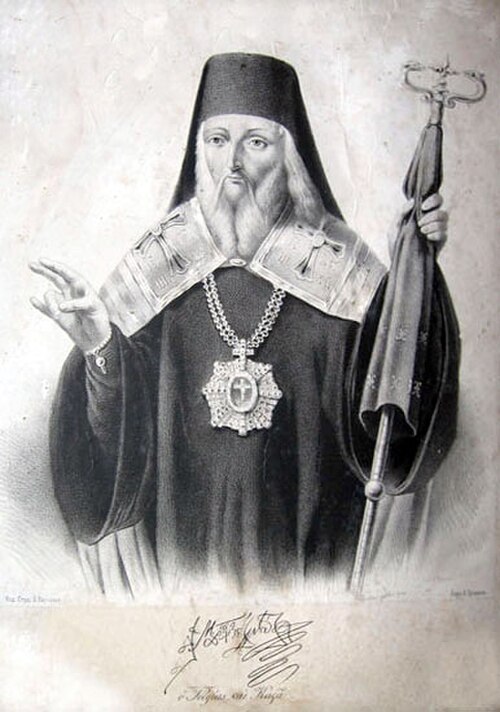
Saint
Ignatius of Mariupol
Metropolitan of Gothia and Kaffa
Greek bishop of Gothia and Kaffa in Crimea and later of Mariupol in present-day Ukraine; died in 1786.
- Feast
- February 3old style February 16
- Reposed
- 178618th century
- Place
- Mariupol
- Order
- Hierarchs
Life
Saint Ignatius of Mariupol, metropolitan of Gothia and Kaffa, was a Greek bishop in Crimea and the one who led the exodus of the Orthodox Greek Christians from Crimea to the shore of the Sea of Azov, where Mariupol came into being. He fell asleep on 3 (16) February 1786 and is remembered on 3 February.
Youth and calling
He was born in 1715 or 1716 on the island of Kythnos (then called Thermia), as Iakovos, in the well-known family of the Gozadinos (Kozadinos), descendants of a noble family that arose in the Cyclades in the time of Frankish rule. The family had originally been of Catholic rite but in the course of centuries became Orthodox; in 1613 his ancestors built the church of Saint Sabbas in Chora on Kythnos, where he was baptized. As a young man he went to Mount Athos and became a monk at the Vatopedi monastery, receiving the name Ignatius. He was ordained priest, then bishop, was called to Constantinople, became a member of the patriarchal synclitus and archbishop. After the death, in 1769, of the metropolitan of Gothia and Kaffa, Gedeon, he was set in his see.
In Crimea
On 23 April 1771 he arrived in Crimea and settled in the Dormition skete, near the Greek village of Mariampol, close to Bakhchisaray, residence of the metropolitans of Gothia in the eighteenth century. His coming coincided with a new Russo-Turkish war. Fearing the total spiritual enslavement and physical destruction of his flock, he asked the Russian government to receive the Christians of Crimea as Russian subjects and to give them land to settle. Empress Catherine II agreed and on 23 April 1778, on Pascha, Metropolitan Ignatius, after the Liturgy, in the cave church of the Dormition skete, called on the faithful to prepare for the exodus from their old captivity. By a decree of the Holy Synod of 14 March 1779 he was numbered among the Russian hierarchs, keeping the ancient title of Gothia and Kaffa, with the right to govern the diocese for life, made up of all the Greeks, and with all the canonical rights of a ruling hierarch. In the official list of Russian bishops he stood immediately after the archbishop of Slavonia and Kherson.
The exodus and Mariupol
In 1778-1780 the Greeks left Crimea with the other Christians of Taurida; according to some sources there were over thirty thousand people, who set out in June 1778 with their holy icon of the Mother of God of Bakhchisaray. The military side was led by Alexander Suvorov, the spiritual and administrative side by Metropolitan Ignatius. Many died on the way, in an epidemic; some did not wish to leave their houses and the graves of their ancestors, and a few even turned to Islam in order to stay in Crimea. They came first to Zaporozhia, and after Ignatius' journey to Saint Petersburg, to the then empty northern shores of the Sea of Azov, where on their way south they founded some twenty villages with names taken from Crimea (Bakhchisaray, Yalta, Urzuf, Sartana, Cherdakly, Karan, Mangush). On 5 August 1780 the metropolitan with the clergy and three thousand settlers reached the place he had fixed, where two years earlier a town had been founded on the site of a settlement of disbanded Zaporozhian Cossacks, renamed Mariupol at the Greeks' request. Metropolitan Ignatius cared for the settling of his flock and often chose the sites of the villages himself. For his deed Catherine II rewarded him with a diamond panagia. It is told, however, that discontent grew among the settlers against him, for the new place seemed gloomy compared with flourishing Crimea; Ignatius had to leave Mariupol and settle outside the town, in a stone cell he had built. In February 1786, after a two-week illness, he fell asleep. He is not the founder of Mariupol, as is sometimes said.
Veneration
He was buried on the right before the iconostasis in the church of Saint Charalambos in Mariupol, in the eastern manner, in a crypt. In 1788 the metropolis of Gothia was abolished and joined to the diocese of Slavonia. On 11 June 1997 the Holy Synod of the Ukrainian Orthodox Church (Moscow Patriarchate) numbered him among the saints, and on 15 November 1998, in the cathedral of Saint Nicholas in Mariupol, the service of glorification was held. On 17 July 2003 a church dedicated to him was opened at Donetsk, and on 30 November 2017 the Council of Bishops of the Russian Church canonized him for church-wide veneration. By decree of the Greek Orthodox bishop of Syros he is honoured as a local saint on his native island. On 1 October 2016 part of his relics was transferred from Mariupol to Chora on Kythnos, and there his memory is also kept on the first Sunday of October.
Commemorated the same day February 3
 Anna the ProphetessProphet · Prophetess of the TempleFeb 3
 AnsgarSaint · Archbishop of Hamburg-BremenFeb 3
 Simeon the God-receiverRighteous · The Righteous of the TempleFeb 3
 Nicholas of JapanEqual-to-the-Apostles · Archbishop of JapanFeb 3
 Laurence of CanterburySaint · Archbishop of CanterburyFeb 3
 WerburghVenerable · Abbess, patron of ChesterFeb 3
 HadelinVenerable · Missionary monk in BelgiumFeb 3
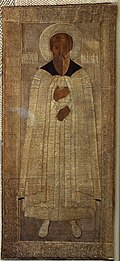 Roman of UglichRight-Believing · Prince of UglichFeb 3
 Simeon of TverSaint · First bishop of TverFeb 3
 Oliver of AnconaVenerableFeb 3
 Alexius of NovgorodSaint · Archbishop of NovgorodFeb 3
- Celerinus of CarthageConfessor · Deacon of CarthageFeb 3