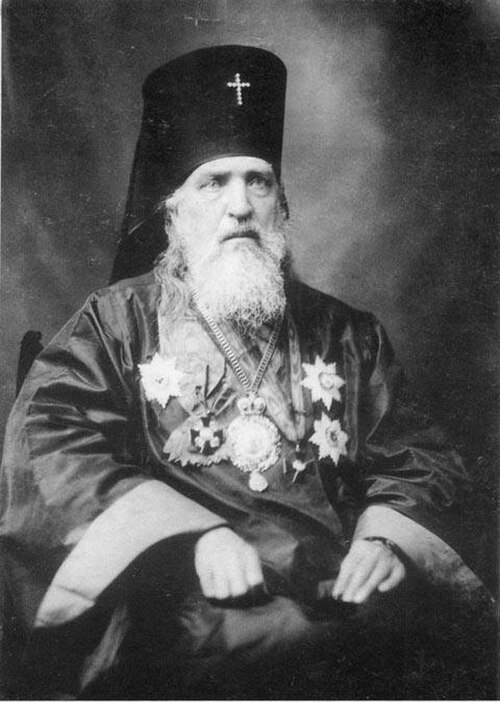
Equal-to-the-Apostles
Nicholas of Japan
Archbishop of Japan
Russian missionary who founded the Orthodox Church in Japan, archbishop of Tokyo, who died in 1912.
- Feast
- February 3old style February 16
- Reposed
- 191220th century
- Place
- Tokyo
Life
Saint Nicholas of Japan, equal to the apostles, was archbishop of Japan and the one who laid the foundation of the Orthodox Church in that country. In the world he was called Ivan Dmitrievich Kasatkin. He fell asleep at Tokyo in 1912. He is commemorated on 3 February, the day of his death by the old calendar, that is, 16 February by the new.
Youth
He was born in 1836 in the region of Smolensk, in Russia, a son of the deacon Dimitry Kasatkin. His mother died when he was five. He finished the seminary at Smolensk and in 1857 entered the Theological Academy in Saint Petersburg. In June 1860 he was tonsured a monk by the rector of the academy, Bishop Nectarius, with the name Nicholas, and soon after was ordained deacon and then priest. When he saw a notice that a priest was needed for the chapel of the Russian consulate at Hakodate, in Japan, he volunteered.
The mission
On 2 July 1861 he reached Hakodate. For a time he studied alone the Japanese language, culture and customs, and for the first eight years he studied also Buddhism, to know the history, the religion and the soul of the Japanese. Christianity was then forbidden by law. The first Japanese he brought to the faith was Sawabe Takuma, a former samurai and Shinto priest, who had come to him intending to kill him; later he was one of the first Japanese Orthodox priests. In 1870 Nicholas was raised to archimandrite and moved to Tokyo, where he began an extensive missionary labour and bought a plot on a height in Kanda Surugadai, where the see of the archbishop was to be. On 30 March 1880 he was consecrated bishop, with the title of Reval, as auxiliary to the archbishop of Riga, although he never saw that city. The Resurrection Cathedral in Tokyo, called Nikorai-do by the people in his honour, was consecrated in 1891, and in 1907 the Holy Synod of Russia raised him to the rank of archbishop of all Japan. By the time he died the Orthodox community numbered about thirty-three thousand faithful and 266 communities.
Translations and schools
He translated into Japanese all the liturgical books and many parts of the Bible, among them the whole New Testament and the Psalms, helped by a Japanese Christian scholar, Nakai Tsugumaro. His translations are still used in worship. He loved church singing and helped to establish it in the Church of Japan. He opened a theological seminary, schools, an orphanage and a library.
The Russo-Japanese War
During the Russo-Japanese War he stayed in Japan, although some urged him to leave. It was the hardest time of his life, between love for the land of his birth and the bishop’s duty to support his faithful. He did not take part in public services in which the defeat of enemies was asked for, but he encouraged his Japanese faithful to pray for their army, and he sent priests and teachers to the camps of Russian prisoners for their instruction and care. His conduct moved Christians and non-Christians alike. He fell asleep on 16 February 1912. It is said that his last word was “resurrection”. The Russian Church numbered him among the saints in 1970, and he is the first saint of the Japanese Orthodox Church.
Commemorated the same day February 3
 Anna the ProphetessProphet · Prophetess of the TempleFeb 3
 AnsgarSaint · Archbishop of Hamburg-BremenFeb 3
 Simeon the God-receiverRighteous · The Righteous of the TempleFeb 3
 Laurence of CanterburySaint · Archbishop of CanterburyFeb 3
 WerburghVenerable · Abbess, patron of ChesterFeb 3
 Ignatius of MariupolSaint · Metropolitan of Gothia and KaffaFeb 3
 HadelinVenerable · Missionary monk in BelgiumFeb 3
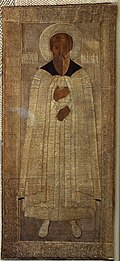 Roman of UglichRight-Believing · Prince of UglichFeb 3
 Simeon of TverSaint · First bishop of TverFeb 3
 Oliver of AnconaVenerableFeb 3
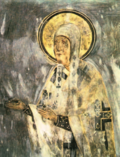 Alexius of NovgorodSaint · Archbishop of NovgorodFeb 3
- Celerinus of CarthageConfessor · Deacon of CarthageFeb 3