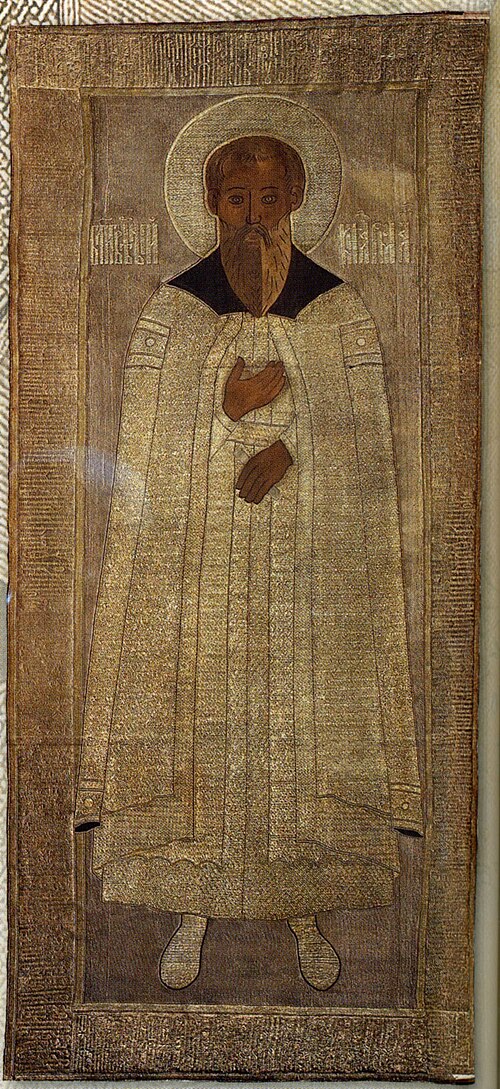
Right-Believing
Roman of Uglich
Prince of Uglich
Prince of Uglich from 1261 until his death in 1285, son of Vladimir.
- Feast
- February 3old style February 16
- Reposed
- 128513th century
Life
Saint Roman, the Right-Believing Prince of Uglich (died 3 February 1285), was appanage prince of Uglich from 1261 until his death, the younger son of Prince Vladimir Konstantinovich. The chronicles mention him almost only at his death, and he is known chiefly through local tradition: a father to his subjects, above all to widows and orphans, builder of fifteen churches, whose prayers are said to have spared Uglich from Mongol-Tatar devastation. His incorrupt relics are venerated locally, and his memory is kept on 3 February, the day of his repose.
Family and reign
The year and place of his birth are unknown. The English source says he was probably born between 1239/1240 and 1249, since he does not appear in the list of princes who survived the Mongol invasion of 1238. A Ukrainian source, however, gives the date 10 October 1225 or 1235, and tradition says he was a child when Batu invaded the Rus' lands. The Laurentian Chronicle shows that his father married in 1232 and that his elder brother Andrei was older than he; he therefore cannot have been sixty at his death, as the "History of the City of Uglich" claims.
He was the younger son of Vladimir Konstantinovich, the first appanage prince of Uglich (died 1249), and his wife, Princess Evdokia Ingvarevna (died 1278), daughter of Prince Ingvar Igorevich of Ryazan. The English source gives her name as Nadezhda. His brother Andrei Vladimirovich ruled Uglich from 1249 to 1261. According to the Ukrainian source, his father Vladimir left Uglich before the invasion and spent about eight years with his family in exile at Novgorod. He then returned, went to the Horde and received from the khan a yarlyk for his patrimony. After Vladimir's death Andrei became prince but died soon after, and in 1261 Roman took up the government.
Almost nothing survives about his political deeds. The chronicles mention Roman only at his death: the Trinity Chronicle says he died in 1283, while the First Sophia Chronicle and the Resurrection Chronicle give 1285. What else is known comes from the "History of the City of Uglich", apparently based on local chronicles, and from Uglich legends recorded in late lists of the eighteenth and nineteenth centuries, which the English source regards as unreliable. According to a local chronicle, in Roman's time the principality was called "Seven Cities", namely Kashin, Bezhetsky Verkh, Zheleznyi Ustyug, Dmitrov, Zvenigorod, Romanov and Uglich as capital, with a number of settlements besides. The "History of Uglich" regards Roman as the founder of the town of Romanov, but Ekzemplyarsky attributes it to another Roman, son of Prince Vasily the Terrible of Yaroslavl.
Works of mercy and death
According to F. H. Kissel, author of the "History of the City of Uglich", Roman was a true father to his subjects. He built hospitals and guest houses in Uglich and in the monasteries, the hospitals maintained at his own expense and the guest houses at that of the monasteries. He built fifteen churches in Uglich, in other towns and in villages. The history portrays him not only as a wise ruler who liked to converse with wise and experienced men, but as an ascetic full of religious feeling, whose fervent prayers are said to have saved Uglich from Mongol-Tatar devastation. The fame of the gentle, wise and merciful prince drew people to Uglich even from other principalities, so that the town grew and was adorned. As the Ukrainian source puts it, he was a true father to his subjects, especially to widows and orphans.
He was married to Alexandra, of unknown origin, who died before him; according to the Russian and Serbian sources they had no descendants. After he was widowed, says the Ukrainian source, he devoted himself solely to works of piety. The English source says he spent his last years in prayer, fasting and almsgiving. According to the chronicler cited by Kissel, Roman, foreknowing his end, called the boyars and clergy to the palace and bequeathed to them to live in peace, love and concord. He died on 3 February 1285 (older chronicles give 1283), and Uglich passed to his cousins, the princes of Rostov, with Dmitry of Rostov at their head. In M. G. Spiridov's genealogical book he is given a son, Prince Dmitry Romanovich, but in the family tree submitted in 1682 to the Chamber of Genealogical Affairs he appears childless. His body was laid in the Transfiguration church at Uglich.
Veneration
The sources disagree on the date of the discovery of his relics. The Russian and Ukrainian ones say that the incorrupt relics of the prince were found in 1486, at the founding of the new cathedral church, two hundred and one years after his death; the English source speaks of their transfer in 1595 to a newly built stone church after they were seen to be incorrupt. At the order of Patriarch Job the relics were examined again by Metropolitan Hermogenes of Kazan, in 1595 or in 1605. Nikolai Barsukov in his "Hagiography" accepts the first year, and Vasily Klyuchevsky in "The Old Russian Lives of the Saints" the second, on the basis of a surviving account of Roman's miracles, which began on 3 February 1605; at that time Semyon Alferiev, with the monk Sergius, wrote the "tale" of him, with stichera and canons.
In 1609 the Poles burned the cathedral at Uglich and the holy relics; his life and the first miracles also perished. The remains of the relics were, at the beginning of the twentieth century, in a side chapel of the cathedral dedicated to him and were still regarded as healing. His service and an account of the miracles survive. Venerated as a local saint, he is commemorated on 3 February, the day of his repose, and on 23 May with the Synaxis of the Saints of Rostov and Yaroslavl. One Ukrainian source gives 16 February as his feast, which does not agree with the others.
Commemorated the same day February 3
 Anna the ProphetessProphet · Prophetess of the TempleFeb 3
 AnsgarSaint · Archbishop of Hamburg-BremenFeb 3
 Simeon the God-receiverRighteous · The Righteous of the TempleFeb 3
 Nicholas of JapanEqual-to-the-Apostles · Archbishop of JapanFeb 3
 Laurence of CanterburySaint · Archbishop of CanterburyFeb 3
 WerburghVenerable · Abbess, patron of ChesterFeb 3
 Ignatius of MariupolSaint · Metropolitan of Gothia and KaffaFeb 3
 HadelinVenerable · Missionary monk in BelgiumFeb 3
 Simeon of TverSaint · First bishop of TverFeb 3
 Oliver of AnconaVenerableFeb 3
 Alexius of NovgorodSaint · Archbishop of NovgorodFeb 3
- Celerinus of CarthageConfessor · Deacon of CarthageFeb 3