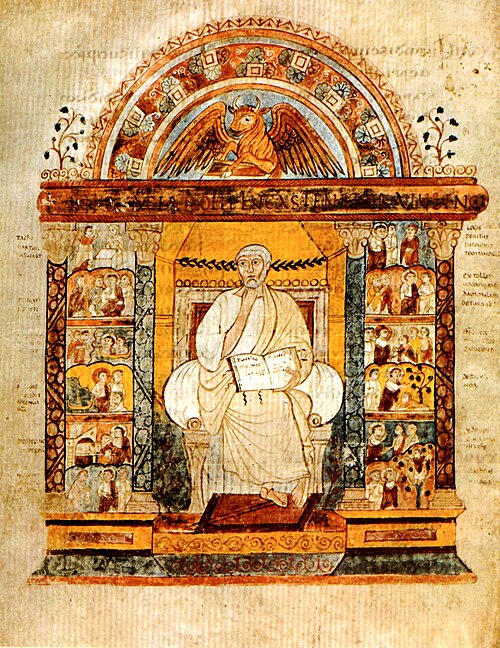
Saint
Laurence of Canterbury
Archbishop of Canterbury
Second archbishop of Canterbury, from 604 to 619, a member of the mission sent from Italy to England.
- Feast
- February 3old style February 16
- Reposed
- 6197th century
- Place
- Canterbury
- Order
- Hierarchs
Life
Saint Laurence of Canterbury was the second Archbishop of Canterbury, from about 604 until his death on 2 February 619. A monk of Rome, he belonged to the mission sent by Pope Gregory the Great to bring the Anglo-Saxons to Christianity, and in the hard years after the death of King Æthelberht he kept the faith alive in Kent. He is venerated mainly in the West, and the Orthodox Church commemorates him on 3 February.
Missionary at Canterbury
He was a monk at Rome, and nothing else is known of his earlier life. He belonged to the mission sent by Pope Gregory I in 595, either landing on the isle of Thanet with Augustine in 597 or, according to other sources, arriving only in 601. Bede says that Augustine sent him to Rome to report the conversion of King Æthelberht of Kent to the pope and to carry a letter of questions. He set out after July 598 together with another missionary, Peter, and returned by June 601 at the latest, bringing Gregory's answers, known as the Libellus responsionum, which Bede preserved in his History.
He is probably the same Laurence the priest from whom the pope learned what he wrote to Queen Bertha, praising her part in the conversion of her husband. In the summer of 601 he returned to England with Mellitus and the second group of missionaries.
Archbishop
After Augustine he took up the see around 604. Augustine had consecrated him archbishop in his own lifetime, though the canons forbade this, for fear that the mission would suffer if the see stood empty. Laurence never received the pallium from Rome, so Rome might have considered the consecration irregular. In 610 he received letters from Pope Boniface IV addressing him as archbishop and Augustine's successor. Mellitus had been sent to Rome that year, took part in a synod there, and brought its decrees back.
In 613 he consecrated the monastery church built by Augustine at Canterbury and dedicated it to Saints Peter and Paul; it later became Saint Augustine's Abbey. He wrote to the bishops of the Britons and the Scots, asking them to keep Easter on the day Rome kept it, but without success. In 609 the bishop Dagan would neither eat with him nor stay under the same roof, because of the differences between the two Churches.
The trial after the king's death
King Æthelberht died in 616, and his son Eadbald abandoned Christianity for Anglo-Saxon paganism. Many missionaries fled to Gaul, among them Mellitus, bishop of London, and Justus, bishop of Rochester. Laurence was ready to leave but remained.
Bede tells that Saint Peter appeared to him in a vision or a dream and rebuked him, and the marks of the blows remained on his body. By showing them to Eadbald he is said to have brought him back to the faith. Historians regard the story mostly as tradition. They note that his decision to stay may also have had political reasons, and that Eadbald may have been baptized again by Justus around 624.
Veneration
He fell asleep on 2 February 619. According to Bede he was buried beside Augustine in the church of Saints Peter and Paul at Canterbury. He was honoured as a saint after his death, above all in England and in the Roman Church, and the Orthodox Church commemorates him on 3 February.
Commemorated the same day February 3
 Anna the ProphetessProphet · Prophetess of the TempleFeb 3
 AnsgarSaint · Archbishop of Hamburg-BremenFeb 3
 Simeon the God-receiverRighteous · The Righteous of the TempleFeb 3
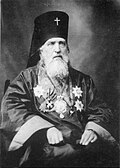 Nicholas of JapanEqual-to-the-Apostles · Archbishop of JapanFeb 3
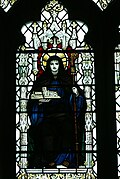 WerburghVenerable · Abbess, patron of ChesterFeb 3
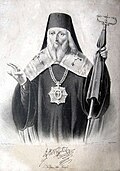 Ignatius of MariupolSaint · Metropolitan of Gothia and KaffaFeb 3
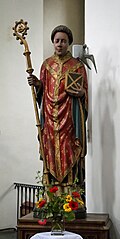 HadelinVenerable · Missionary monk in BelgiumFeb 3
 Roman of UglichRight-Believing · Prince of UglichFeb 3
 Simeon of TverSaint · First bishop of TverFeb 3
 Oliver of AnconaVenerableFeb 3
 Alexius of NovgorodSaint · Archbishop of NovgorodFeb 3
- Celerinus of CarthageConfessor · Deacon of CarthageFeb 3