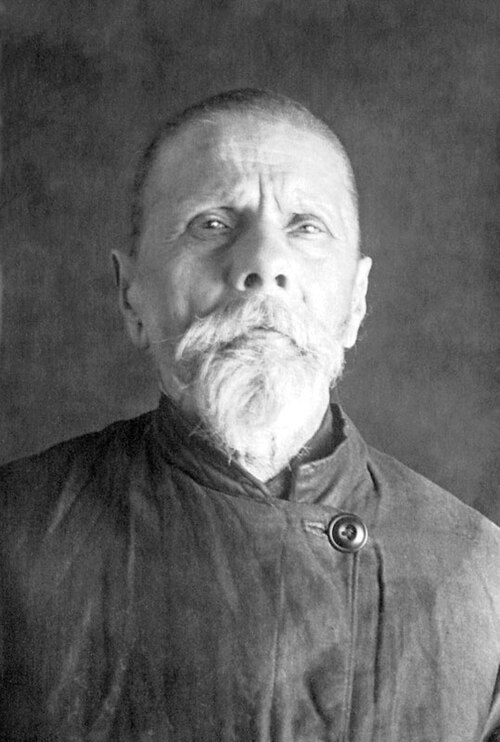
Hieromartyr
Basil Arkhangelsky
Archpriest
Archpriest born at Serpukhov in 1864, shot at the Butovo firing range in 1937; canonized in 2003.
- Feast
- October 31old style November 13
- Reposed
- 193720th century
- Place
- Butovo firing range
- Order
- Martyrs
Life
Holy Hieromartyr Basil Arkhangelsky (Vasily Vasilyevich Arkhangelsky) was an archpriest of the Russian Church, born on 24 February 1864 at Serpukhov and shot on 13 November 1937 (31 October on the old calendar) at the Butovo firing range, near Moscow. He was numbered among the holy new martyrs and confessors of Russia for veneration throughout the Church by decision of the Holy Synod of 7 May 2003. He is remembered on 31 October on the old calendar (13 November on the new), the day of his death, and in the Synaxis of the New Martyrs and Confessors of Russia.
The priest
He was born at Serpukhov, where his father was a psalm-reader. In 1884 he finished the theological seminary of Moscow. He was married and had four children. After ordination as priest, in 1885, he received the parish of the church of the village of Matveevskoye, Podolsk district, Moscow province. In 1891 he moved to the church of the Akhtyrka icon of the Mother of God in the village of Akhtyrka, Khotkovo volost, Dmitrov district. He founded and opened three parish schools in the villages of the Akhtyrka parish. In 1919 he was raised to the rank of archpriest. Among church honours he received in 1914 a gold cross, in 1925 a cross with ornaments, in 1929 the palitsa, in 1935 the mitre.
The arrests
The first time, in 1920, he was sentenced to three months' imprisonment, suspended, on the charge of counter-revolutionary activity. After that the OGPU began to collect material secretly against Father Basil. In the night of 2 to 3 September 1929 he was arrested a second time and put in Butyrka prison in Moscow. On 3 September a parishioner from the village of Komyakino was questioned, who gave testimony about his words after a molieben. On 23 November 1929 the Special Council of the OGPU Collegium sentenced him, under article 58, point 10, to three years of exile in the Northern Territory, for "anti-Soviet and anti-Semitic agitation". The first place of exile was Barabinsk, in the Novosibirsk district, but later he was moved to the Vologda region. In 1932, after the end of exile, he was forbidden to settle in large cities and within a hundred kilometres around them. So he was sent to a remote parish, of the church of the Nativity of the Mother of God in the village of Timoshevo, Volokolamsk district.
On 22 September 1937 he was arrested a third time and put in Volokolamsk prison. In a thorough search only seventeen Soviet silver coins of fifty kopeks each were found, which were taken from him. On 23 September NKVD investigators summoned the chairman of the village council, who gave testimony about him. At the interrogation Father Basil answered that he had not engaged in counter-revolutionary activity, and at the search, "when the church books were being examined, I said, jokingly, that you will not find Trotsky's letters, I burned them all". There were no more interrogations. On 11 November 1937 the troika of the NKVD of the Moscow region sentenced him to death for "carrying on among the people subversive and anti-Soviet work aimed at ruining the collective farm, and uttering defeatist moods". On 13 November 1937 the sentence was carried out at the field at Butovo, near Moscow, and Father Basil was buried in one of the common graves.
Commemorated the same day October 31
 StachysApostle · Bishop of ByzantiumOct 31
 Serapion of AntiochSaint · Patriarch of AntiochOct 31
 Quentin of AmiensMartyrOct 31
- Urban of MacedoniaApostle · Bishop of MacedoniaOct 31
 Hundred Thousand Martyrs of TbilisiHoly MartyrsOct 31
 Narcissus of AthensApostle · Apostle of the SeventyOct 31
 John KochurovHieromartyr · Archpriest at Tsarskoye SeloOct 31
 Epimachus of PelusiumMartyr · Martyr of EgyptOct 31
 Peter KalnishevskyConfessor · Last Koshovy Otaman of the Zaporozhian SichOct 31
 Spyridon the Prosphora-bakerVenerable · Prosphora-baker of the Kiev CavesOct 31
 Nicodemus of the Kiev CavesVenerable · Prosphora-baker of the Kiev CavesOct 31
- Mantuanus of MilanSaint · Archbishop of MilanOct 31