Confessor
Peter Kalnishevsky
Last Koshovy Otaman of the Zaporozhian Sich
Last otaman of the Zaporozhian Sich, imprisoned for years at Solovki, where he died at a very great age.
- Feast
- October 31old style November 13
- Reposed
- 180319th century
- Place
- Solovetsky Islands
- Order
- Confessors
Life
The Righteous Peter Kalnishevsky was the last Koshovy Otaman of the Zaporozhian Sich, leader of the Cossacks beyond the Dnieper rapids in 1762 and from 1765 to 1775. After the Sich was abolished he was imprisoned for life at the Solovetsky Monastery, where he spent a quarter of a century in confinement and reposed in 1803 at a very great age. The Church in Ukraine honours him as a generous founder of churches and as a man who bore long suffering with patience and faith.
Origins
According to the inscription on his tombstone he was born in 1690 or 1691. Most scholars place his birth in the village of Pustovoitivka in the Lubny Regiment, today in the Sumy region, though some historians question both the date and the place. He was named after the Apostle Peter, on whose feast he was evidently born, since documents often mention how he kept his name day.
The sources disagree about his family. Some make him a member of the minor gentry of the Lubny Regiment, others of a peasant family, and Muscovite records call him a "Podolian nobleman". He seems to have come from a priestly family, for his brother and nephew held church ranks. This may explain his good knowledge of liturgical order and his great love for building churches.
A legend preserved in his home village says that at the age of eight, while herding cattle, he met some Zaporozhians in the fields and, won over by their free life, went with them to the Sich. Perhaps this is why he never learned to read and write: all his papers were written for him by his secretary, Ivan Hloba.
Rise in the Sich
The first documentary mention of him dates from 1754, when he was already osavul of the Host, responsible for public order, enrolled in the Kushchivka kurin. His older relatives Andrii, David and Zynovii helped him advance. In the 1750s he led, with Russian government backing, the suppression of haydamak bands on the Southern Bug and in New Serbia, a harsh campaign that included executions.
In 1755-1756 he was part of the Zaporozhian delegation sent to Saint Petersburg to Empress Elizabeth, seeking the removal of duties on goods brought into Zaporozhia and an increase in the Host's annual pay. He also helped draw up the register of the Zaporozhian Host of 1756. He then served as judge of the Host.
On 9 September 1762 he was elected Koshovy Otaman for the first time. He attended the coronation of Empress Catherine II, but his independent character displeased her, and in October 1763 he was removed from office on her orders. He remained judge of the Host. On 1 January 1765, after the elderly otaman Fedoriv was allowed to retire and became a monk, Peter Kalnishevsky was again elected Koshovy, and he held the office, re-elected year after year, until the Sich was abolished in 1775.
The otaman
As otaman he firmly defended the lands and rights of Zaporozhia, travelling several times with delegations to Saint Petersburg, including in 1765-1766, to seek the demarcation of its lands and the transfer of the Host to the College of Foreign Affairs. He strengthened his own authority, limiting the rights of the officers and of the Cossack council. In 1768, during a rising of the poor Cossacks, he took refuge with the officers in the fortress of the New Sich, and the next day the rising was put down.
He encouraged farming and trade in the Zaporozhian steppe and the settlement of peasants from every part of Ukraine. He refused to hand over fugitives sheltering in the Sich, despite the demands of landowners. During his ten years as otaman 45 new villages and some 4,000 farmsteads were founded in Zaporozhia, with a population of about 55,000.
As a soldier he took part in the Russo-Turkish wars of 1735-1739 and 1768-1774 and distinguished himself with the Zaporozhians at the taking of Ochakiv, Kinburn, Bakhchisarai and Khadjibey. In the war of 1768-1774, though nearly eighty, he proved a skilful commander. In 1770 Empress Catherine awarded him a gold medal set with diamonds, worn at the neck on the ribbon of the Order of Saint Andrew, inscribed in recognition of his outstanding bravery against the enemy and his particular zeal in service. Some Ukrainian sources also speak of the rank of lieutenant general.
Founder of churches
Peter Kalnishevsky was a wealthy and devout man. At his expense more than thirty Orthodox churches were built, among them those at Lokhvytsia, Romny and the Mezhyhirya Monastery, the Holy Trinity church in his native Pustovoitivka, the Protection church in Romny, the Saint Nicholas church in Smila, and the church at his winter homestead, today the village of Petrykivka. During his time as otaman the Host funded the building of the Holy Trinity Cathedral in Samara, today Novomoskovsk, and several churches in the villages along the Oril. Schools and hospitals operated beside the monasteries and churches.
He gave the Holy Trinity Cathedral in Samara a great Gospel book half a metre tall, which then cost 600 gold roubles and is kept today in the museum at Romny. He also maintained the church on Khortytsia island and bought many liturgical books.
Following the tradition of the Zaporozhian otamans, patrons of the Transfiguration Monastery of Mezhyhirya near Kyiv, he helped rebuild its buildings after the fire of 1765, and in 1772 he built there a great stone gate and beside it a church dedicated to the Apostles Peter and Paul.
He corresponded with Saint Paisius Velichkovsky and received spiritual guidance from him. He gave generously to the Moldavian monasteries of Saint Paisius and to other monasteries on Athos and in the Romanian lands. In a letter of 1772 Saint Paisius wrote to him that, for adorning the holy houses, Christ was building for him a dwelling not made with hands in heaven, and that for clothing the naked He would clothe his soul in the garment of incorruption.
The fall of the Sich
After the Peace of Küçük Kaynarca of 10 July 1774, Catherine II's government judged that the Sich was no longer needed, and the land disputes between the Zaporozhians and Russian military settlers were blamed on the Cossacks. On 23 April 1775 Prince Potemkin laid before the government a plan to abolish the Sich.
In early June 1775 a large army returning from the Turkish war, under General Peter Tekeli, secretly approached the Sich from several sides, taking advantage of the fact that many Zaporozhians had not yet returned from the front. The Cossacks wanted to resist, but the otaman, seeing the enemy's great superiority and unwilling to sacrifice his men to no purpose, surrendered the fortress without a fight. The soldiers plundered the treasury, the stores, the archive and the church. His decision to spare the Cossacks' lives later made possible the revival of the Cossacks in the Kuban.
On 3 August 1775 the empress issued a manifesto announcing that the Zaporozhian Sich no longer existed, accusing the Zaporozhians of seizing others' lands and seeking to govern themselves.
Imprisonment at Solovki
The otaman was arrested on 4 June 1775 and held first in Moscow. After the empress confirmed the sentence he was sent, on Potemkin's proposal, to life imprisonment at the Solovetsky Monastery under a guard of seven. Even his closest relatives never learned what had become of him. Only almost a century later did researchers discover that the otaman had been sent to Solovki, the secretary Ivan Hloba to Turukhansk, and the judge Pavlo Holovaty to a monastery at Tobolsk.
The journey went through Moscow to Arkhangelsk in strict secrecy, the prisoner's name never spoken, and from there across the White Sea to Solovki. He arrived at the end of July 1776. The monastery was ordered never to release him, to forbid not only correspondence but any conversation with outsiders, and to keep him under a guard of soldiers.
He was held first in a cell made in an embrasure of the fortress wall, and from 1792 in a solitary cell near the kitchen. In 1779 the monastery's deputy superior, Father Simon, wrote that rain water constantly seeped into the cell and that the old man's clothes were rotting on him. Local peasants said he was let out into the air only three times a year, at Christmas, Pascha and the Transfiguration. When, very old, he was led back from church and asked pilgrims who was now tsar, people were forbidden to answer him.
When he was moved from one cell to another after long years of confinement, a deep layer of filth was found in it. He had become almost blind, with a long beard and long nails, and his kaftan had fallen to rags on his shoulders.
Gifts from prison
He was allowed one rouble a day for his keep, forty times more than other prisoners. From this money he had his cell repaired in 1780, and the rest he saved for years to make gifts to the monastery. In 1794 he gave the Transfiguration Cathedral a silver altar cross weighing more than 13 kilograms, in 1798 a silver-gilt icon cover with crowns was made at his expense, and in 1801 he presented a cover for a Gospel printed on fine paper. Researchers reckon it took him twelve years and three months to save the money for these gifts.
Throughout his imprisonment he behaved calmly and devoutly, and so earned the respect of the monks. In his last years his conditions were somewhat eased.
Pardon and repose
By a decree of 2 April 1801, issued with a general amnesty, Emperor Alexander I pardoned him and allowed him to live wherever he wished. He was then, by the reckoning of the time, 110 years old and almost blind. He no longer wished to return home and stayed in the monastery, saying that he had grown entirely used to it and enjoyed full freedom there as well. Although he had spent more than 25 years in a solitary cell, almost cut off from people, he kept a clear mind to the end.
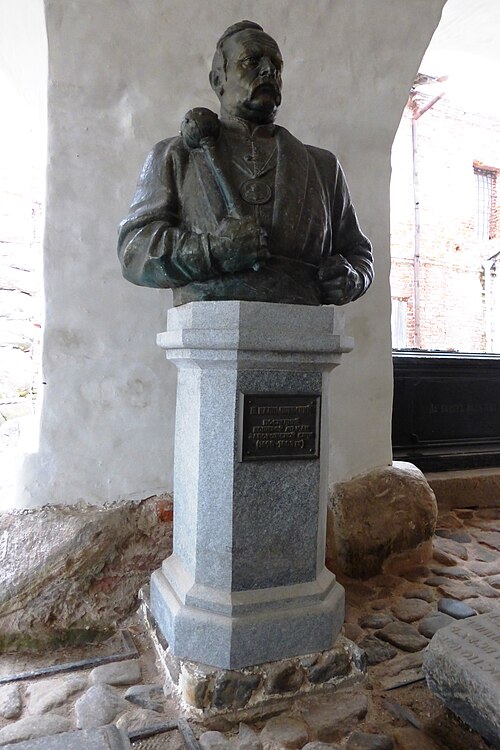
He reposed on 31 October 1803, aged about 112 or 113. The Solovki monks gave him a special honour, burying him on the south side of the Transfiguration Cathedral. In Soviet times the cemetery was destroyed, and in 2002 the surviving slab from his grave was moved to the Saint Herman courtyard of the monastery. On 28 June 2004 a monument to him, the work of the Zaporizhzhia sculptor Mykola Sobol, was blessed there.
Veneration
In 2008 the Ukrainian Orthodox Church of the Kyiv Patriarchate numbered him among the saints as the Righteous Peter the Much-Suffering, commemorated on the feast of the Protection of the Mother of God, patroness of the Cossacks. On 23 December 2014 the Synod of the Ukrainian Orthodox Church of the Moscow Patriarchate blessed the local veneration of the Righteous Peter Kalnishevsky in the diocese of Zaporizhzhia, with his memory on the day of his repose, 31 October.
An icon with a particle of his relics is kept in the Protection Cathedral in Zaporizhzhia. The saint is shown before the Samara icon of the Mother of God, holding a scroll with a prayer asking the Theotokos to cover them with her holy protection and deliver them from all evil. Many streets in Ukraine bear his name, and since 1991 a festival in his honour has been held in the Romny district.
Commemorated the same day October 31
 StachysApostle · Bishop of ByzantiumOct 31
 Serapion of AntiochSaint · Patriarch of AntiochOct 31
 Quentin of AmiensMartyrOct 31
- Urban of MacedoniaApostle · Bishop of MacedoniaOct 31
 Hundred Thousand Martyrs of TbilisiHoly MartyrsOct 31
 Narcissus of AthensApostle · Apostle of the SeventyOct 31
 John KochurovHieromartyr · Archpriest at Tsarskoye SeloOct 31
 Epimachus of PelusiumMartyr · Martyr of EgyptOct 31
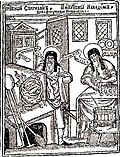 Spyridon the Prosphora-bakerVenerable · Prosphora-baker of the Kiev CavesOct 31
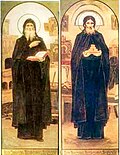 Nicodemus of the Kiev CavesVenerable · Prosphora-baker of the Kiev CavesOct 31
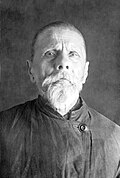 Basil ArkhangelskyHieromartyr · ArchpriestOct 31
- Mantuanus of MilanSaint · Archbishop of MilanOct 31