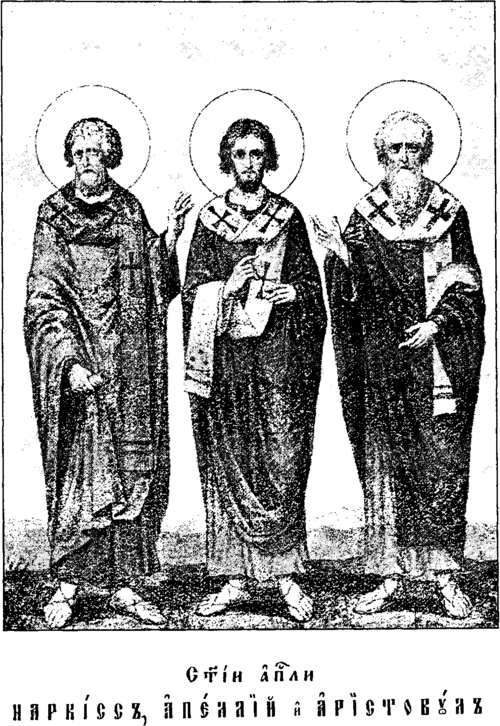
Apostle
Narcissus of Athens
Apostle of the Seventy
One of the Seventy, named by the Apostle Paul in Romans; by tradition a bishop of Athens.
- Feast
- October 31old style November 13
- Reposed
- 11st century
- Order
- Apostles
Life
Saint Narcissus the Apostle is numbered among the Seventy Apostles and, according to tradition, was bishop of Athens. He is named by the Apostle Paul in the Epistle to the Romans (16:11): "Greet them that are of the household of Narcissus, which are in the Lord." The Church remembers him on 31 October, with the apostles Stachys, Ampliatus, Apelles, Urbanus and Aristobulus, and on 4 January, in the Synaxis of the Seventy.
With Urbanus of Macedonia, Stachys, Ampliatus, Apelles of Heraklion and Aristobulus of Britain, whose names Paul gives together, which cannot be accidental, he assisted the Apostle Andrew. Some think the Narcissus of the epistle was the famous freedman of the emperor Nero, who had many slaves, among them Christians, to whom Paul sends greeting. If that opinion is set aside, according to the Synaxarion of Nikodemos in the Greek Menaia, Paul made him bishop at Athens, and tradition says the Apostle Philip ordained him bishop of Athens, following, it seems, Dionysius the Areopagite. It is also said that the Apostle Andrew made a companion of his with the same name bishop at Patras or Athens, and the same of a disciple of Philip. The three Narcissi seem to be one and the same person. In the service of the apostles his name is mentioned eight times: "divine and all-blessed disciple of Christ, preacher of the Holy Trinity, enlightener of those in darkness". In the canon, the sixth ode calls him "great president of the Athenians and planter of beautiful gardens". According to some Greek sources he ended his life as a martyr.
Commemorated the same day October 31
 StachysApostle · Bishop of ByzantiumOct 31
 Serapion of AntiochSaint · Patriarch of AntiochOct 31
 Quentin of AmiensMartyrOct 31
- Urban of MacedoniaApostle · Bishop of MacedoniaOct 31
 Hundred Thousand Martyrs of TbilisiHoly MartyrsOct 31
 John KochurovHieromartyr · Archpriest at Tsarskoye SeloOct 31
 Epimachus of PelusiumMartyr · Martyr of EgyptOct 31
 Peter KalnishevskyConfessor · Last Koshovy Otaman of the Zaporozhian SichOct 31
 Spyridon the Prosphora-bakerVenerable · Prosphora-baker of the Kiev CavesOct 31
 Nicodemus of the Kiev CavesVenerable · Prosphora-baker of the Kiev CavesOct 31
 Basil ArkhangelskyHieromartyr · ArchpriestOct 31
- Mantuanus of MilanSaint · Archbishop of MilanOct 31