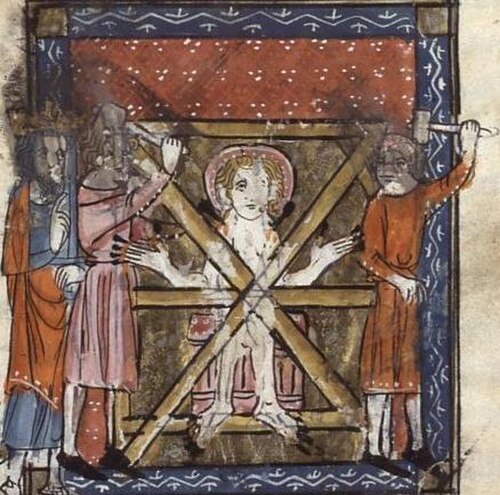
Martyr
Quentin of Amiens
Gallo-Roman saint venerated at Saint-Quentin, who died around 287.
- Feast
- October 31old style November 13
- Reposed
- 2873rd century
- Place
- Saint-Quentin
- Order
- Martyrs
Life
The Holy Martyr Quentin (Quentin of Amiens) was, according to tradition, a Roman who preached in Gaul and was killed for the faith around 287. His veneration has remained strong at Saint-Quentin, in northern France. His feast is on 31 October.
Life and martyrdom
According to the legend of his life, he was a Roman citizen, son of a senator named Zeno, brought up in pagan belief but who accepted Christianity. Filled with apostolic zeal, he travelled to Gaul as a missionary with Lucian, who was later martyred at Beauvais, and others (the martyrs Victoricus and Fuscian are said to have been Quentin's followers). He settled at Amiens, in Picardy, and performed many miracles there. Because of his preaching he was imprisoned by the prefect Rictiovarus, who had come to Amiens from Trier; according to some sources the prefect ordered their seizure and torture in 286. Quentin was manacled and tortured repeatedly, but refused to abjure his faith. The prefect left Amiens for Reims, the capital of Gallia Belgica, where he wanted Quentin judged; but on the way, in a town called Augusta Veromanduorum (now Saint-Quentin, Aisne), Rictiovarus decided to interrupt his journey and pass sentence: Quentin was tortured again, then beheaded and thrown by the soldiers into the marshes around the Somme. According to another source, the soldiers guarded the body until night, then threw it into the river, and after some days Christians found it and buried it on a hill near the town.
The finding of the relics
A blind woman, Eusebia, of a senatorial family, came from Rome (following a divine order) and miraculously found the body; another blind woman recovered her sight by the holy relics. The time that had passed is given differently: five years, according to one source, fifty-five, according to another. The relics were buried on a hill, where a small chapel was built, which later became the basilica of Saint-Quentin. The place was again forgotten during the persecution of Julian the Apostate, though the nearby chapel was preserved.
The life of Bishop Eligius (mainly written in the seventh century) says that the exact place of the tomb had been forgotten and that in 641 the bishop of Noyon, after several days of searching, miraculously found it. When the relics were discovered, together with the great nails with which the body had been pierced, Eligius distributed the nails, the teeth and the hair in other places, and enclosed the rest of the sacred treasure in a rich shrine of his own work, for he was a skilful goldsmith, and placed it behind the high altar. He also rebuilt the church, now the basilica of Saint-Quentin.
Devotion
In the Middle Ages the basilica became an important place of pilgrimage, which spread the cult of Saint Quentin through the whole surrounding region. Though not formally canonized, his veneration was kept through the centuries, especially in France, as is shown by the considerable number of place names derived from the saint's name (see Saint-Quentin).
Commemorated the same day October 31
 StachysApostle · Bishop of ByzantiumOct 31
 Serapion of AntiochSaint · Patriarch of AntiochOct 31
- Urban of MacedoniaApostle · Bishop of MacedoniaOct 31
 Hundred Thousand Martyrs of TbilisiHoly MartyrsOct 31
 Narcissus of AthensApostle · Apostle of the SeventyOct 31
 John KochurovHieromartyr · Archpriest at Tsarskoye SeloOct 31
 Epimachus of PelusiumMartyr · Martyr of EgyptOct 31
 Peter KalnishevskyConfessor · Last Koshovy Otaman of the Zaporozhian SichOct 31
 Spyridon the Prosphora-bakerVenerable · Prosphora-baker of the Kiev CavesOct 31
 Nicodemus of the Kiev CavesVenerable · Prosphora-baker of the Kiev CavesOct 31
 Basil ArkhangelskyHieromartyr · ArchpriestOct 31
- Mantuanus of MilanSaint · Archbishop of MilanOct 31