Holy Martyrs
Hundred Thousand Martyrs of Tbilisi
Believers put to death at Tbilisi in 1226, commemorated as saints in the Georgian Orthodox Church.
- Feast
- October 31old style November 13
- Reposed
- 122613th century
- Place
- Tbilisi
- Order
- Martyrs
Life
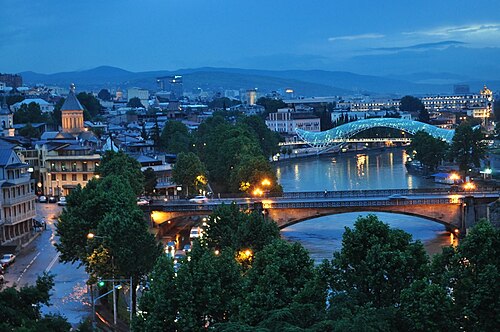
The Hundred Thousand Martyrs of Tbilisi are saints of the Georgian Orthodox Church, put to death for not renouncing Christianity after the Khwarazmian sultan Jalal al-Din captured the Georgian capital, Tbilisi, in 1226. The Georgian Church commemorates them on 13 November (31 October by the old calendar).
The fall of Tbilisi
Jalal al-Din's first encounter with the kingdom of Georgia took place in 1225, when his army inflicted a crushing defeat on the Georgians at Garni, bringing an end to the country's medieval flowering. The next year he marched on Tbilisi, forcing Queen Rusudan and her court to flee. The Georgian force left to defend the capital put up a fierce resistance, but Jalal's army eventually broke into the city, with the help of some local Muslims, on 9 March 1226. The Khwarazmian soldiers sacked Tbilisi and killed its Christians. The Muslim historians Ibn al-Athir and al-Nasawi, Jalal's secretary and biographer, confirm the killing of Christians who did not accept Islam, at the sultan's order. Nasawi writes, without stating the number of the dead: "the city was taken. Swords ruled over its inhabitants. All the Georgians and Armenians there were killed." The thirteenth-century Armenian historian Kirakos Gandzaketsi writes that the sultan took the city, destroyed a multitude of people and forced many to renounce Christianity. After that, many, for fear of death, exchanged truth for falsehood, "while others boldly preferred death to a wretched life and inherited the glory of martyrs". Another Armenian contemporary does not speak of a massacre but says the sultan forced some of the Christians to give up their faith.
The chronicle's account and the number of the dead
The anonymous Georgian Chronicle of a Hundred Years, of the fourteenth century, so written a hundred years after the events, laments: "Words cannot tell the devastation the enemy brought: tearing infants from their mothers' breasts, they beat their heads against the bridge." It relates that Jalal al-Din ordered the dome of Sioni Cathedral torn down and a throne for himself put in its place. The icons of the Lord Christ and the Mother of God were carried out of the cathedral and laid on the bridge over the Mtkvari to force the Christians to tread on them. Those who refused to profane the icons and renounce the faith for Islam were beheaded. Archbishop Zachary Machitadze says the same. The chronicler says the dead were "at'ni bevrni": the first part means "ten", the second in modern Georgian "many", but formerly also "ten thousand", from an old Persian word. Hence the figure "a hundred thousand" that the chronicle gives; other sources, like M. Sabinin, speak of ten thousand killed, among them defenders of the citadel who had surrendered. No contemporary testimony survives that counts the dead. Some Georgians chose martyrdom, and this memory has remained in the Georgian Church as a commemoration of those who stayed faithful to Christ.
Commemorated the same day October 31
 StachysApostle · Bishop of ByzantiumOct 31
 Serapion of AntiochSaint · Patriarch of AntiochOct 31
 Quentin of AmiensMartyrOct 31
- Urban of MacedoniaApostle · Bishop of MacedoniaOct 31
 Narcissus of AthensApostle · Apostle of the SeventyOct 31
 John KochurovHieromartyr · Archpriest at Tsarskoye SeloOct 31
 Epimachus of PelusiumMartyr · Martyr of EgyptOct 31
 Peter KalnishevskyConfessor · Last Koshovy Otaman of the Zaporozhian SichOct 31
 Spyridon the Prosphora-bakerVenerable · Prosphora-baker of the Kiev CavesOct 31
 Nicodemus of the Kiev CavesVenerable · Prosphora-baker of the Kiev CavesOct 31
 Basil ArkhangelskyHieromartyr · ArchpriestOct 31
- Mantuanus of MilanSaint · Archbishop of MilanOct 31