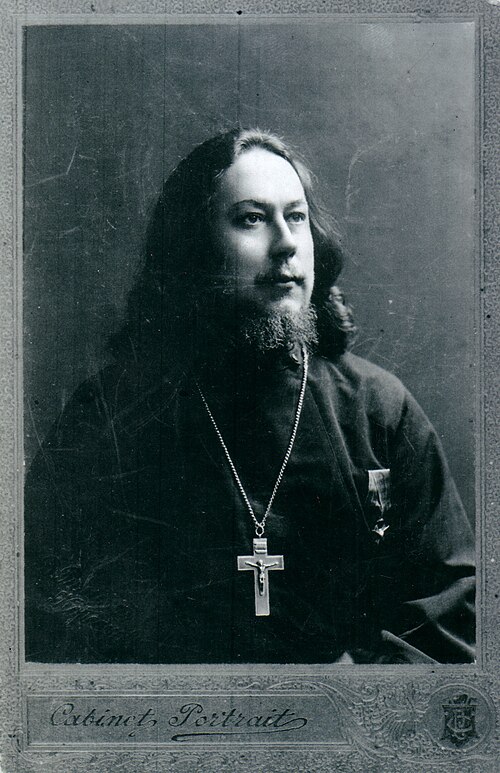
Hieromartyr
John Kochurov
Archpriest at Tsarskoye Selo
Russian archpriest killed at Tsarskoye Selo on 31 October 1917, in the days of the October Revolution.
- Feast
- October 31old style November 13
- Reposed
- 191720th century
- Place
- Pushkin
- Order
- Martyrs
Life
Saint John Kochurov, Hieromartyr, archpriest at Tsarskoye Selo, was killed on 31 October 1917, in the days of the October Revolution, being the first priest killed by the Bolsheviks at that time. The Russian Church canonized him in 1994, as John of Tsarskoye Selo. He is remembered on 31 October.
He was born on 13 June 1871 in the village of Bigildino in the province of Ryazan, in the family of a priest with many children. He finished the seminary of Ryazan in 1891 and the Theological Academy of Saint Petersburg in 1895. That year he married Alexandra Chernyshova, daughter of a deacon, and was ordained deacon and then priest, on 27 August, at the Alexander Nevsky Lavra, by Bishop Nicholas of the Aleutians and Alaska.
Together with his friend and fellow student Alexander Hotovitzky he accepted the proposal to serve in the diocese of the Aleutians and Alaska. He was appointed rector of the church of Saint Vladimir in Chicago, and on 11 October 1895 he arrived at the place of his service. The parish met on the ground floor of a small wooden house. In the first three years he brought 86 Uniates and six Catholics to Orthodoxy, and the number of regular parishioners grew to 215 in Chicago and 88 in Streator. The faithful were poor immigrants: Russians from the Galician and Hungarian Slavs, Arabs, Bulgarians and Slovaks who came from the Uniate Church. He founded mutual-aid brotherhoods and children's church schools in Chicago and Streator.
Under the guidance of Bishop Tikhon, later Patriarch of Moscow and a saint, he engaged the noted architect Louis Sullivan to design the church. To finance it he sought and obtained donations from Tsar Nicholas II and from Americans such as Harold Fowler McCormick and Charles R. Crane. Construction began in April 1902 and was completed the next year, when it was consecrated by Bishop Tikhon. The church later became Holy Trinity Cathedral. He helped found other parishes in the Chicago area and at Madison, Streator and Joliet in Illinois, and supported the parishes in Buffalo, New York, and Hartshorne, Oklahoma. With Alexis Toth he took part in founding a major Orthodox mutual-aid society for newly arrived immigrants and translated religious texts into English, looking to the time when the Church in America would consist of English-speaking members. He helped organize the first All-American Council, held at Mayfield, Pennsylvania, in 1907. He was made archpriest on 6 May 1906 and then dean of the New York area.
He returned to Russia in 1907 and was sent to Narva, in today's Estonia, where he used the skill of teaching catechism in schools gained in America. In 1916 he was transferred to the cathedral of Saint Catherine at Tsarskoye Selo near Saint Petersburg, one of the residences of the imperial family. He became a beloved priest, skilled in moving sermons. In October 1917 the Bolshevik uprising in Saint Petersburg quickly spread to Tsarskoye Selo. People thronged the churches, where the clergy held prayer services and led processions through the town, praying for peace. On 31 October 1917 (Old Style) the Bolsheviks entered Tsarskoye Selo in force and arrested Father John, who was killed the same day. He was canonized in December 1994 by the Council of Bishops of the Russian Church. He is also remembered on 12 December, at the Synaxis of the first martyrs of the American lands, and on the Sunday nearest 25 January, at the feast of the New Martyrs and Confessors of Russia.
Commemorated the same day October 31
 StachysApostle · Bishop of ByzantiumOct 31
 Serapion of AntiochSaint · Patriarch of AntiochOct 31
 Quentin of AmiensMartyrOct 31
- Urban of MacedoniaApostle · Bishop of MacedoniaOct 31
 Hundred Thousand Martyrs of TbilisiHoly MartyrsOct 31
 Narcissus of AthensApostle · Apostle of the SeventyOct 31
 Epimachus of PelusiumMartyr · Martyr of EgyptOct 31
 Peter KalnishevskyConfessor · Last Koshovy Otaman of the Zaporozhian SichOct 31
 Spyridon the Prosphora-bakerVenerable · Prosphora-baker of the Kiev CavesOct 31
 Nicodemus of the Kiev CavesVenerable · Prosphora-baker of the Kiev CavesOct 31
 Basil ArkhangelskyHieromartyr · ArchpriestOct 31
- Mantuanus of MilanSaint · Archbishop of MilanOct 31