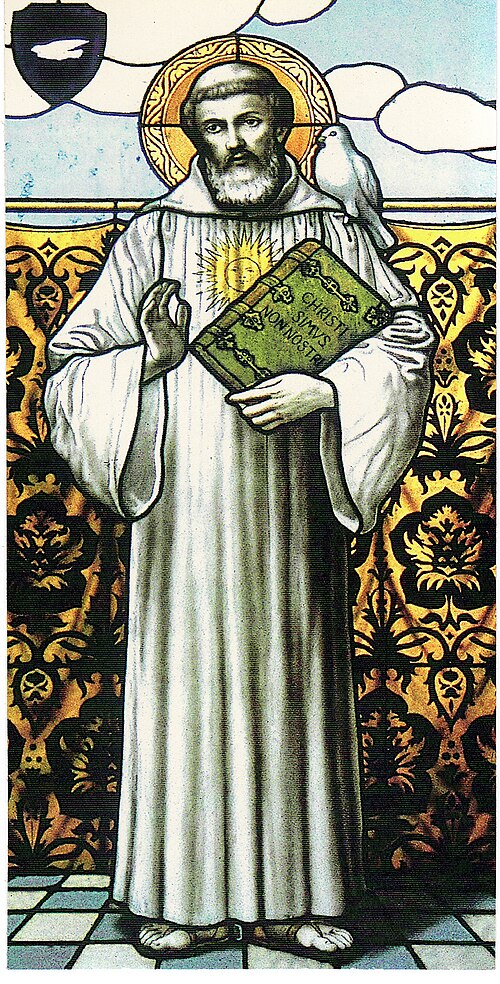
Venerable
Columbanus
Irish missionary and monastery founder
Irish monk who founded monasteries in the Frankish and Lombard kingdoms, among them Luxeuil and Bobbio.
- Feast
- November 23old style December 6
- Reposed
- 6157th century
- Place
- Bobbio
- Order
- Venerables
Life
Venerable Columbanus was an Irish monk and missionary, founder of monasteries in the Frankish and Lombard kingdoms, above all Luxeuil, in today's France, and Bobbio, in Italy. He gave his monks a strict rule and set down rules of penance. He is honoured as a saint of the undivided Church. He fell asleep in the Lord on 21 November 615, and his commemoration is on 23 November.
Youth in Ireland
Columbanus (in Irish Colmán, "little dove") was born in 543 in Leinster, in Ireland. It is told that before his birth his mother had a vision of his remarkable gifts. He studied first under Abbot Sinell, in a monastery on an island of the River Erne, where he composed a commentary on the Psalms. Then he went to the monastery of Bangor, to Abbot Comgall, where he studied grammar, rhetoric, geometry and Holy Scripture, as well as Greek and Latin. Around 590, after many years at Bangor, Comgall reluctantly gave him leave to cross the sea on pilgrimage for Christ, in the manner of Irish monks, for whom voluntary exile was a form of ascetic struggle.
In Gaul
He set sail with twelve companions, among them Gall and Columbanus the Younger, and landed at Saint-Malo in Brittany. Then he entered the Frankish kingdom of Burgundy. According to Jonas, his biographer, the Christian faith had grown weak there, and little remained but the creed. King Guntram welcomed them and gave them land at Annegray, in a ruined Roman fortress. The school filled so quickly with students that they moved to Luxeuil and built a second monastery at Fontaines. At times Columbanus withdrew to a cave at some distance for quiet.
His rule, much shorter than that of Saint Benedict, has ten chapters: on obedience, silence, food, poverty, humility, chastity, the choir offices, discretion, mortification and perfection. Obedience is complete, and failings were met with bodily punishment or severe fasting. He also set down a rule of penance, which stresses private confession to a priest and the penances the priest sets.
Trials
The Irish customs of Columbanus, among them the date of Easter and the form of the tonsure, brought the displeasure of the Frankish bishops. In 602 the bishops gathered to judge him, but he did not appear. He wrote them a letter urging them to hold synods more often. Then he wrote to Pope Gregory the Great, asking his support for his customs, but received no answer, probably because the pope died in 604.
Then he rebuked King Theuderic II for his sinful life, which brought the anger of the king's grandmother, Queen Brunhilda. Columbanus was arrested at Besançon, escaped and returned to Luxeuil. Soldiers then drove him out by force, to take him back to Ireland without his Frankish monks. The ship, sailing from Nantes, was driven back to shore by a storm, and Columbanus found shelter with King Chlothar II and then with Theudebert II.
The Alps and Italy
He reached the court of Theudebert at Metz in 611. He went up the Rhine to Lake Zurich and then to Bregenz, on Lake Constance, where Gall, who knew the local language, preached to the pagans, and many were baptized. After about a year, war between the Frankish kingdoms led him to cross the Alps. At Milan the Lombard king Agilulf and Queen Theodelinda received him with honour. Columbanus wrote against Arianism and, at the king's request, wrote to Pope Boniface IV about the dispute of the Three Chapters. In 614 he received land at Bobbio and built a monastery there, beside a ruined church dedicated to the Apostle Peter.
Repose and legacy
In the last year of his life, King Chlothar invited him to return to Burgundy, but he stayed, asking only that the king protect the monastery of Luxeuil. He withdrew to his cave above the River Trebbia and fell asleep in the Lord at Bobbio on 21 November 615. He was buried there. Gall remained in Switzerland, and the monastery of Saint Gall bears his name. The rule of Columbanus was approved by the council of Mâcon in 627, but near the end of the century it was replaced by the rule of Saint Benedict, and for a long time the two were kept together. His life was written by Jonas of Bobbio about twenty years after his death. His letters, sermons, verses and rules have survived.
Commemorated the same day November 23
 Alexander NevskyRight-Believing · Prince of Novgorod and VladimirNov 23
 Amphilochius of IconiumSaint · Bishop of IconiumNov 23
 Dionysius I of ConstantinopleSaint · Patriarch of ConstantinopleNov 23
 Gregory of AgrigentoSaint · Bishop of AgrigentoNov 23
 Grigol PeradzeNew Martyr · Georgian archimandrite and theologianNov 23
 Trudo of HesbayeSaint · Apostle of HesbayeNov 23
 Metrophanes of VoronezhSaint · First Bishop of VoronezhNov 23
 Alexandra BryachislavnaRight-Believing · Wife of Alexander NevskyNov 23
 Philip RaspopovHieromartyr · PriestNov 23
 Seraphim ThievartVenerable Martyr · HieromonkNov 23
- Sisinius of CyzicusConfessorNov 23
- Adalbert of CasauriaVenerableNov 23