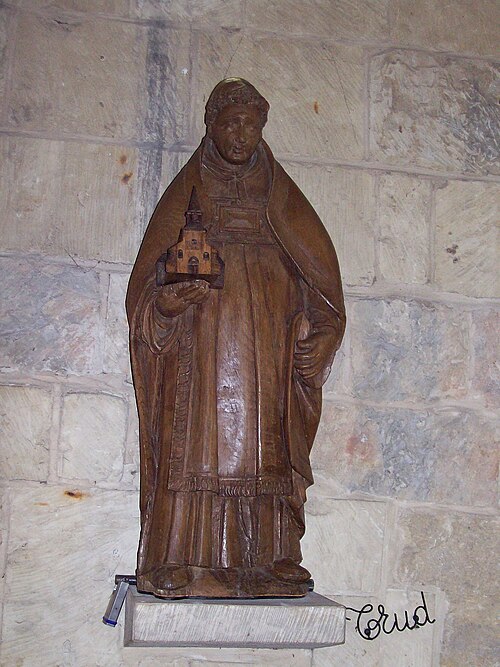
Saint
Trudo of Hesbaye
Apostle of Hesbaye
Called the Apostle of Hesbaye in present-day Belgium; died around 698, remembered on 23 November.
- Feast
- November 23old style December 6
- Reposed
- 6987th century
- Place
- Sint-Truiden
Life
Saint Trudo, also called Tron, Trudon or Truiden, was in the seventh century a priest and abbot, called the “Apostle of Hesbaye,” a region of present-day Belgium. He died in the year 693 or 698, and the Church remembers him on 23 November.
He was born in Hesbaye into a noble Frankish family, and his mother was of the royal house of Austrasia. It is told that as a child he built a miniature church out of thrown stones. As a young man he often went to church and gave generously to the poor. Tradition says that one night, after prayer, he had a vision of an angel who told him that he would have a priestly ministry. Devoted to the service of God from childhood, he went to Saint Remaclus, bishop of Liège, who sent him to Chlodulf, bishop of Metz. There he received his education at the church of Saint Stephen, for which he always kept a strong affection and to which he later gave his foundation. He was ordained priest by Chlodulf in 650 or 655.
Back in his native region he preached the Gospel to pagans and built, about 656, a church at Sarchinium on the river Cicindria. It was blessed by Theodard of Maastricht in honour of Saints Quintinus and Remigius. Disciples gathered around him, and from the house of prayer there a monastery grew in time, which became Sint-Truiden, and around it the town of the same name arose. He also founded, about 660, a convent for women at Odeghem near Bruges, which later also bore his name.
One account says that Trudo once stopped at the house of a married couple. In the night the wife woke and, as she was about to open the door, saw two shafts of light, one at the head of the sleeping priest, the other at his feet. Frightened, she woke her husband, who saw the lights too. Convinced that a holy man had come into their house, they asked him in the morning to stay a day. Trudo spent the day giving them spiritual counsel and, at the husband's request, baptized their son. He usually spent his nights praying in church. On his deathbed, having made the sign of the cross, he prayed to his last breath: “Direct, O Lord, the way of Thy servant before Thine eyes.”
After his death he was buried in the church he had built. His relics, together with those of Saint Eucherius, bishop of Orléans, who had died there in exile in 743, were translated in 880 by Franco, bishop of Liège. Because of the threat of the Normans they were hidden in an underground crypt. After the great fire of 1085 they were lost, but were found again in 1169, and on 11 August of that year Bishop Rudolph III made an official recognition and translation. Because of these translations the martyrologies also note 5 and 12 August and 1 and 2 September. His life was written by Donatus, a deacon of Metz, at the order of Bishop Angilram (769-791), and was reworked by Theodoric, abbot of Saint-Trond (died 1107).
Commemorated the same day November 23
 Alexander NevskyRight-Believing · Prince of Novgorod and VladimirNov 23
 ColumbanusVenerable · Irish missionary and monastery founderNov 23
 Amphilochius of IconiumSaint · Bishop of IconiumNov 23
 Dionysius I of ConstantinopleSaint · Patriarch of ConstantinopleNov 23
 Gregory of AgrigentoSaint · Bishop of AgrigentoNov 23
 Grigol PeradzeNew Martyr · Georgian archimandrite and theologianNov 23
 Metrophanes of VoronezhSaint · First Bishop of VoronezhNov 23
 Alexandra BryachislavnaRight-Believing · Wife of Alexander NevskyNov 23
 Philip RaspopovHieromartyr · PriestNov 23
 Seraphim ThievartVenerable Martyr · HieromonkNov 23
- Sisinius of CyzicusConfessorNov 23
- Adalbert of CasauriaVenerableNov 23