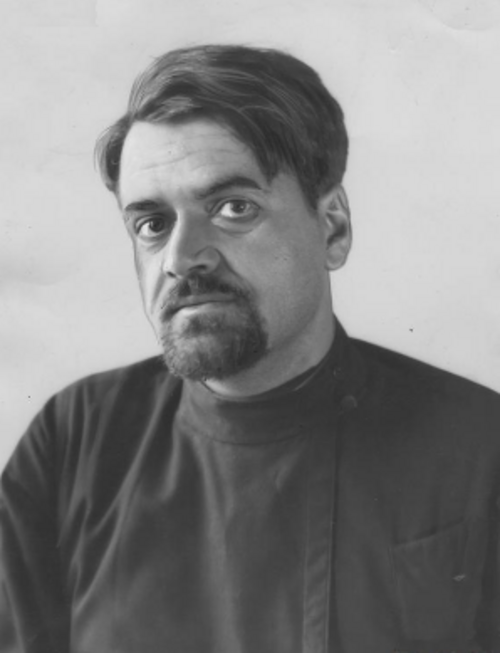
New Martyr
Grigol Peradze
Georgian archimandrite and theologian
Georgian theologian, philologist and patrologist who helped Jews in Poland, was arrested and died at Auschwitz in 1942.
- Feast
- November 23old style December 6
- Reposed
- 194220th century
- Place
- Auschwitz II-Birkenau concentration camp
- Order
- Martyrs
Life
Saint Grigol Peradze, Hieromartyr, a Georgian archimandrite, theologian and patrologist, suffered at Auschwitz on 6 December 1942. A prominent scholar of the Georgian Church, he helped Jews in occupied Poland, was arrested by the Gestapo and killed in the camp. He was canonized in 1995 by the Georgian Orthodox Church and is remembered on 6 December.
He was born in 1899 in the village of Bakurtsikhe in Kakheti, in eastern Georgia, the second son of the priest Romanoz Peradze and Mariam Samadalashvili, and was named after Saint Gregory of Khandzta. His father died when he was six, and the family moved to Tbilisi. He attended the parish school and, from 1913, the theological seminary in Tbilisi, which he finished in 1918 near the top of his class. He then began studies at the university of Tbilisi, but in 1919-1921 he served in the army and fought against the Bolsheviks in defence of the Democratic Republic of Georgia. When Georgia was occupied by Soviet Russia in February 1921, he was sent, by decision of the Church, to study in Germany, with the support of his mentor Cornelius Kekelidze, of Catholicos-Patriarch Ambrose and of some German scholars. He left in November 1921, but was never allowed to return to his homeland, neither in 1921 nor in 1927, and so remained stateless. He studied in Berlin and Bonn, and in 1927 took his doctorate with a thesis on the history of Georgian monasticism; he was then an associate professor at the university until 1932.
In 1927 he was one of the founders of the first Georgian parish abroad, the church of Saint Nino in Paris. Around Christmas 1930 he fell gravely ill and vowed that if he recovered he would devote his life to God. On 18 April 1931 he was tonsured a monk at the Greek cathedral of Holy Wisdom in London, the next day he was ordained deacon, and at the end of May, in Paris, priest. He was first the priest of the church of Saint Nino. In the same year he began to publish the Georgian scientific journal Jvari Vazisa. He lectured at Oxford, Dublin, Berlin, Paris and Kraków and represented the Georgian Church at many congresses. On 5 January 1934 he was raised to archimandrite. In the 1930s he discovered important Georgian manuscripts in Romania, Bulgaria, Greece, Italy, Germany and Austria, among them, at the Bachkovo monastery in Bulgaria, the Typikon of the Georgian monastery of Petritsoni.
In 1933 he moved to Warsaw, where he was, until 1942, professor of patrology at the Faculty of Orthodox Theology of the university and served in the cathedral of Saint Mary Magdalene. When Poland was invaded in 1939 he stayed in the capital. For him solidarity with Jews in peril went without saying, and the help he gave them and his part in the Warsaw resistance led to his arrest by the Gestapo in May 1942 and his being sent to Auschwitz. He was killed there on 6 December 1942. According to reports, he went willingly to his death in place of another prisoner, the father of a large family.
On 19 September 1995 the Council of Bishops of the Georgian Orthodox Church numbered him among the saints, and the canonization was recognized also by the Polish Orthodox Church. A chapel was built in his name in Warsaw. He is venerated in the Georgian and Polish Churches as a martyr.
Commemorated the same day November 23
 Alexander NevskyRight-Believing · Prince of Novgorod and VladimirNov 23
 ColumbanusVenerable · Irish missionary and monastery founderNov 23
 Amphilochius of IconiumSaint · Bishop of IconiumNov 23
 Dionysius I of ConstantinopleSaint · Patriarch of ConstantinopleNov 23
 Gregory of AgrigentoSaint · Bishop of AgrigentoNov 23
 Trudo of HesbayeSaint · Apostle of HesbayeNov 23
 Metrophanes of VoronezhSaint · First Bishop of VoronezhNov 23
 Alexandra BryachislavnaRight-Believing · Wife of Alexander NevskyNov 23
 Philip RaspopovHieromartyr · PriestNov 23
 Seraphim ThievartVenerable Martyr · HieromonkNov 23
- Sisinius of CyzicusConfessorNov 23
- Adalbert of CasauriaVenerableNov 23