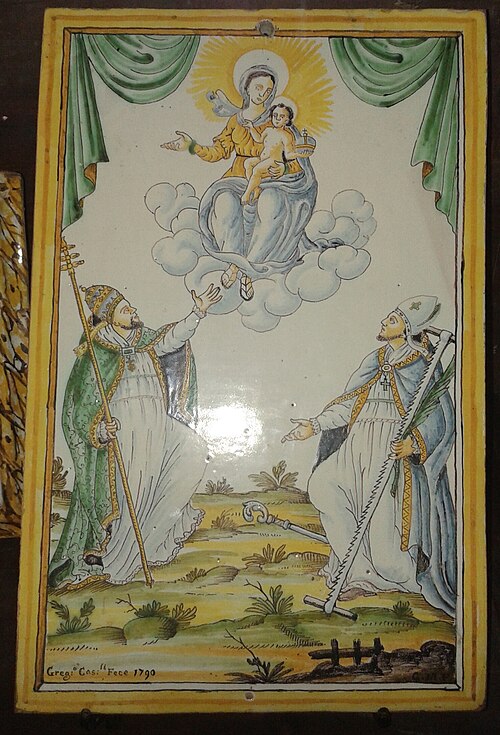
Saint
Crispoldus
Bishop of Bettona
Venerated as a martyr of the 1st century, patron of the city of Bettona in Umbria.
Life
Saint Crispoldus was, according to a tradition, bishop of the town of Bettona in Umbria, Italy, and a martyr of the first century; he is the patron of the town. He is commemorated on 12 May. Our sources call him a saint of the Roman Catholic Church and speak of a legendary Passion of the twelfth century; they show no formal Orthodox veneration.
The tradition
According to the legendary Passion of the twelfth century, Crispoldus was a native of Jerusalem and one of the seventy disciples of the Saviour; in the year 58 Saint Peter is said to have sent him to Italy to preach. He went to Umbria and worked miracles at Bettona. He was consecrated bishop of Bettona by Saint Brictius (Brizio), bishop of Massa Martana, also named bishop of Spoleto and of Foligno; according to Giuseppe Cappelletti, Brictius may have been a bishop over a wider region, not of one particular diocese, which explains the link with several towns. The Russian source says that after Brictius he also received the see of Foligno; the dioceses of Nocera Umbra and Foligno also have his name in their lists of bishops. His Germanic name makes the link with the apostles improbable and perhaps legendary.
He began to preach in his diocese, but was arrested by soldiers of the emperor Maximian (250 to 310), tried before the prefect Asterius and invited to sacrifice to the Roman gods. He refused and was killed after tortures. At the same time a man, Barontius (Baronzio), was beheaded for being a Christian. Crispoldus's sister Tutela, with twelve other women, tried to bury Crispoldus and Barontius but was caught. They too refused to sacrifice and were put to death. Their martyrdom is said to have been on 12 May.
Veneration
On the place of the martyrdom, in what is today Passaggio di Bettona, a church was built. Crispoldus is mentioned in a document of 1018 in the archives of Assisi cathedral. The church of San Crispolto was built in the eighth century, when the relics were moved within the walls of the town; there a silver-gilt reliquary bust is in the transept to the left of the main altar. It was first Benedictine, then given to the Franciscans, and was renovated in the eighteenth century. Other churches keep traditions about him: the church of Santa Maria Infraportas in Foligno says the place was consecrated by him in the year 58, and the abbey of San Crispolto at Passaggio keeps the tradition that he suffered there. In Bettona the church of Santa Maria Maggiore was built in the thirteenth century and consecrated in 1225 by Bishop Guido.
Commemorated the same day May 12
 Epiphanius of SalamisSaint · Archbishop of Salamis in CyprusMay 12
 Pancras of RomeMartyr · of RomeMay 12
 Germanus of ConstantinopleSaint · Patriarch of ConstantinopleMay 12
 Rictrude of MarchiennesVenerable · Abbess of Marchiennes AbbeyMay 12
 Simeon of VerkhoturyeRighteous · Patron of the UralsMay 12
 Dionysius of RadonezhVenerable · Archimandrite of the Trinity LavraMay 12
 Anthony MedvedevVenerable · Superior of the Lavra of Saint SergiusMay 12
- John the VlachNew MartyrMay 12
 Philip of AgiraHieromartyr · Priest of SicilyMay 12
- Theodore the AsceticVenerable · AsceticMay 12
 AchilleusSaintMay 12
- Aethelhard of CanterburySaint · Archbishop of CanterburyMay 12