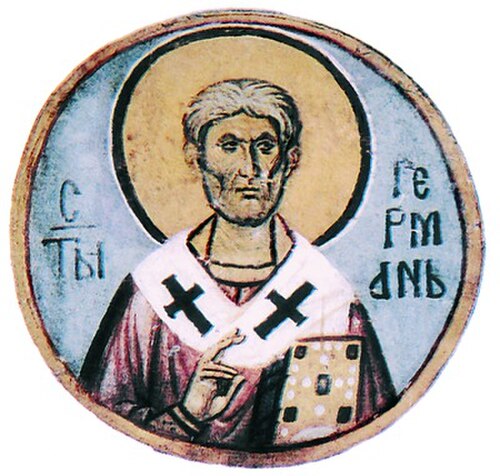
Saint
Germanus of Constantinople
Patriarch of Constantinople
Patriarch of Constantinople from 715 to 730, who defended the holy icons against iconoclasm.
Life
Saint Germanus I, hierarch, was patriarch of Constantinople from 715 to 730 and defender of the holy icons against iconoclasm. He is venerated by the Orthodox and Catholic Churches and commemorated on 12 May.
Youth and episcopate
He was born at Constantinople, around 634 (according to other sources, later), in a distinguished family, son of the patrician Justinian. According to Theophanes the Confessor, Justinian was killed in 668 for involvement in the death of the emperor Constans II and the usurpation of Mizizios. Emperor Constantine IV defeated his rival and punished his supporters; Germanus escaped death but was made a eunuch by the victors and sent into the clergy, so that he could not reach public office. He studied Scripture, was in a monastery and around 705 was ordained bishop of Cyzicus. Of the council of 712, held under the emperor Philippicus, which favoured Monothelitism and abolished the decisions of the sixth council, historians note that Germanus took part; as patriarch, however, he showed he was no Monothelite, convoking a council that confirmed the decisions of the Sixth Ecumenical Council and anathematized Cyrus and Sergius.
The patriarch
On 11 August 715 he was moved from Cyzicus to the see of Constantinople, with the agreement of the clergy, senate and people. He helped negotiate the withdrawal of Anastasius II before Theodosius III. He sought reconciliation with the Armenian Church, so sincerely that the Armenians also commemorate his name on the same day. In his time the iconoclast dispute broke out. He wrote to those who had started it, Bishops Constantine of Nacoleia, Theodosius of Ephesus and Thomas of Claudiopolis, three letters to persuade them, and in 724 or 725 he summoned Constantine to Constantinople to rebuke him for the destruction of icons. When Emperor Leo III the Isaurian began the iconoclast policy, the clash was unavoidable. Leo tried to avoid an ecumenical council that would condemn the iconoclasts and gathered a council (silentium) of officials. On 17 January 730 he summoned the patriarch and raised again the question of the veneration of icons. Germanus answered that he could change nothing in matters of faith without an ecumenical council: “If I am Jonah, throw me into the sea. Without an ecumenical council I cannot change the faith, my lord.” He laid down his omophorion. Earlier he had written to the pope of his resistance and had sent to Rome some holy treasures of Constantinople. Pope Gregory II praised his zeal and steadfastness.
In his place the patriarch Anastasius was set, who signed the edict against icons. Germanus withdrew to his family home or a monastery and died a few years later, in great old age, in 740. He was buried at the Chora monastery; later his relics were taken to France. The Second Council of Nicaea (787) placed him in the diptychs among the saints.
Writings
Several of his writings survive, among them an “Ecclesiastical History” (an explanation of the Divine Liturgy), read in Greek and Latin for centuries, and hymns, homilies and letters; doubt has been raised about the authorship of one of these works. Pope Pius XII placed a text of his in the constitution proclaiming the dogma of the Assumption of the Mother of God. The hymn “A great and mighty wonder” was translated by John Mason Neale.
Commemorated the same day May 12
 Epiphanius of SalamisSaint · Archbishop of Salamis in CyprusMay 12
 Pancras of RomeMartyr · of RomeMay 12
 Rictrude of MarchiennesVenerable · Abbess of Marchiennes AbbeyMay 12
 CrispoldusSaint · Bishop of BettonaMay 12
 Simeon of VerkhoturyeRighteous · Patron of the UralsMay 12
 Dionysius of RadonezhVenerable · Archimandrite of the Trinity LavraMay 12
 Anthony MedvedevVenerable · Superior of the Lavra of Saint SergiusMay 12
- John the VlachNew MartyrMay 12
 Philip of AgiraHieromartyr · Priest of SicilyMay 12
- Theodore the AsceticVenerable · AsceticMay 12
 AchilleusSaintMay 12
- Aethelhard of CanterburySaint · Archbishop of CanterburyMay 12