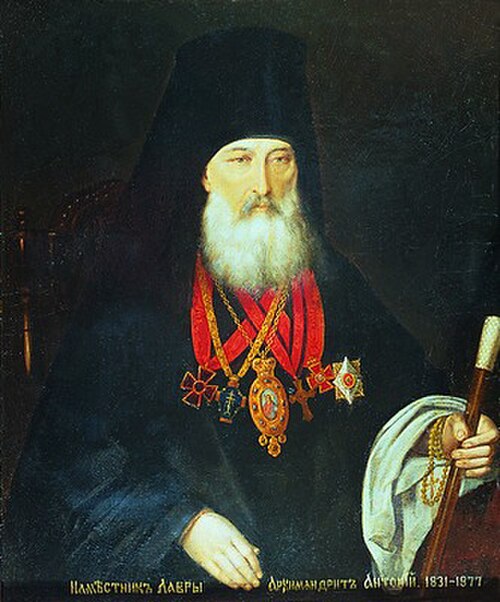
Venerable
Anthony Medvedev
Superior of the Lavra of Saint Sergius
Archimandrite and superior of the Trinity Lavra, born in 1792 and died in 1877; a local saint.
- Feast
- May 12old style May 25
- Reposed
- 187719th century
- Place
- Sergiyev Posad
- Order
- Venerables
Life
Saint Anthony Medvedev (born Andrei Gavrilovich Medvedev, 1792 to 1877) was an archimandrite and for forty-six years the superior (namestnik) of the Holy Trinity Lavra of Saint Sergius, a spiritual son and support of Metropolitan Philaret of Moscow. He is venerated as a local saint: he was glorified on 16 October 1998 with the blessing of Patriarch Alexy II. According to the sources we have, this is not a canonization for the whole Church.
Youth
He was born on 6 October 1792 in the village of Lyskovo in the Makaryev district of the Nizhny Novgorod province, in a family of freed peasants, his father being a cook to Prince Gruzinsky. There were four children. His father died when he was four. He learned to read at home, was apprenticed to the pharmacist of the Lyskovo hospital, and later the prince entrusted him with the running of the hospital. In 1812 he received official permission to practise medicine. His soul, however, was not in this craft. Conversations with monks decisively changed the course of his life, and a great influence on him was Olympias Strigaleva, abbess of the Alexeyevsky community of nuns at Arzamas.
In 1817 he set out for Sarov, where he was received as a novice only on his second coming, on 27 July 1818. After a year and a half he moved to the Ascension Hermitage at Vysokogorsk, where he was first sacristan. On 27 June 1822 he was tonsured a monk with the name Anthony, after Saint Anthony of the Kyiv Caves, on 20 July he was ordained hierodeacon and on 22 July hieromonk. In 1824 he made a pilgrimage to Kyiv, a journey that, through meetings with people experienced in the spiritual life and acquaintance with the customs of other monasteries, broadened his outlook. On 9 July 1826 he was appointed superior of the Vysokogorsk hermitage, which flourished under him: the churches were renewed, the services were ordered with dignity, new cell buildings were raised, and the brotherhood grew from twenty to ninety monks. Anthony went several times to Sarov to speak with the elders, among them Saint Seraphim.
Superior of the Lavra
In 1831 Metropolitan Philaret of Moscow chose him as superior of the Holy Trinity Lavra of Saint Sergius. On 15 March he was raised to archimandrite, and on 19 March he arrived at the Lavra. He remained in this office for forty-six years and fully justified the hierarch's trust, becoming his spiritual son, friend and collaborator. Within three years the former Lavra could not be recognized. All the skete foundations around the Lavra, Gethsemane, the Caves, the Paraclete and Bogolyubivaya, owe their existence to him. The churches of the Lavra were adorned inside and out, the services were ordered, and many pilgrims came. The Trinity Cathedral and the churches of Saint Nikon, the Holy Spirit and Smolensk were changed from cold churches to heated ones.
In 1832 he organized a hospital for men pilgrims in the brothers' cells, and outside the walls a hospital and almshouse for women. In 1838, on the site of a burnt guesthouse, he built a house of mercy with an almshouse, a hospital and a church. In 1840, in the Corner Tower, he opened a school and shelter for a hundred orphans, fed and taught at the monastery's expense, while another hundred came to learn and to eat. Pilgrims were fed. An icon-painting workshop, a school of icon painting (1839) and a lithographic workshop (1844) were established. The Lavra fed the poor, gave out flour and bread in years of poor harvest and sheltered migrants, and the town prison received a church and better rooms.
Anthony watched over the life of the monks, honoured and encouraged the ascetic elders of the Lavra, and helped the monks of Optina to publish books. From his work together with Metropolitan Philaret there appeared in 1841 the first Life of Saint Seraphim of Sarov. He received state orders: Saint Anna second class (1836), Saint Vladimir third class (1849) and second class (1863). For twenty-five years of service at the Lavra the Holy Synod gave him the right to wear the panagia (1856), and in 1859 he was raised to archimandrite of the first class. From 1852 he was a corresponding member of the Imperial Russian Archaeological Society. For more than thirty-five years he corresponded with Metropolitan Philaret (Drozdov).
Last years and veneration
Longing for quiet, he asked as early as 1840 to be allowed to retire, but this was not granted; in 1843 he built himself a house at the Makhrishchi monastery. In 1872 he asked Metropolitan Innocent (Veniaminov) to be relieved of his post because of old age, but again the request was refused. In 1873 he suffered a mild stroke, after which he grew very weak and remained bedridden. He reposed in 1877.
At the Lavra he was remembered diligently at all the litanies for the departed. On 16 October 1998 he was glorified as a locally venerated saint, with the blessing of Patriarch Alexy II, who himself led the service. By then his remains had been found and placed in the Cathedral of the Holy Spirit. He is commemorated on 12 May (Old Style). He left spiritual letters to a spiritual daughter, a word of counsel to novices, and monastic letters.
Commemorated the same day May 12
 Epiphanius of SalamisSaint · Archbishop of Salamis in CyprusMay 12
 Pancras of RomeMartyr · of RomeMay 12
 Germanus of ConstantinopleSaint · Patriarch of ConstantinopleMay 12
 Rictrude of MarchiennesVenerable · Abbess of Marchiennes AbbeyMay 12
 CrispoldusSaint · Bishop of BettonaMay 12
 Simeon of VerkhoturyeRighteous · Patron of the UralsMay 12
 Dionysius of RadonezhVenerable · Archimandrite of the Trinity LavraMay 12
- John the VlachNew MartyrMay 12
 Philip of AgiraHieromartyr · Priest of SicilyMay 12
- Theodore the AsceticVenerable · AsceticMay 12
 AchilleusSaintMay 12
- Aethelhard of CanterburySaint · Archbishop of CanterburyMay 12