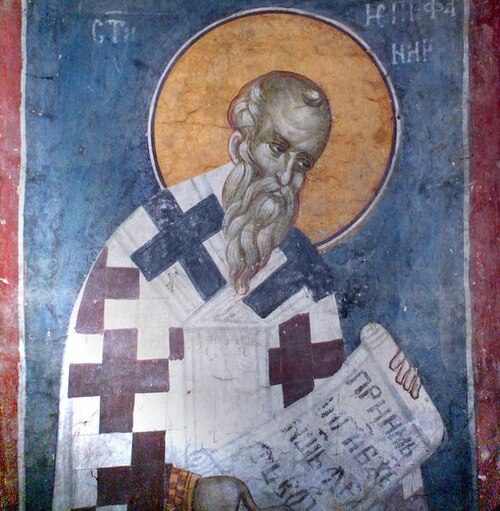
Saint
Epiphanius of Salamis
Archbishop of Salamis in Cyprus
Bishop of Salamis in Cyprus at the end of the fourth century, Church Father and defender of the faith.
Life
Saint Epiphanius, hierarch, was bishop of Salamis in Cyprus for nearly forty years, until his repose in 403, a bishop filled with zeal for the right faith, a Father of the Church and, together with the Apostle Barnabas, a protector of the island. He is known above all for the Panarion, in which he set out eighty heresies. The Orthodox Church commemorates him on 12 May.
Origins and baptism
Epiphanius was born about 315 (by other accounts 308), in the village of Besanduk, near Eleutheropolis, in Palestine. The sources differ on his origin: the tradition of the synaxarion calls him a Phoenician, born of simple parents, a farmer and a linen weaver, while other sources count him a Jew. He had a sister, Kallitropi. Orphaned of his father, he was taken in by a teacher of the Law, Tryphon, who helped him to study. He learned the Scriptures and five languages, Greek, Latin, Hebrew, Syriac and Coptic, and Blessed Jerome therefore called him Pentaglossos, the five tongued.
At the death of his foster father he inherited all his property. One day he saw a Christian monk, Lucian, who, having no money, gave a poor man the coat he was wearing. The gesture moved him. He asked to be taught the Christian faith and received Baptism, together with his sister. He gave up his property, became a monk and a disciple of Saint Hilarion the Great, whose memory is kept on 21 October.
Monk and founder
Eager to know the monastic life, he spent four years in the desert of Egypt among the monks there. Through his labours he received the gift of working miracles. To flee from human glory he withdrew to the desert of Spanidrion, where robbers held him for three months. Through his word of repentance one of them came to believe in God, was baptized with the name John, and remained his disciple and biographer.
Returning to Palestine, about 333, he founded a monastery at Ad, near Eleutheropolis and close to his native village, where he was abbot for about thirty years. He was ordained priest. The monastery is often mentioned in the quarrels of Blessed Jerome with Rufinus and with John, bishop of Jerusalem.
Bishop of Salamis
The people of Lycia sent to ask him to be their bishop, but Epiphanius, learning of it, fled secretly to Hilarion, in the desert. After two months of prayer together, Hilarion sent him to Salamis, then called Constantia. There the assembled bishops were seeking a shepherd to replace the one who had fallen asleep, and to the eldest of them, Bishop Papius, it was revealed that Epiphanius should be chosen. They consecrated him in 367 (by other sources 365). He was also metropolitan of the Church of Cyprus.
As bishop he was known for his zeal for the faith, his love for the poor and his simplicity of character. He suffered much from clergy who slandered him. It is told that, through the purity of his life, he saw at the Divine Liturgy the coming of the Holy Spirit upon the Gifts. Once, when he did not see it, he suspected that the cause was the state of one of those in the sanctuary and quietly said to him: Depart, my son, you are unworthy to serve today.
He travelled widely to combat error. He was at the synod of Antioch in 376, where teaching on the Trinity was debated against Apollinarianism, and in 382 he went to Rome, to a council, supporting Paulinus of Antioch.
Writings
His best known work is the Panarion, written between 374 and 377, a book of remedies for those bitten by the serpent of heresy. It lists eighty heresies, from the pre-Christian ones, among them the philosophical schools and the Jewish sects, to the Christian ones of the fourth century. Epiphanius compares his adversaries to poisonous beasts. At times his zeal ran ahead of the facts, and he himself admits writing against the Origenists only from hearsay. The work nevertheless preserves fragments of lost writings. There is also the Ancoratus, one of his earliest works, with the teaching on the Holy Trinity and the Resurrection, and the treatise on weights and measures, written for a Persian priest in 392.
Against Origenism
In 393 or 394, preaching in Jerusalem, he attacked the followers of Origen and urged Bishop John of Jerusalem to condemn his writings. In the letter to John, preserved in the translation of Blessed Jerome, Epiphanius tells how, entering a church in the village of Anablatha, he saw a curtain bearing the image of Christ or of a saint, which he tore down, judging that such a thing was against the Scriptures. Scholars today accept the letter as authentic. Epiphanius also ordained a priest for the monastery of Jerome at Bethlehem, which put him in conflict with Bishop John of Jerusalem. Other writings were put under his name, against icons, and were used by the iconoclasts, but scholars doubt their authenticity. The Seventh Ecumenical Council, which confirmed the veneration of the holy icons, named Epiphanius a Father and Teacher of the Church.
To Constantinople and repose
In 402, through the intrigues of the Empress Eudoxia and of Patriarch Theophilus of Alexandria, the aged Epiphanius, nearly eighty, was summoned to Constantinople, to the Synod of the Oak, to judge Saint John Chrysostom. When he understood that he was being used against him, he would not take part in an unlawful synod and embarked again for Cyprus. On the ship he felt his end approaching, left his disciples the charge to keep the commandments of God and to guard the mind from impure thoughts, and fell asleep two days later, in May 403.
The people of Salamis went out to meet his body with carriages and candles. Brought to the cathedral, he was honoured for seven days by a large part of the population of Cyprus, and on 12 May 403 he was buried in a new church which he himself had built.
Veneration
His tomb has remained one of the most important places of pilgrimage in Cyprus. The Church regards him as a standard of the faith, but does not hide that at times he was harsh and hasty in judgment. Saint Epiphanius is honoured as a saint and Father of the Church by the Orthodox Church, by the Roman Catholic Church and by other communities.
Commemorated the same day May 12
 Pancras of RomeMartyr · of RomeMay 12
 Germanus of ConstantinopleSaint · Patriarch of ConstantinopleMay 12
 Rictrude of MarchiennesVenerable · Abbess of Marchiennes AbbeyMay 12
 CrispoldusSaint · Bishop of BettonaMay 12
 Simeon of VerkhoturyeRighteous · Patron of the UralsMay 12
 Dionysius of RadonezhVenerable · Archimandrite of the Trinity LavraMay 12
 Anthony MedvedevVenerable · Superior of the Lavra of Saint SergiusMay 12
- John the VlachNew MartyrMay 12
 Philip of AgiraHieromartyr · Priest of SicilyMay 12
- Theodore the AsceticVenerable · AsceticMay 12
 AchilleusSaintMay 12
- Aethelhard of CanterburySaint · Archbishop of CanterburyMay 12