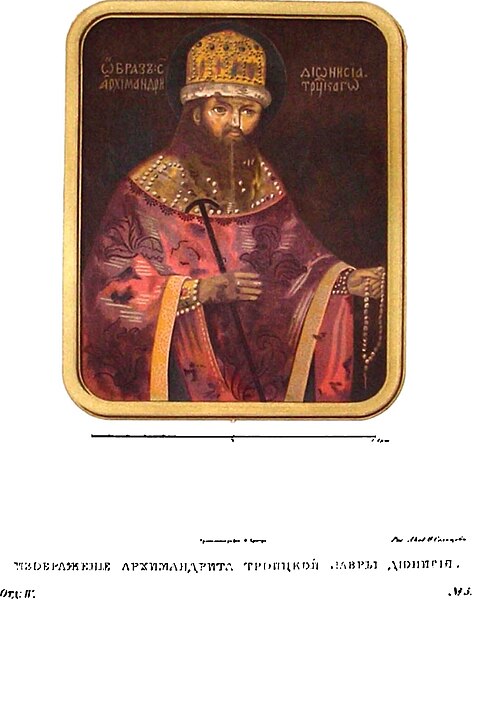
Venerable
Dionysius of Radonezh
Archimandrite of the Trinity Lavra
Archimandrite of the Trinity Lavra of Saint Sergius, born at Rzhev, who died about 1633.
- Feast
- May 12old style May 25
- Reposed
- 163317th century
- Place
- Rzhev
- Order
- Venerables
Life
Saint Dionysius of Radonezh (in the world David Fyodorovich Zobninovsky) was archimandrite of the Trinity Lavra of Saint Sergius during the hard years of the Time of Troubles at the beginning of the seventeenth century. He cared for the wounded and the starving, called the people to the defence of their country, blessed the army that liberated Moscow and corrected the service books, for which he was unjustly condemned and then fully vindicated. He reposed in 1633, and his relics rest in the Trinity Lavra.
Childhood and parish priesthood
He was born around 1570 in Rzhev into a townsman's family and was baptised David, in honour of Saint David of Thessalonica. When he was five or six his parents moved to Staritsa, where his father became headman of the Yamskaya quarter. The boy was entrusted for his education to two local priests, Gury Rzhevitin and German Tulupov.
When he came of age, at his parents' insistence, he married a woman named Vassa, who bore him two sons, Basil and Cosmas. He was ordained priest for the church of the Theophany on one of the estates of the Dormition Monastery in Staritsa.
Monk and archimandrite in Staritsa
Around 1601-1602 his wife and both his sons died. Left alone, he was tonsured a monk with the name Dionysius in the same Dormition Monastery of Staritsa, where he soon became treasurer and, in mid-1605 or in August 1607, archimandrite.
During his time as abbot Patriarch Job, deposed by the pretender False Dmitry, was brought to the monastery. Contrary to the pretender's orders, Dionysius received the aged patriarch with great warmth, and when Job died in June 1607 the archimandrite placed a stone monument over his grave.
Abbot of the Lavra in the Time of Troubles
In February 1610 Dionysius was appointed archimandrite of the Trinity Monastery, newly delivered from the Polish-Lithuanian siege, which had been lifted by the forces of Mikhail Skopin-Shuisky and Jacob De la Gardie. Immediately after his appointment he set about opening infirmaries and houses of refuge for strangers and wanderers, where the wounded, the sick and the starving from the ravaged land were received.
Together with the cellarer Abraham Palitsyn he wrote and sent letters to the troubled towns, calling them to unite against the enemy and to support the people's army as best they could. Copies of three such letters survive, from June 1611, October 1611 and April 1612.
On 14 August 1612 the archimandrite received in the monastery the second people's army on its way to Moscow and blessed the warriors to liberate the capital, telling them that God and the great wonderworker Sergius were with them, to stand and suffer for the true Orthodox faith. The author of the New Chronicle notes that his words greatly raised the soldiers' spirits.
At about the same time an unsigned letter appeared, addressed to the commanders Prince Dmitry Trubetskoy and Prince Dmitry Pozharsky, which scholars attribute to Dionysius. The author urged them to unite their forces and spoke of the commandment of love for a Christian and of how true leaders of the people should act if they did not wish to destroy their country and bring down the wrath of God.
In November 1612, at the liberation of Moscow, Dionysius served a moleben at the Lobnoye Mesto on Red Square before the united armies that had entered the capital. On 26 April 1613 he received in the Lavra the young Tsar Michael Fyodorovich on his way to Moscow, and on 11 July 1613 he took part in his coronation.
Correcting the books
On 8 November 1616 Tsar Michael ordered him by charter to correct the Book of Needs (Trebnik), with the help of elders skilled in letters, grammar and rhetoric, since it was to be printed again. With the elders Arseny Glukhoy and Anthony Krylov and the priest John Nasedka, the archimandrite corrected the text and considerably enlarged it compared with the edition of 1602. The learned monks also corrected other service books: the Pentecostarion, the Octoechos and the General Menaion.
The work was finished in May 1618, and Dionysius himself took it to the officials and to the patriarchal locum tenens, Metropolitan Jonah. The texts were examined by a council that opened on 4 July 1618. That same day several monks of the Lavra rose against the archimandrite, the typikarios Philaret, the precentor Longin and the sacristan Markell (Kolchin), joined by the elder Dorotheus of the Novospassky Monastery and Archimandrite Abraham of the Chudov Monastery. They accused him of scraping, cutting and writing in the books as he pleased.
Condemnation and patience
After long and heated disputes, on 18 July 1618 the council condemned the correctors, claiming that they had erased the name of the Holy Trinity from the books and did not confess that the Holy Spirit is fire. The first charge concerned their correction of the closing doxologies of prayers, where they had removed the mention of the other Persons of the Trinity from prayers addressed to the Father alone or to the Son alone. The second concerned the prayer for the blessing of water on the eve of Theophany, from which they had removed the words “and with fire”, which they had rightly judged to be a later addition, not finding them in the oldest texts.
Dionysius and John Nasedka were forbidden to serve, and the elders Arseny and Anthony were barred from communion. For four days the archimandrite was brought to the patriarchal court and to the residence of Metropolitan Jonah, where he was beaten and ordered to pay a fine of five hundred roubles. Paying would have ended the case but would have meant admitting guilt, so Dionysius refused. He was placed under guard and then sent “for humbling” to the Novospassky Monastery, where he bore everything with patience.
Vindication
In April 1619 Patriarch Theophanes III of Jerusalem arrived in Moscow, and in June Philaret Nikitich, the tsar's father, returned from Polish captivity. A week after Philaret's enthronement as patriarch a council was convened which re-examined the case of Archimandrite Dionysius and fully acquitted him and his companions. Arseny Glukhoy and Anthony Krylov became correctors at the Moscow Printing House, John Nasedka a priest of the Annunciation Cathedral, and Dionysius returned to the Lavra.
Patriarch Philaret accepted nearly all the corrections to the doxologies, as well as the removal of the words “and with fire”. He charged Abbot Jonah of the Antoniev-Siysky Monastery to make this correction by his own hand in all the books he could reach and to ensure that priests blessed the water on the eve of Theophany without the addition. The ethnographer S. V. Maksimov believed that the memory of this trial survived in the Russian proverb “the fire burns the priest”, about misfortune that no one escapes.
Builder and scholar
In the early 1620s the archimandrite was the moving spirit behind much building, raising new churches and restoring those that had been ruined. In 1621 a stone church of Saint Michael Maleinos, patron of Tsar Michael, was built beside the refectory of the Lavra. In 1622 the church over the tomb of Saint Nikon of Radonezh was taken down and rebuilt, and consecrated on 21 September 1624. He gave churches books, censers, crosses, sacred vessels and vestments, many bought with his own money, and kept many more in reserve for their needs. Some years earlier he had consecrated at Deulino the church of the Saviour Not Made by Hands, built by the tsar's order in memory of the truce concluded there between Russia and Poland.
Another great undertaking was linked with his former teacher, German Tulupov, who became a monk in the Lavra. At the archimandrite's request he compiled a Menaion of readings (1627-1632), a collection of lives of Russian saints (1633) and a collection with the lives and services of Saints Sergius and Nikon of Radonezh (around 1630), which bears corrections in Dionysius's own hand.
Repose and veneration
Archimandrite Dionysius reposed at the beginning of May 1633. At Patriarch Philaret's order his body was brought to Moscow, to the church of the Theophany, where his funeral was held. He was then buried in the Trinity Lavra beside the south-west porch of the Trinity Cathedral. Today his relics rest in the chapel known as Serapion's, in the same cathedral.
He is commemorated on 12 May and in the Synaxes of the Saints of Tver (established in 1979), of Radonezh (1981) and of Moscow (2001). His deeds were painted by M. I. Scotti (1851) and by Viktor Vasnetsov, who showed him dictating, with Abraham Palitsyn, the letter calling the people's army together. In 1913 Vasnetsov worked on a design for a monument to Patriarch Hermogenes and Archimandrite Dionysius on Red Square, which was never built.
A church in the Monastery of Saint Nicholas in Gomel, Belarus, bears his name; altars dedicated to him once existed in Rzhev, Glebovo and Desyatiny, and in 1871 a charitable brotherhood named after him and Saint Arsenius of Novgorod was founded in Rzhev.
Commemorated the same day May 12
 Epiphanius of SalamisSaint · Archbishop of Salamis in CyprusMay 12
 Pancras of RomeMartyr · of RomeMay 12
 Germanus of ConstantinopleSaint · Patriarch of ConstantinopleMay 12
 Rictrude of MarchiennesVenerable · Abbess of Marchiennes AbbeyMay 12
 CrispoldusSaint · Bishop of BettonaMay 12
 Simeon of VerkhoturyeRighteous · Patron of the UralsMay 12
 Anthony MedvedevVenerable · Superior of the Lavra of Saint SergiusMay 12
- John the VlachNew MartyrMay 12
 Philip of AgiraHieromartyr · Priest of SicilyMay 12
- Theodore the AsceticVenerable · AsceticMay 12
 AchilleusSaintMay 12
- Aethelhard of CanterburySaint · Archbishop of CanterburyMay 12