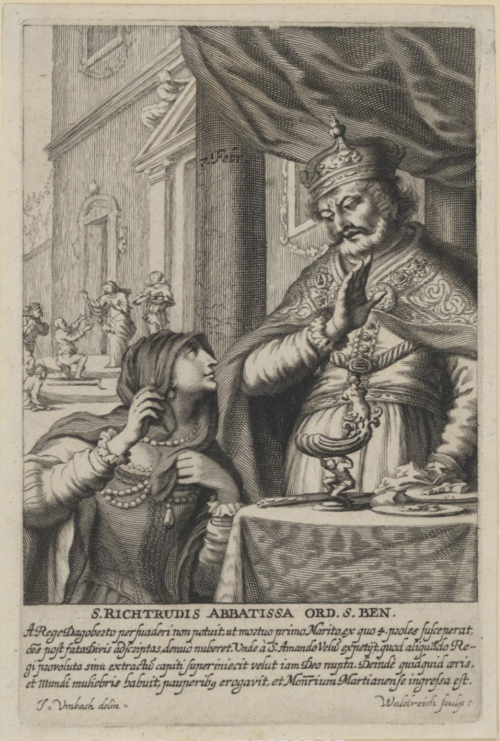
Venerable
Rictrude of Marchiennes
Abbess of Marchiennes Abbey
Abbess of Marchiennes in Flanders in the seventh century; her life was written by Hucbald in 907.
- Feast
- May 12old style May 25
- Reposed
- 6877th century
- Place
- Marchiennes
- Order
- Venerables
Life
Saint Rictrude was a saint and abbess of Marchiennes Abbey in Flanders in the seventh century. The main source for her life is a Life written in 907 by Hucbald, commissioned by the abbey. She married Saint Adalbald, despite her family's opposition, and they had four children, all later named saints. She died at Marchiennes at seventy-four, between 676 and 691. She is commemorated on 12 May, and in other places on 7 February, 29 May, 2 August and 29 October.
She was born around 612 or 614 in Gascony, during a series of Basque raids and in the reign of Clothar II, to a noble and devout family, probably of the Gascon nobility. Her father was Ernold, her mother Lichia. From youth her spiritual guide was Saint Amandus, bishop and missionary, exiled to Gascony by Dagobert I. Her Life says that a Frank, Adalbald, of just and noble stock, saw her, loved her and chose her, despite the "violent opposition" of her parents. They married during a military expedition in Gascony. He was a nobleman, a man of faith, loved at the court of Dagobert I and Clovis II. They lived at Marchiennes, where he owned land. Their four children were Maurontus of Douai, who was a court official, then priest and abbot, and three daughters, Clotsendis, who succeeded her mother as abbess, Eusebia of Hamage, abbess there, and Adalsindis of Hamage, a nun. According to the Life the children were baptized by notable people: Maurontus by the hermit Richarius, Clotsendis by Saint Amandus, and Eusebia had Nanthild, wife of Dagobert, for godmother. Adalsindis died young. The Life speaks of a "devout and joyful life" of the spouses.
Soon after the birth of the youngest child Adalbald was killed on the road from Marquette-en-Ostrevant to Gascony, perhaps by his own father-in-law, offended that his daughter married an enemy of his people. Rictrude mourned him. Saint Amandus, her guide, advised her to found an abbey at Marchiennes and, when Maurontus came of age, to enter it. She governed it forty years. The king, probably Dagobert I, wished to marry her to one of his officials, first with gifts and flattery, then with threats. She pretended to agree but remained steadfast in her resolve to serve God, and Amandus promised to obtain the king's consent. At a banquet with the king and court in her villa at Boiry she stood up and, instead of a toast, covered her head with the veil blessed by Amandus, showing her wish for the monastic life. The king left in anger, but Amandus mediated a reconciliation, and Clovis II allowed her to enter Marchiennes Abbey, a double monastery. Scholars see in this an example of noble women embracing the monastic life so that wealth and power remained outside lay politics. On her gravestone was written: "Field of virtue, image of piety." Portions of her relics are kept at Douai.
Commemorated the same day May 12
 Epiphanius of SalamisSaint · Archbishop of Salamis in CyprusMay 12
 Pancras of RomeMartyr · of RomeMay 12
 Germanus of ConstantinopleSaint · Patriarch of ConstantinopleMay 12
 CrispoldusSaint · Bishop of BettonaMay 12
 Simeon of VerkhoturyeRighteous · Patron of the UralsMay 12
 Dionysius of RadonezhVenerable · Archimandrite of the Trinity LavraMay 12
 Anthony MedvedevVenerable · Superior of the Lavra of Saint SergiusMay 12
- John the VlachNew MartyrMay 12
 Philip of AgiraHieromartyr · Priest of SicilyMay 12
- Theodore the AsceticVenerable · AsceticMay 12
 AchilleusSaintMay 12
- Aethelhard of CanterburySaint · Archbishop of CanterburyMay 12