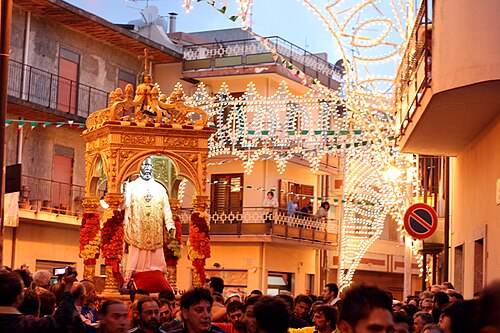
Hieromartyr
Philip of Agira
Priest of Sicily
A priest of Agira in Sicily, venerated as a confessor of Christ and a healer of the possessed.
Life
Saint Philip of Agira, called the "Apostle of Sicily", was a priest and the first Christian missionary of Sicily, honoured above all for casting out unclean spirits. He is remembered on 12 May. Our sources do not agree on his age: according to one tradition, ascribed to writings put under the name of Athanasius of Alexandria, he was born in Cappadocia around the year 40 and died in the first century, in the year 103; according to a second source, attributed to a certain Eusebius, he was born in Thrace in the time of the emperor Arcadius, towards the end of the fourth century. Nothing else can be said of him with certainty.
Birth and training
His life story says he was born in Thrace to elderly parents who had lost all their children: the waters of the river Sagari had taken them on the day of the Exaltation of the Holy Cross. Grieving, the parents prayed earnestly for a child, and the mother was shown in a dream that she would bear a son, who should be called Philip. After nine months an infant was born, to their joy.
Philip spent his youth studying the Gospel and at twenty-one was ordained deacon. He then set out for Rome, to see the city and its bishop, of whom he had heard much from his parents, especially his mother. On the way the ship was caught in a storm, and everyone asked Philip to pray to the Lord. According to the story, the ship reached Rome unharmed through his prayers and the appearance of the Apostle Peter as helmsman. In Rome he met the monk Eusebius, who knew Latin, a language unknown to Philip. Eusebius remained his companion for life.
Sent to Sicily
The pope, informed by revelation of his coming, called him and had him serve the Liturgy as deacon. After the laying on of hands and a blessing, Philip pronounced the liturgical texts in Latin. When he wished to speak Latin outside the services as well, the pope prayed once more for him, and the saint spoke it fluently. The pope then ordained him priest and sent him to the district of Agira in Sicily, to preach the Gospel and drive out the demons of Etna. He gave him a written charge to struggle against the demonic powers.
With Eusebius he sailed to Messina. Philip climbed a mountain from which the summit of Etna could be seen and, calling on the name of Christ and asking the help of Saint Peter, drove the demons out of that place, and they left with loud lamentation. Later, by laying on of hands, he drove evil spirits out of more than four hundred possessed. He built many churches on the island and opposed the superstitious custom of bringing gifts to graves for the repose of the dead.
His repose and veneration
He died in peace, at the age of sixty-three. Over his tomb the monastery of Saint Philip of Agira was built, and it became one of the best-known centres of Byzantine monasticism in Sicily. His title varies: he is sometimes called venerable, sometimes hieromartyr, though nothing is known of his monastic life, and several texts say plainly that he died in peace. He is honoured especially in Sicily and Malta, by the Orthodox and the Catholic Churches, on 12 May.
Commemorated the same day May 12
 Epiphanius of SalamisSaint · Archbishop of Salamis in CyprusMay 12
 Pancras of RomeMartyr · of RomeMay 12
 Germanus of ConstantinopleSaint · Patriarch of ConstantinopleMay 12
 Rictrude of MarchiennesVenerable · Abbess of Marchiennes AbbeyMay 12
 CrispoldusSaint · Bishop of BettonaMay 12
 Simeon of VerkhoturyeRighteous · Patron of the UralsMay 12
 Dionysius of RadonezhVenerable · Archimandrite of the Trinity LavraMay 12
 Anthony MedvedevVenerable · Superior of the Lavra of Saint SergiusMay 12
- John the VlachNew MartyrMay 12
- Theodore the AsceticVenerable · AsceticMay 12
 AchilleusSaintMay 12
- Aethelhard of CanterburySaint · Archbishop of CanterburyMay 12