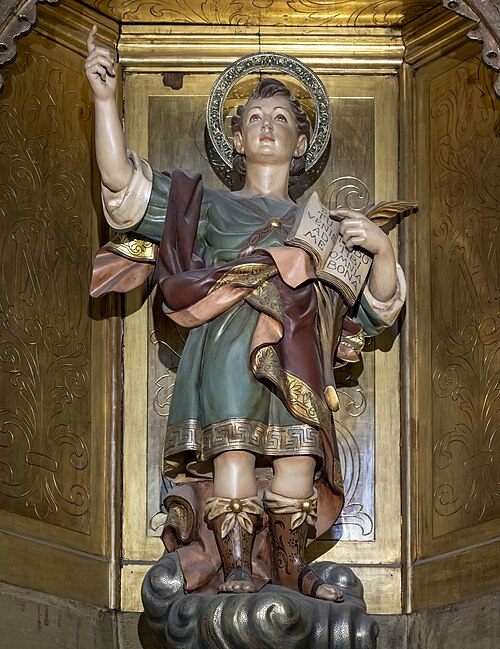
Martyr
Pancras of Rome
of Rome
Young Roman convert to Christianity, beheaded for his faith at the age of fourteen around 304.
Life
Saint Pancras of Rome, the martyr, was a young man from Phrygia who came to Rome, received holy Baptism and was beheaded for his faith in Christ at fourteen, in the persecution of Diocletian, around 304. His name is Greek and means "all-powerful." He is a saint of the undivided Church, honoured above all in the West, and he is remembered on 12 May.
His life, according to tradition
The account of his life, which has the character of legend, says that he was born around 289 near Synnada in Phrygia, to parents of Roman citizenship. His mother died at his birth, and his father died soon after. The child was entrusted to his uncle Dionysius, and both moved to Rome, to a villa on the Caelian Hill. There they heard the preaching of a bishop, named Marcellinus in some versions and Cornelius in others, and were baptized. Pancras remained a zealous believer, and after his uncle's death he was left alone.
Martyrdom
In the persecution of Diocletian, around 303 to 304, Pancras was brought before the authorities and asked to offer sacrifice to the gods. Tradition says that the emperor, impressed by his youth, promised him wealth and power, but the boy refused. He was condemned to be beheaded on the Via Aurelia, outside the city walls, on 12 May. A pious woman, Octavilla, recovered the body, anointed it with spices and laid it in a tomb in the catacombs beside the road. The account does not fully agree with history: it mentions Pope Cornelius, who died in 253, and Diocletian was not at Rome between 286 and 303.
Veneration
His veneration at Rome is attested from the fifth century. Pope Symmachus (498-514) built a church over his tomb on the Via Aurelia, and the Aurelian gate is today called Porta San Pancrazio. Saint Gregory the Great gave the cult new life: he had a silver reliquary made for the martyr's head, and he sent relics to England with the mission of Augustine of Canterbury. For this reason many English churches bear his name, among them St Pancras Old Church in London, one of the oldest places of Christian worship in England, as well as the London district and station of St Pancras. The reliquary with his head is kept in the basilica of Saint Pancras in Rome.
In medieval art he is shown as a young soldier. He is regarded as a patron of children and is invoked against headaches, cramps and false witness. The Church remembers him on 12 May.
Commemorated the same day May 12
 Epiphanius of SalamisSaint · Archbishop of Salamis in CyprusMay 12
 Germanus of ConstantinopleSaint · Patriarch of ConstantinopleMay 12
 Rictrude of MarchiennesVenerable · Abbess of Marchiennes AbbeyMay 12
 CrispoldusSaint · Bishop of BettonaMay 12
 Simeon of VerkhoturyeRighteous · Patron of the UralsMay 12
 Dionysius of RadonezhVenerable · Archimandrite of the Trinity LavraMay 12
 Anthony MedvedevVenerable · Superior of the Lavra of Saint SergiusMay 12
- John the VlachNew MartyrMay 12
 Philip of AgiraHieromartyr · Priest of SicilyMay 12
- Theodore the AsceticVenerable · AsceticMay 12
 AchilleusSaintMay 12
- Aethelhard of CanterburySaint · Archbishop of CanterburyMay 12