
Hieromartyr
Damian Voskresensky
Archbishop of Kursk and Oboyan
Archbishop of Kursk and Oboyan, born into a priest's family, shot at Sandarmokh in 1937; canonized in 2000.
- Feast
- October 21old style November 3
- Reposed
- 193720th century
- Place
- Saint Petersburg
- Order
- Martyrs
Life
Saint Damian (Voskresensky), Hieromartyr and Archbishop of Kursk and Oboyan, was a bishop of the Russian Orthodox Church who passed through prisons, exile and the camps during the first two decades of Soviet rule. A village priest, then a monk, a seminary teacher and a bishop, he was shot in 1937 in the forest of Sandarmokh in Karelia. The Church remembers him as a shepherd who sought to gather clergy and faithful around the Church in a time of persecution.
Early life and parish priesthood
In the world he was Dmitry Grigoryevich Voskresensky, born on 23 October 1873 in the village of Brusovoye in the Kursk province, into the family of a priest. He studied at the Kursk theological school and then at the Kursk Theological Seminary, from which he graduated in 1894.
That same year he became a reader (psalmist) at the Cathedral of the Transfiguration in the town of Putivl, and soon afterwards he was appointed supervisor and teacher of penmanship and drawing at the theological school of Stary Oskol. On 6 January 1897 he was ordained priest for the church in the village of Nikolayevka in the Putivl district (today in the Sumy region of Ukraine), where he served for several years as a parish priest.
Widowhood, studies and monastic life
In 1901 his wife died. Left a widower, Father Dmitry entered the Saint Petersburg Theological Academy and, at the same time, the Archaeological Institute in the capital. Two sons, Andrian and Mikhail, had been born of his marriage; the second would later become an archbishop himself.
In 1904 and 1905, while still a student, he served as dean of the academic clergy and also served at the Suvorov church of the Nicholas Academy of the General Staff, taking the place of its rector, Georgy Shavelsky, who had gone to the front of the Russo-Japanese War. On 27 November 1904 he was tonsured a monk with the name Damian. In 1905 he completed the academy with the degree of candidate of theology.
Also in 1905 he published a study on the shortcomings of Russian iconography and the means of correcting them, a sign of his love for sacred art, deepened by his archaeological training. Later he wrote on Saint Joasaph, Bishop of Belgorod (1910), and a work comparing Russian Orthodoxy with the Western confessions in worship and rites, first printed in the diocesan gazette of Smolensk (1914) and then as a separate book.
Teacher and rector
From 1905 Hieromonk Damian taught at the Smolensk Theological Seminary. In 1907 he was appointed superintendent of the theological school at Stary Oskol, and in 1908 of the school at Oboyan. On 28 July 1911 he became rector of the Smolensk Seminary and, as the office required, was raised to the rank of archimandrite.
Bishop of Pereslavl
On 29 April 1918, in the first months of the new regime, he was consecrated Bishop of Pereslavl, vicar of the diocese of Vladimir. Persecution came quickly. In September 1920 the revolutionary tribunal of Vladimir sentenced him to prison for the whole duration of the civil war for keeping “counter-revolutionary literature and manuscripts”. He was released by a special order of the Central Executive Committee.
In 1922 the Renovationist schism broke out, seeking to bend the Church to the new power. On 2 November 1922 the Renovationist Supreme Church Administration retired him and assigned him Tashkent as his place of residence. The same year he was arrested on the charge of resisting the confiscation of church property, though in truth he was pursued for opposing the Renovationists. The indictment said that, disagreeing with the changes in church life that suited the Soviet order, he had secretly stirred the people against the Renovationist clergy. On 23 February 1923 he was exiled for two years to Turkestan.
From November 1925 he was again Bishop of Pereslavl and administered the diocese of Vladimir.
A fall and a return
In those troubled years, when the Patriarchal Locum Tenens, Metropolitan Peter, was in prison and the leadership of the Church was torn apart, Bishop Damian erred for a short time. On 22 December 1925 he joined the so-called Gregorian schism of Archbishop Gregory (Yatskovsky). At the gathering of that group he was elected a member of its Provisional Supreme Church Council, which the authorities registered on 2 January 1926 together with eight other bishops, and he signed the instruction drawn up there.
After Metropolitan Sergius (Stragorodsky) suspended the members of the council, Damian signed, with Archbishops Gregory and Constantine, a letter to Metropolitan Peter asking him to approve the new council. Having received Peter's reply, he went with the other delegates to Nizhny Novgorod to meet Metropolitan Sergius.
On 2 February 1926 he left the group with a written declaration. He told his former colleagues that it had become fully clear to him that their undertaking was “of men” (in the words of Acts 5:38), and he asked them as a brother, for the sake of the peace of the Church, to follow him in humility. Metropolitan Sergius received him back into communion in his existing rank.
Archbishop of Poltava and of Kursk
In May 1927 he was appointed Archbishop of Poltava and Pereyaslav, a see he held for less than a year. On 25 April 1928 he was transferred to Kursk, the land of his birth, as Archbishop of Kursk and Oboyan.
In June and July 1932 great peasant uprisings against the collective farms broke out in the western districts of the region. According to the political police (OGPU), as many as 63,000 people took part, demanding land, freedom and a government without collective farms. The investigators attributed these movements to an organisation called the “Zealots of the Church”, which Archbishop Damian was alleged to have founded.
Under interrogation the archbishop openly stated what he had sought as a pastor: to gather around his clergy and the lay faithful people of deep faith, able to defend the Church, forming small circles of zealots who would resist every attack upon it and preach Orthodoxy.
Solovki and martyrdom
On 22 November 1932 he was retired, and in the same month he was arrested. On 26 December 1932, tried together with a group of faithful close to him, he was sentenced by the Special Council of the OGPU to be shot. The sentence was commuted to ten years in the Solovki special-purpose camp on the islands of the White Sea.
In the camp he did not hide his faith. He told his fellow prisoners that Russia was living through a lawlessness such as had never existed anywhere, but that in the end the truth of God would prevail.
In the year of the Great Terror, on 9 October 1937, the special troika of the NKVD for the Leningrad region again sentenced him to death. On 3 November 1937 (21 October in the Old Style), Archbishop Damian was shot in the forest of Sandarmokh in Karelia, where thousands of Solovki prisoners were killed in those days, and so received the crown of martyrdom.
Veneration
In 1998 a conference in his memory was held in Kursk, which grew into a regular gathering known as the Damian Readings, devoted to the Church and society in the history of Russia and of the Kursk land; the third was held in 2006 and the tenth in April 2013 at the Kursk Agricultural Academy.
In August 2000 the Jubilee Council of Bishops of the Russian Orthodox Church numbered him among the saints as a hieromartyr, together with the other New Martyrs and Confessors of Russia. He is commemorated on the day of his martyrdom, 21 October (3 November in the New Style).
Commemorated the same day October 21
 Hilarion the GreatVenerable · Hermit of GazaOct 21
 Viator of LyonSaintOct 21
 Hilarion of MeglenSaint · Bishop of MeglenOct 21
 Dasius, Gaius and ZoticusHoly Martyrs · Martyrs of NicomediaOct 21
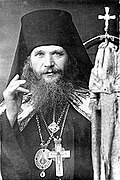 Paulin KroshechkinHieromartyr · Archbishop of MogilevOct 21
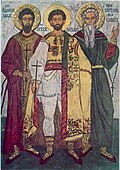 Visarion SaraiVenerable MartyrOct 21
- Sophronius of CioaraVenerable · Defender of Orthodoxy in TransylvaniaOct 21
 Jacob of OmuchVenerableOct 21
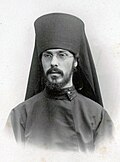 Neophytus OsipovVenerable Martyr · ArchimandriteOct 21
- Theophilus of LugaVenerable · Founder of Omuch HermitageOct 21
 Pelagia TestovaNew MartyrOct 21
 Arkady YershovHieromartyr · Archbishop of SverdlovskOct 21