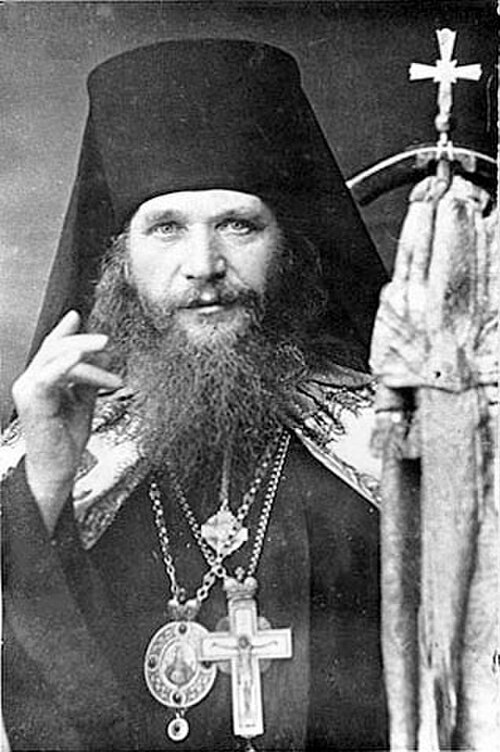
Hieromartyr
Paulin Kroshechkin
Archbishop of Mogilev
Archbishop of Mogilev and Mstislavl from 1933, killed in 1937 in the Kemerovo region.
- Feast
- October 21old style November 3
- Reposed
- 193720th century
- Place
- Kemerovo Oblast
- Order
- Martyrs
Life
Saint Paulinus Kroshechkin, Hieromartyr, was Archbishop of Mogilev and Mstislavl from 1933, a simple pastor of peasant birth, loved by the people, shot in a camp in the Kemerovo region on 3 November 1937. Born on 19 (31) December 1879 in the village of Kerenkovo in the Penza governorate, he was numbered among the New Martyrs and Confessors of Russia by the Council of Bishops in August 2000. He is commemorated on 21 October (3 November New Style).
Youth
Born Pyotr Kuzmich Kroshechkin into a peasant family, he lost his father early, Kuzma Ivanovich, and was raised by his mother, Evdokia, whom, when bishop, he cared for tenderly and always consulted about everyday matters. He studied at the parish school and the town school at Mokshan. In 1895 he entered Sarov, from 1898 was a novice at the Nikolo-Babaev monastery, then for two and a half years a novice at the Spaso-Yakovlevsky monastery at Rostov, after which he returned to Babaev, studying on his own under the guidance of a retired bishop. In 1904 he was accepted as a novice at the Novospassky monastery in Moscow, where he was sacristan, continued to study with private teachers and from 1909 taught at the monastery's novice school. He was tonsured a monk, in 1910, with the name Paulinus, in honour of Saint Paulinus of Nola. He was ordained hierodeacon and then hieromonk. In 1912 he graduated from the Moscow seminary, completing the four-year course in two, and entered the Moscow Theological Academy, graduated in 1916 as candidate of theology. From 1916 he taught at the pastoral-missionary seminary at the Grigory-Bizyukov monastery in the Kherson diocese. In 1920 and 1921 he was superior of the Novospassky monastery, as archimandrite.
Bishop
From 2 May 1921 he was Bishop of Rylsk, second vicar of the Kursk diocese. He often visited parishes and monasteries, composed several akathists, among them the service with akathist of Saint Paulinus of Nola, his heavenly patron, and preached much; though not a great orator, his simple sermons were loved by the parishioners. In 1922 he was arrested and sentenced (5 December) to five years. He spent about a year in a single cell in a Moscow prison, where he made himself a cross from a piece of bread before which he prayed; for this he was mocked and beaten by the guards. He was released early and settled in Moscow, under surveillance, near the Novospassky monastery.
From 14 October 1926 he was Bishop of Polotsk and Vitebsk. He was the initiator and organizer of the secret election of the patriarch by gathering signatures among the bishops, in which most of those who signed were for the election of Metropolitan Cyril Smirnov of Kazan. For this, like the other hierarchs who took part, among them the locum tenens Sergius, he was arrested and held in prison from December 1926; he did not betray his helpers, and only one of the couriers, John Kuvshinov, was arrested, who was shot. He was released in April 1927, most likely at the request of Metropolitan Sergius. From 1 December 1927 he was Bishop of Perm and Solikamsk, often visited parishes and made a journey to the remotest part of the diocese, the town of Cherdyn, which bishops rarely reached.
On 2 December 1930 he was named Bishop of Borovsk and administrator of the Kaluga diocese, and from 30 September 1931 Bishop of Kaluga. Most clergy received him coolly at first, for his peasant origin, simplicity, easy way of talking with the people and modest monastic appearance. He read much, had a library of some two thousand books, and introduced into the diocese especially solemn Sunday evening services, which strengthened the spirit of the faithful in the time of persecution. He liked to sing church hymns with the people, teaching the flock to say the prayers with understanding. He was gentle and kind-hearted, loved by children; he loved animals: in his garden he built a little bridge over a path the ants had made, so as not to step on them by mistake. He gave the poor a large part of his property, money and food, though he himself was in great need. During his time at Kaluga the Annunciation cathedral and the churches Nikolo-Slobodskaya, Spaso-Slobodskaya and Voskresenskaya were blown up, and eighty-three clergy, fourteen servers, eight churchwardens and sixty-one nuns were shot or exiled.
On 16 June 1933 he was named Archbishop of Mogilev. In Belarus there was an autocephalist group and many Renovationists. Archbishop Paulinus put much effort into healing the schism in his diocese: he talked with the priests and united them with the official Church, negotiated with Bishop Philaret Ramensky of Bobruisk, who led the autocephaly, and succeeded in agreeing on its abolition, on which he sent a report to Metropolitan Sergius. In 1934 he sent the latter a report congratulating him on his elevation to Metropolitan of Moscow and Kolomna.
Arrest and end
The NKVD learned of this report, and on 2 October 1935 the archbishop was arrested and accused of creating a "united counter-revolutionary church bloc". He did not admit guilt. He was held in the Minsk prison and sentenced to ten years of camp. He was held in the Mariinsk camps, in today's Kemerovo region, brigadier on an agricultural farm, and, with the other clergy, held secret morning services. An informer told the camp management that Archbishop Paulinus said: "The mockery and persecution of believers by Soviet power only strengthen our strength as believers in God, so we must unceasingly keep alive the spirit of religion, not only in ourselves but in other people."
On 28 September 1937 a case was opened against him for creating a counter-revolutionary group and leading it. He did not admit guilt, saying only that he had held molebens: "This is no crime, since in the Stalin Constitution it is said that everyone is given the right to freely practise religious worship." On 28 October 1937 the troika of the NKVD of West Siberia sentenced him to death, and on 3 November the sentence was carried out. Suf.ering with him were Bishop Arkady Ershov of Yekaterinburg (1878 to 1937), Fr Anatoly Levitsky (1894 to 1937), Fr Nikandr Chernelevsky (1880 to 1937) and the reader Cyprian Annikov (1875 to 1937). Archbishop Paulinus and those shot with him were numbered among the New Martyrs and Confessors of Russia at the Jubilee Council of Bishops in August 2000, for veneration throughout the Church.
Commemorated the same day October 21
 Hilarion the GreatVenerable · Hermit of GazaOct 21
 Viator of LyonSaintOct 21
 Hilarion of MeglenSaint · Bishop of MeglenOct 21
 Dasius, Gaius and ZoticusHoly Martyrs · Martyrs of NicomediaOct 21
 Visarion SaraiVenerable MartyrOct 21
- Sophronius of CioaraVenerable · Defender of Orthodoxy in TransylvaniaOct 21
 Jacob of OmuchVenerableOct 21
 Neophytus OsipovVenerable Martyr · ArchimandriteOct 21
- Theophilus of LugaVenerable · Founder of Omuch HermitageOct 21
 Pelagia TestovaNew MartyrOct 21
 Damian VoskresenskyHieromartyr · Archbishop of Kursk and OboyanOct 21
 Arkady YershovHieromartyr · Archbishop of SverdlovskOct 21