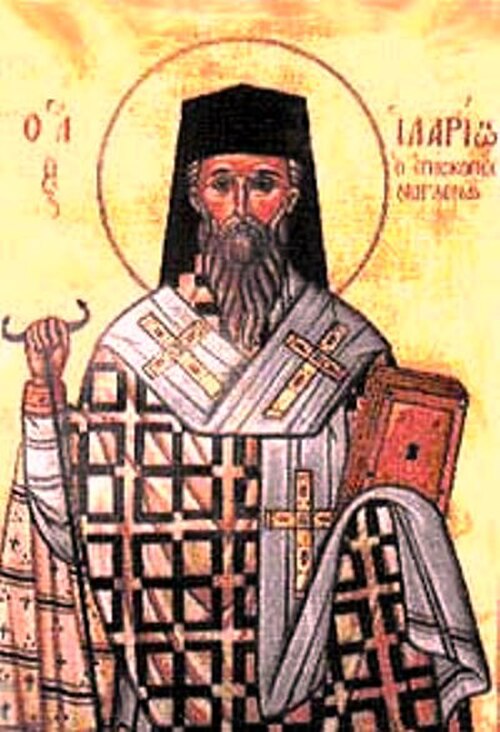
Saint
Hilarion of Meglen
Bishop of Meglen
Bulgarian saint of the 12th century, born at Ohrid, bishop of Meglen, who died in 1164.
- Feast
- October 21old style November 3
- Reposed
- 116412th century
- Place
- Ohrid
- Order
- Hierarchs
Life
Saint Hilarion of Meglen, the Hierarch, was a Bulgarian bishop of the twelfth century, the first attested bishop of the diocese of Meglen in Macedonia. He was born, according to tradition, at Ohrid, to a distinguished family, and was a monk and abbot, then pastor in a city where many Bogomils, Paulicians and Armenians lived. The Church honours him as a champion of the true faith, who brought many back to Orthodoxy. He fell asleep on 21 October 1164.
Youth and call to the episcopate
Hilarion's parents were distinguished and pious people and gave him from childhood to learn the sacred books. Scholars of the nineteenth century concluded that he was of Bulgarian origin, since as a saint he is venerated only among the South Slavs. According to the Lives he was born into a distinguished family and received a good education, probably at Ohrid. At eighteen he left his parents' house and entered a monastery. After many years there he was chosen abbot of an unidentified monastery.
According to the Long Life of Archbishop Eustathius of Ohrid (1133 to 1142), the Mother of God appeared to him and told him not to delay but to put the light on the lampstand: to take Hilarion, the abbot of the monastery, and set him as shepherd over the people of Meglen, for he would turn many from stumbling and guide them to the light of understanding. So, around 1134, Eustathius consecrated Hilarion bishop of the city of Meglen. Some sources call Eustathius archbishop of Tarnovo, but the Bulgarian and Russian ones give the archbishop of Ohrid.
The struggle with heretics
In Meglen lived many followers of Bogomil, Paulician and Manichaean teachings, condemned by the Church as heresies. After the death of Tsar Samuel, in 1015, Meglen was taken by Emperor Basil II, the Bulgar-slayer, who settled there many Syrians, Armenians and Pechenegs. Hilarion began, as soon as he came to head the diocese, an open struggle with those of other belief, described in his Life, written by Patriarch Euthymius of Tarnovo (1375 to 1417).
When he came to the cathedral of Meglen he first kissed the icons, which the Bogomils and other iconoclasts did not honour. Then, in his sermon, he urged the people to hold the right faith, to fulfil the commandments of the Lord and to flee every heresy. To believe in the undivided Holy Trinity, in the incarnation of Christ, in the Life-giving Cross, to honour the holy relics and to keep all the traditions of the Church, and to anathematize heretics, among them Arius, Eunomius, Sabellius, Macedonius, Apollinarius, Origen, Theodore of Mopsuestia, Nestorius, Dioscorus, Severus and Eustathius, Mani and Paul of Samosata.
Hilarion realized that a large part of the people was inclined to Manichaean, Armenian (Monophysite) and Bogomil teaching, and many of those of other belief wished to discuss the faith with him. One day the Bogomils began a dispute with him. They asked why he opposed their belief, by which the good God made heaven and the evil one the earth. Hilarion answered from Scripture that "the earth is the Lord's and the fullness thereof". They said the Old Testament is from the devil. He answered that if that were so Christ would not have called the first and greatest commandment "Hear, O Israel, the Lord thy God is one". The Bogomils showed their displeasure at the sign of the cross, which they regarded as a hateful instrument of torture, which the Orthodox honoured. Hilarion told them that before the crucifixion the cross was an instrument of death and as such accursed, but after it was sanctified by the blood of Christ and its sign became sanctification for all the faithful. Concluding, he invited them to be baptized. Many of those present were baptized at once and renounced their former belief.
Stoned
Seeing the baptism of their people, the leaders of the heretics were filled with anger and began to revile Hilarion, calling him a liar. He called their teaching evil, godless and mad. The heretics, enraged, took stones and beat him without mercy until he fell to the ground. Thinking him dead, they left him. When Hilarion came to himself, he rose and went to his cell, for the place of the beating was far from the city. Learning of the deed, the assembly of the Orthodox decided with one voice to attack the heretics and destroy them. Hilarion forbade them, saying: "No, my children, but remember the words of the Lord to Peter: put your sword in its place." When he had recovered, he began again to preach and to baptize heretics, bringing them into the Church.
Another time some came to him saying that they too thought orthodoxly and kept all the traditions. Hilarion answered that the catholic Church had received all good from the eyewitnesses of the Son of God, the holy Apostles, and keeps it unshaken, and that the Armenians had held all this until the Fourth Ecumenical Council at Chalcedon, from which they separated themselves. Some then said that the Orthodox Church had changed many traditions of Christ. Hilarion replied that Christ gave many things in one way, and the Apostles and their successors developed them as the faith spread. At His baptism, for example, Christ did not turn to the west, did not renounce Satan, did not say the Creed, had no need of the prayer of baptism, was not placed in a font, was not anointed with myrrh and did not at once receive the Body and Blood of the Lord, and we do all of this now. Christ did not give Communion in churches either, but in a common room at the common table, and was not dressed in priestly vestments, while we serve in churches and stand in episcopal vestments.
By his dogmatic teaching, says the Life, Hilarion also strengthened the faith of Emperor Manuel I Komnenos (1143 to 1180), who was inclined toward a mistaken teaching. The emperor learned of him.
Repose and relics
He fell asleep on 21 October 1164 and was buried in the monastery he founded, of the Holy Apostles, built on the place of the heretics' gatherings, together with a church. He was succeeded as abbot by his disciple Peter, whom the saint himself had appointed, and who probably wrote the first Life of him. After his death Hilarion appeared to the monks and restored order in the monastery, which had fallen into lawlessness. At his tomb many healings and other miracles began to occur. The coffin was opened and the relics found incorrupt.
Until the early thirteenth century the veneration of the saint was local, and the days of his death and of the translation of his relics were linked with those of Saint Hilarion the Great. On 21 October 1204 or 1206 the Bulgarian tsar Kaloyan moved the saint's relics to the capital Tarnovo and placed them, probably, in the church of the Ascension of the Lord. Later Tsar Ivan Asen II moved them to the newly built church of the Forty Holy Martyrs, raised in memory of the victory at Klokotnitsa in 1230. After the Ottoman conquest and the fall of Tarnovo, in 1393, the relics were lost. According to Viktor Grigorovich, relying on accounts of eyewitnesses, about 1845 the relics were in a tomb in the Church of the Ascension, turned into a mosque. By other reports they were hidden at the conquest and carried to Constantinople in the nineteenth century. An anonymous Byzantine chronicle says that Sultan Bayezid I found the body of Saint Hilarion the Wonderworker, bishop of Meglen, and gave it to the lord Constantine, who lived at Zhiglovo, and he took it to the monastery of the holy Archangels at Sarandapor. By another version the relics were taken to the church of Saint Joachim of Osogovo.
His memory is kept on 21 October, the day of the translation of the relics to the old capital of Tarnovo. Near a village stands the monastery of Saint Hilarion of Meglen. In Bulgaria there is only one church dedicated to him, a small, beautiful church in the village of Struma, near Sandanski.
Commemorated the same day October 21
 Hilarion the GreatVenerable · Hermit of GazaOct 21
 Viator of LyonSaintOct 21
 Dasius, Gaius and ZoticusHoly Martyrs · Martyrs of NicomediaOct 21
 Paulin KroshechkinHieromartyr · Archbishop of MogilevOct 21
 Visarion SaraiVenerable MartyrOct 21
- Sophronius of CioaraVenerable · Defender of Orthodoxy in TransylvaniaOct 21
 Jacob of OmuchVenerableOct 21
 Neophytus OsipovVenerable Martyr · ArchimandriteOct 21
- Theophilus of LugaVenerable · Founder of Omuch HermitageOct 21
 Pelagia TestovaNew MartyrOct 21
 Damian VoskresenskyHieromartyr · Archbishop of Kursk and OboyanOct 21
 Arkady YershovHieromartyr · Archbishop of SverdlovskOct 21