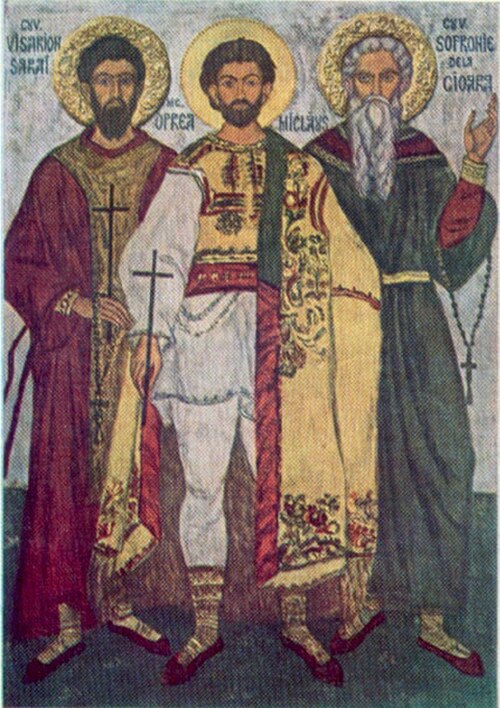
Venerable Martyr
Visarion Sarai
Orthodox monk imprisoned by the Habsburg authorities at Deva, Timișoara and Kufstein, where he died in 1745.
- Feast
- October 21old style November 3
- Reposed
- 174518th century
- Place
- Kufstein
- Order
- Martyrs
Life
Saint Visarion Sarai, Venerable Martyr, born Nicholas, was an Orthodox hieromonk of Serbian stock, from Bosnia, who travelled through the Banat and Transylvania in 1744 urging the Romanians who had entered the union with Rome to remain in, or return to, the Orthodox faith. Arrested by the imperial authorities, he was moved through prisons as far as the fortress of Kufstein in the Tyrol, where, according to the most widespread tradition, he died in torment without renouncing his faith. The Romanian Orthodox Church numbered him among the saints in 1950, and he is commemorated on 21 October.
Origin and the road to monastic life
He was born in 1714 in the village of Majdan (now Mrkonjić Grad) in Bosnia and was baptized Nicholas. His parents, Maxim and Maria, moved after his birth to Kostajnica, in present-day Croatia. We know his age from his own statement of 1744, when he said he was 30. At 17 or 18 he went to the Holy Land and entered the monastery of Saint Sabbas the Sanctified near Jerusalem, where he was tonsured in 1738 and given the name Visarion. Romanian church historians say that the tonsure was done by Patriarch Meletius of Jerusalem. On his return he spent some time in the monasteries of the Holy Mountain and then settled at the monastery of Pakra in Slavonia, where he served almost seven years as hierodeacon and then as hieromonk. For some years he also lived in a cave as a hermit, until he decided to go a second time to the holy places.
He had no schooling. The historian David Prodan described him as simple and uneducated, appearing in the guise of an ascetic. Many think he knew Romanian, which gave rise to the guess that he was of Romanian origin, but according to other sources he gave his sermons and public addresses through an interpreter.
Sent to the Romanians of Transylvania
In that time the Orthodox Romanians and Serbs in the Habsburg Empire were under pressure from the state authorities and the Catholic Church. Under Empress Maria Theresa union with Rome was strongly imposed in Transylvania, and the Orthodox bishopric was dissolved. The Serbian metropolitan Arsenije IV Jovanović Šakabenta, who led the Serbian Church in the Empire (patriarch of the Serbs from 1725 to 1737, then metropolitan of Karlovci until 1748), sent Visarion to the Banat and Transylvania, to support the Orthodox in their struggle against the union and to preach among those who had entered it. The sources do not agree on the year he set out, 1742 in some, January 1744 in others; he crossed into Transylvania on 11 March 1744, accompanied by three Aromanian merchants, Dima Nino, Gheorghe Nicola and Gavrilă Bistro.
His first stop was the monastery of Hodoș-Bodrog near Lipova, where his preaching against the union had great success. On the hill at the edge of the town he raised a wooden cross that survives to this day, in one of the outer apses of the church of the Dormition in Lipova. It is said that soon a spring flowed from beneath the cross, called "the Saint's Spring", whose water is said to have the gift of healing. After Visarion's martyrdom the cross remained a place of pilgrimage for Orthodox Romanians, despite the official ban of the Austrian authorities.
Received in triumph at Dobra, he set out toward the Mărginimea Sibiului, preaching in the villages he crossed. He passed through Deva, Orăștie, Sebeș, Miercurea Sibiului and Săliște, and spoke everywhere against the union with Rome. The simplicity of his words and the example of his life made people receive him with love and enthusiasm, and his arrival in villages was often met with solemn processions and the ringing of church bells. The Greek-Catholic historian George Barițiu wrote that he felt no need for many words and lectures on dogma, as the Jesuits gave, but with short and fearsome words knew how to make the crowds shudder.
Arrest and prisons
The imperial authorities arrested him in April 1744, on the order of General-Governor Czernin, as he was heading for Sibiu. The Uniate bishop Inocențiu Micu-Klein pointed out that violent means against those plotting against the union were not permitted to him, but he was summoned to Vienna and could no longer influence the inquiry. Visarion was imprisoned at Sibiu and interrogated on 27 April 1744. He declared that he had left Pakra with a passport given by Metropolitan Arsenije, but refused to answer questions about his preaching against the union.
He was then moved through the prisons of Alba Iulia, Deva, Hunedoara, Timișoara, Osijek and Raab (now Győr), until the prison of Kufstein in the Tyrolean mountains, one of the harshest in the empire. Historians incline to think that he died there, under torture, without renouncing the Orthodox faith. The year of death is not certain, Romanian sources give "after 1745", and some even say he was released after a time under pressure from Russian diplomats in Vienna, which cannot be verified.
Aftermath
His arrest did not end the unrest. In 1744 to 1746 the movement against the union broke out, and in 1759, after the restoration of the Orthodox diocese, more than half of the Uniate parishes passed to Orthodox jurisdiction. The Uniate scholar Samuil Micu wrote that the man who had the reputation of a saint "greatly frightened the Romanians away from the union", and the historian Silviu Dragomir says that the disturbances he started open the series of national-church movements of the eighteenth century in Transylvania. According to Orthodox tradition, his work halted the spread of the union in Transylvania.
Veneration
The faithful's veneration of him began right after his death and lasted nearly two hundred years. On 28 February 1950 the Holy Synod of the Romanian Orthodox Church numbered him among the saints and entered him in the calendar. The solemn proclamation as confessor saint took place on 21 October 1955 in the Orthodox cathedral of Alba Iulia. On 14 June 1962 the Serbian Orthodox Church followed this example. He is commemorated on 21 October.
Commemorated the same day October 21
 Hilarion the GreatVenerable · Hermit of GazaOct 21
 Viator of LyonSaintOct 21
 Hilarion of MeglenSaint · Bishop of MeglenOct 21
 Dasius, Gaius and ZoticusHoly Martyrs · Martyrs of NicomediaOct 21
 Paulin KroshechkinHieromartyr · Archbishop of MogilevOct 21
 Sophronius of CioaraVenerable · Defender of Orthodoxy in TransylvaniaOct 21
 Jacob of OmuchVenerableOct 21
 Neophytus OsipovVenerable Martyr · ArchimandriteOct 21
- Theophilus of LugaVenerable · Founder of Omuch HermitageOct 21
 Pelagia TestovaNew MartyrOct 21
 Damian VoskresenskyHieromartyr · Archbishop of Kursk and OboyanOct 21
 Arkady YershovHieromartyr · Archbishop of SverdlovskOct 21