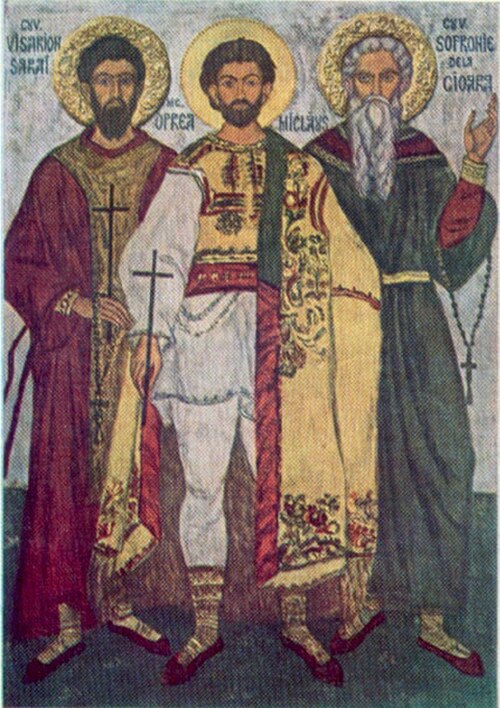
Venerable
Sophronius of Cioara
Defender of Orthodoxy in Transylvania
Orthodox monk who fought for the freedom of worship of the Romanians of Transylvania.
- Feast
- October 21old style November 3
- Born
- 170118th century
- Place
- Curtea de Argeș
- Order
- Venerables
Life
Saint Sophronius of Cioara, the Venerable, was an Orthodox monk of Transylvania who stood at the head of the second movement in defence of the Orthodox faith against union with Rome in eighteenth-century Transylvania and demanded the freedom of worship of the Romanians. The Romanian Orthodox Church canonized him on 28 February 1950, and the solemn proclamation as holy confessor took place on 21 October 1955 in the Orthodox cathedral at Alba Iulia. He is commemorated on 21 October. He died in Wallachia, at Curtea de Argeș.
Beginnings
He was born in the first half of the eighteenth century in the village of Cioara (today Săliștea, Alba County), then in the Habsburg Empire. His name in the world was Stan Popa (or Popovici, according to other sources), which shows that an ancestor was a priest. He was himself a priest and stayed at Cioara until his wife's death, when he became a monk in Wallachia, at a monastery, perhaps Cozia or Curtea de Argeș. Nicolae Iorga says he could barely read and wrote very badly. He returned to Cioara and built in the forest near the village a small wooden skete, gathering a few disciples and, by some reports, teaching children. He lived in monasticism until 1757, when he began to lead the uprising of the Orthodox of Transylvania against the Habsburg policy of urging all Romanians to join the Greek-Catholic Church.
The Church in Habsburg Transylvania
The Habsburg Empire used the Catholic religion as a tool of unity and domination. The Transylvanian Romanians, tolerated only because of their Orthodoxy, were a good opportunity, and Vienna thought that by winning them it would strengthen its position. In 1701 Emperor Leopold I urged the Orthodox Church of Transylvania to unite with Rome. The Romanians were urged to accept union, keeping their Eastern rite, but admitting the four doctrinal points of the Council of Florence: the primacy of the pope, the existence of purgatory, the Filioque and the use of unleavened bread. The clergy were first attracted with material advantages, that is equality with the Catholic priests, with the same income and privileges. But many Orthodox priests did not join the union, and the devotion of the common people to the old faith remained, in Seton-Watson's words, truly touching, and the need for an Orthodox bishop and religious freedom grew little by little.
Sophronius's movement (1759 to 1761)
Sophronius preached against union with the Catholics and against the growing pressure on the Orthodox communities. It is said that he went to Karlovci, from where he returned with a mission given by the Serbian metropolitan that the Romanians of Banat and Transylvania should leave the Uniate hierarchy and put themselves under the jurisdiction of the Metropolitanate of Karlovci. In spring 1757 the Austrian authorities at Vințu de Jos destroyed his little skete, to put down Orthodox resistance, and began arresting priests who preached against the union, so Sophronius fled Cioara, leaving the community without a guide.
After signs of popular discontent, Empress Maria Theresa issued in 1759 a first edict of toleration, too modest for those concerned, which increased rather than eased the disturbances. On 6 October 1759 Sophronius addressed the faithful from Brad, saying that the empress's edict allowed them to choose freely between the Orthodox and the Greek-Catholic Church. The authorities grew uneasy and imperial troops hunted him; he was arrested and imprisoned at Bobâlna. On 13 February 1760 he was freed by force, after the uprising of some six hundred peasants led by Archpriest Ioan of Cioara. He went on preaching against the union in the land of Zărand and the Land of the Moți, and in southern Transylvania and along the upper Mureș an uprising broke out against the Uniate Romanians, whose churches were seized by force and whose priests were driven from the altars with beatings. On 21 April 1760 he addressed the faithful at Zlatna, and on 12 May those at Abrud. The Council of Ministers in Vienna, alarmed by his popularity, decided on 3 June to arrest and execute him.
On 2 August he was seized in the church at Abrud and taken to Zlatna, but after an uprising of some seven thousand peasants of the area he was freed and then guarded and hidden by the peasants working at the royal mines of Abrud, who were in almost open revolt and said that the power of the lords was at an end. On 14 to 18 February 1761 he organized at Alba Iulia a meeting of the Orthodox synod of Transylvania, which demanded full freedom of worship. The authorities sent General Adolf von Buccow to pacify the region and seize him, but Sophronius managed to flee to Wallachia, where he had many sympathizers and where he stayed until his death. He went on living in monasticism, at the monasteries of Robaia (1764 to 1766) and another (1766 to 1771), then at Curtea de Argeș, all in Argeș County.
Results
The disturbances continued, and in 1769 the empress issued a new edict of toleration, which gave legal status to the "Eastern Greek cult", that is the Orthodox. In reality tensions remained, and a climate of religious toleration came only with the edict of 13 October 1781 of Emperor Joseph II. Sophronius's movement led to a peaceful rising of the Orthodox peasants so that their Church should no longer be only "tolerated", though it was that of the majority, but "officially recognized". In the end the Orthodox won a notable victory: the court of Vienna recognized the legal existence of their Church and named as bishop Dionisie Novacovici, the first bishop of the Transylvanian Orthodox since 1701, when the Orthodox metropolitanate of Alba Iulia had been abolished.
The historian Keith Hitchins sought an explanation for the strong devotion of ordinary people to the ancient faith, even though union would have brought them advantages. The Greek-Catholic intellectuals approached the question of the Romanian people in Transylvania differently, thinking more and more in terms of "nation". Sophronius's Orthodox movement, centred on religion, and the movement of the Greek-Catholic scholars, centred on the idea of nation, had complementary effects, keeping alive the link between the Romanians of Transylvania and those of Wallachia and Moldavia, and both may be seen as steps toward national unity.
Commemorated the same day October 21
 Hilarion the GreatVenerable · Hermit of GazaOct 21
 Viator of LyonSaintOct 21
 Hilarion of MeglenSaint · Bishop of MeglenOct 21
 Dasius, Gaius and ZoticusHoly Martyrs · Martyrs of NicomediaOct 21
 Paulin KroshechkinHieromartyr · Archbishop of MogilevOct 21
 Visarion SaraiVenerable MartyrOct 21
 Jacob of OmuchVenerableOct 21
 Neophytus OsipovVenerable Martyr · ArchimandriteOct 21
- Theophilus of LugaVenerable · Founder of Omuch HermitageOct 21
 Pelagia TestovaNew MartyrOct 21
 Damian VoskresenskyHieromartyr · Archbishop of Kursk and OboyanOct 21
 Arkady YershovHieromartyr · Archbishop of SverdlovskOct 21