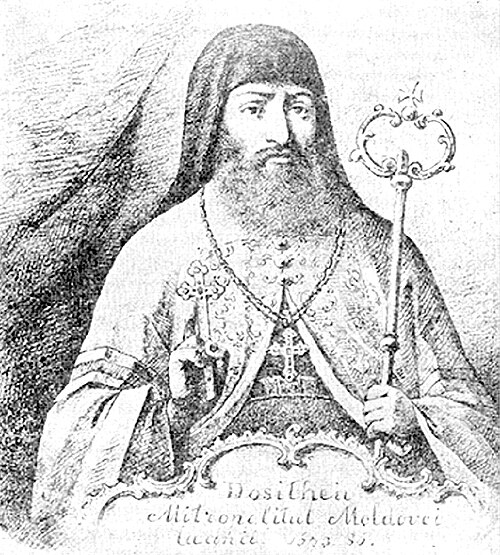
Saint
Dosoftei of Moldavia
Metropolitan of Moldavia
Metropolitan of Moldavia, scholar, poet and translator, author of the verse Psalter; died in 1693.
- Feast
- December 13old style December 26
- Reposed
- 169317th century
- Place
- Zhovkva
- Order
- Hierarchs
Life
Saint Dosoftei, in the world Dimitrie Barilă, was Metropolitan of Moldavia, a scholar, poet and translator, among the greatest of Romanian culture in the seventeenth century, the first notable poet of the Romanian language and author of the Psalter in verse. He was born on 26 October 1624 at Suceava and fell asleep on 13 December 1693 at Zhovkva in Poland. The Holy Synod of the Romanian Orthodox Church canonized him in July 2005, a decision proclaimed on 14 October 2005. His feast is kept on 13 December. In 2007 he was added to the calendar of the Russian Church, with the same day.
Beginnings and service
His father was named Leontari, his mother Misira, and his grandfather Barilă, of Greek descent. He studied at Iași, probably at the college founded in 1640 at the monastery of the Three Hierarchs, then at the school of the Orthodox Brotherhood in Lviv, where he did humanistic studies and languages: Greek, Latin, Slavonic and Polish. Around 1648 he was tonsured a monk at Probota, with the name Dosoftei. He was bishop of Huși from 1658 to 1660, bishop of Roman from 1660 to 1671, then metropolitan of Moldavia, from 1671 to 1674 and again from 1675 to 1686. He was one of the hierarchs who promoted the introduction of the Romanian language into the Church.
Scholar and poet
Through his ties with Moscow and with Nicolae Milescu he brought from Russia a printing press with type and paper, with which from 1679 he printed at Iași, in Romanian, the main service books, some translated by himself. After 1665 he began the Psalter in verse, printed at Uniev monastery in Ukraine in 1673, for which he had before him a Greek edition and Jan Kochanowski's Psalter in verse. In it are found elements recalling the rhythm and rhyme of the people, and it may be regarded as the beginning of the written poetry of the Romanians. His psalms reached distant places, and many, in hours of sadness, repeated his beautiful lines of lament. He also wrote original verse, Verses to the Illustrious Coat of Arms of the Land of Moldavia, which open the Psalter, a Chronological Poem on the Princes of Moldavia, the Divine Liturgy (Iași, 1679), the Psalter with explanation (1680), a Euchologion with explanation (1683), the Paroemiae of the year (1683) and the four volumes of the Life and Conduct of the Saints (Iași, 1682 to 1686). He also translated from the Fathers and from Byzantine writers. He is also regarded as the first translator into Romanian of works of history and literature, and the first Romanian scholar to copy documents and inscriptions. He is regarded as founder of the Romanian church language.
Politics, exile and veneration
At the head of a group of Moldavian boyars who sought closeness with Russia, he took part in the negotiations of 1674 and 1684 on the passage of Moldavia under the tsar's rule. In 1683 to 1684 he lived at Stryi. In autumn 1686, because of political events, he was taken to Poland by the troops of King Jan Sobieski and remained there to the end of his life, falling asleep at Zhovkva (now in the Lviv region, Ukraine) on 13 December 1693.
His labour for the education of the people and for the Romanian language kept his memory among descendants, and in the nineteenth and twentieth centuries he was regarded as a national hero of enlightenment. Several streets in Chișinău, Bălți, Cahul, Călărași, Căușeni, Drochia, Fălești, Orhei, Soroca and Strășeni bear his name. In 2004 the Republic of Moldova issued a stamp and a coin in his memory, and in 2015 his bronze bust, made by the sculptor Veaceslav Jiglițchi, was set on the Alley of Church Personalities in Chișinău.
Commemorated the same day December 13
 SolomonProphet · King of IsraelDec 13
 JacobRighteous · The Patriarch IsraelDec 13
 LucyMartyr · of SyracuseDec 13
 RebeccaRighteous · The MatriarchDec 13
 DeborahProphet · Prophetess and JudgeDec 13
 BenjaminRighteous · The PatriarchDec 13
 MiriamProphet · Sister of Moses and AaronDec 13
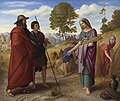 RuthSaint · Ancestor of the LordDec 13
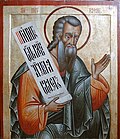 NathanProphet · The ProphetDec 13
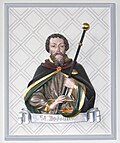 JudocVenerable · Hermit of Breton birthDec 13
 HezronRighteous · Ancestor of the SaviorDec 13
 JudithSaint · Widow who saved BethuliaDec 13