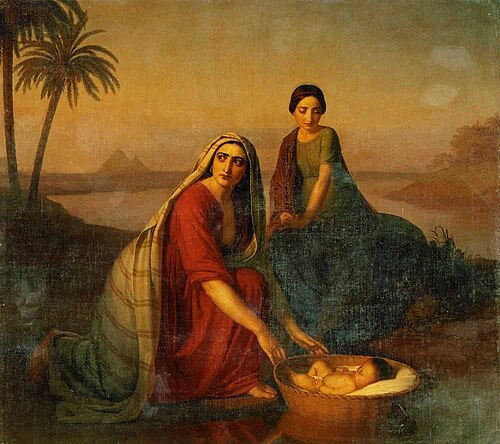
Prophet
Miriam
Sister of Moses and Aaron
Prophetess, sister of Moses and Aaron, who sang to God after the crossing of the Red Sea.
- Feast
- December 13old style December 26
- Reposed
- 1274 BC13th century BC
- Place
- Kadesh
- Order
- Prophets
Life
Saint Miriam the Prophetess (in Romanian Mariam) was the sister of Moses and Aaron, of the tribe of Levi, the daughter of Amram and Jochebed. She is honoured by the Orthodox Church as a righteous woman of the Old Testament. Scripture calls her a prophetess. She watched over the infant Moses on the Nile and led the women's song after the crossing of the Red Sea. Her story is told in the Book of Exodus and the Book of Numbers.
The childhood of Moses
Miriam first appears, unnamed, in the account of the birth of Moses. Pharaoh had ordered that all the male infants of the Hebrews be killed, but the parents of Moses hid him for three months. When they could do so no longer, his mother put him in a basket of papyrus coated with pitch and laid it among the reeds at the edge of the Nile. His sister stood at a distance to learn what would happen (Exodus 2:4). Pharaoh's daughter found the basket, opened it and took pity on the weeping child. Then Miriam came forward and asked whether she should call a nurse from among the Hebrew women. The princess agreed, and Miriam brought the child's own mother, who thus raised her own son, with wages from the royal house. Through the skill and courage of a young girl Moses stayed alive and came to know his people.
Prophetess and singer
After the Israelites crossed the Red Sea as on dry land and the Egyptian army was drowned, Moses and the children of Israel sang the song of deliverance to the Lord. Scripture says: "Then Miriam the prophetess, the sister of Aaron, took a tambourine in her hand, and all the women went out after her with tambourines and dancing. And Miriam sang to them: Sing to the Lord, for he has triumphed gloriously" (Exodus 15:20-21). She is the first woman called a prophetess in the Bible. The prophet Micah recalls that God sent before the people Moses, Aaron and Miriam (Micah 6:4).
Illness and death
In the wilderness Miriam and Aaron spoke against Moses because of a Cushite woman he had married. The real reason was another: they were asking whether the Lord speaks only through Moses. God called all three to the tent of meeting and said that He speaks with Moses face to face, and with other prophets in visions. Miriam became white as snow, struck with leprosy. Aaron begged Moses not to leave her so, and Moses cried to the Lord, "O God, please heal her." She was shut outside the camp for seven days and during that time the people did not set out, but waited for her. Then she was healed and returned (Numbers 12).
Miriam died in the wilderness of Zin, at Kadesh, in the first month of the fortieth year after the exodus from Egypt, and was buried there (Numbers 20:1). The people then had no water, which Jewish tradition links with her death, since it tells of a well that followed Israel in her merit.
Veneration
The Orthodox Church counts her among the righteous women of the Old Testament. She is remembered on the Sunday of the Forefathers and on the Sunday before the Nativity of the Lord. In one of the hymns of the Praises on that Sunday, Sarah, Rebecca, Anna and Miriam, "the glory of women," are pictured as exchanging glad tidings. The song of deliverance of the Red Sea, in which she took part, is sung at Matins as the first ode of the canon and on Holy Saturday. Nothing is known of her relics.
Commemorated the same day December 13
 SolomonProphet · King of IsraelDec 13
 JacobRighteous · The Patriarch IsraelDec 13
 LucyMartyr · of SyracuseDec 13
 RebeccaRighteous · The MatriarchDec 13
 DeborahProphet · Prophetess and JudgeDec 13
 BenjaminRighteous · The PatriarchDec 13
 RuthSaint · Ancestor of the LordDec 13
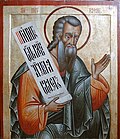 NathanProphet · The ProphetDec 13
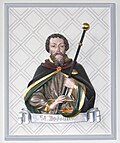 JudocVenerable · Hermit of Breton birthDec 13
 HezronRighteous · Ancestor of the SaviorDec 13
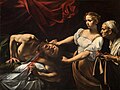 JudithSaint · Widow who saved BethuliaDec 13
 Dosoftei of MoldaviaSaint · Metropolitan of MoldaviaDec 13