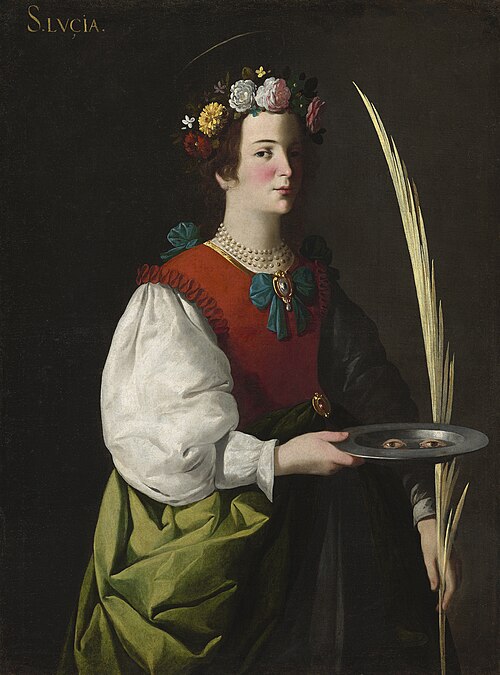
Martyr
Lucy
of Syracuse
Maiden of Syracuse, killed for her faith in Christ during the persecution of Diocletian.
- Feast
- December 13old style December 26
- Reposed
- 3044th century
- Place
- Syracuse
- Order
- Martyrs
Life
The Holy Martyr Lucy of Syracuse was a Christian virgin of Sicily who received the crown of martyrdom in the persecution of Diocletian, around the year 304. She is one of the best known women martyrs of the early centuries, honoured in both East and West. Her name comes from the Latin lux, light, and her memory is kept on 13 December.
Life
The details of her life are known from later accounts, written in the fifth and sixth centuries and similar to the life of Saint Agatha. According to tradition she was born around 283 at Syracuse, to a rich and noble family. Her father, of Roman descent, died when she was five, and her mother was called Eutychia. Lucy had consecrated her virginity to Christ and wished to give her dowry to the poor. Her mother, who did not know her vow, suffered from a bleeding illness and feared for her daughter's future, so she found her a betrothed from a rich pagan family.
Fifty-two years earlier Saint Agatha had been martyred at Catania, near Syracuse, and her tomb drew pilgrims, who told of many healings. Eutychia was persuaded to make a pilgrimage there, hoping for a cure. At the tomb Saint Agatha appeared to Lucy in a dream and told her that her mother would be healed because of her faith and that Lucy would be the glory of Syracuse, as Agatha was of Catania. Her mother recovered and agreed that Lucy should give a large part of the wealth to the poor.
Martyrdom
News that her property and jewels were being given to the poor reached the betrothed, who denounced her to Paschasius, the governor of Syracuse. He ordered her to offer sacrifice before the image of the emperor. Lucy refused and was condemned to be taken to a house of shame. It is said that the guards could not move her, even when they harnessed her to a team of oxen. Then they heaped wood around her and set it alight, but the fire did not burn her. In the end she received the crown of martyrdom by a sword thrust into her throat.
Later accounts, though not the earliest ones, add that before her death she foretold the punishment of Paschasius and the speedy end of the persecution, saying that Diocletian would reign no more. Paschasius then ordered that her eyes be taken out. Another version says she took out her own eyes to turn away a persistent suitor. When her body was prepared for burial her eyes were found whole, healed in a miraculous way. For this reason Saint Lucy is the patroness of those who suffer from diseases of the eyes.
Relics and veneration
The earliest proof of her veneration is the gravestone of Euskia, a woman who died on the feast of Saint Lucy in the fourth or fifth century, found in the catacombs of Syracuse. Before the year 600 there was a monastery of Saint Lucy at Syracuse and at Rome, and in the sixth century she appears in the procession of virgins in the basilica of Sant'Apollinare Nuovo in Ravenna.
Her holy relics were buried in the catacombs of Syracuse. In 1040 they were taken by George Maniaces, who freed the city from the Arabs, and carried to Constantinople, and in 1204 to Venice, where they rest in the church of the district named after her. According to another tradition they were taken in the early eighth century to Corfinio, then in 970 to Metz. A fragment was brought back to Syracuse and is kept in the cathedral.
Saint Lucy is the patroness of Syracuse and, together with Saints Rosalia and Agatha, of Sicily. She is painted with a sword and a palm branch, signs of martyrdom, and with a lamp or a cup holding eyes. Her name is mentioned in the Roman Canon of the Mass. In the Scandinavian countries her day, 13 December, is kept with lights, and children wear crowns of candles. The Caribbean island of Saint Lucia bears her name.
Commemorated the same day December 13
 SolomonProphet · King of IsraelDec 13
 JacobRighteous · The Patriarch IsraelDec 13
 RebeccaRighteous · The MatriarchDec 13
 DeborahProphet · Prophetess and JudgeDec 13
 BenjaminRighteous · The PatriarchDec 13
 MiriamProphet · Sister of Moses and AaronDec 13
 RuthSaint · Ancestor of the LordDec 13
 NathanProphet · The ProphetDec 13
 JudocVenerable · Hermit of Breton birthDec 13
 HezronRighteous · Ancestor of the SaviorDec 13
 JudithSaint · Widow who saved BethuliaDec 13
 Dosoftei of MoldaviaSaint · Metropolitan of MoldaviaDec 13