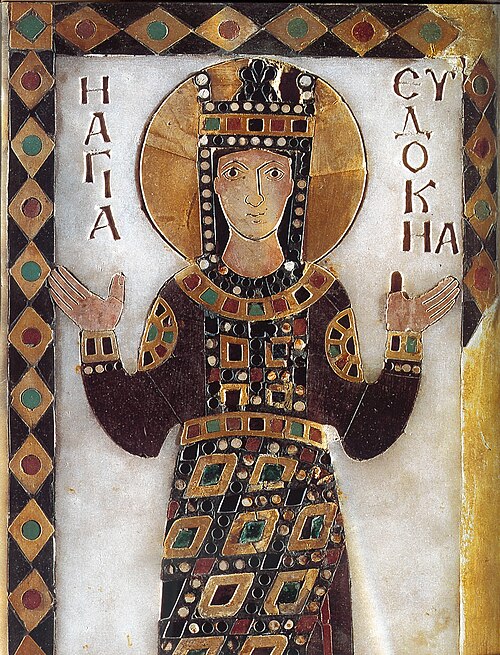
Right-Believing
Eudocia
Empress of Byzantium
Daughter of an Athenian philosopher and wife of Theodosius II, who ended her life in Jerusalem.
- Feast
- August 13old style August 26
- Reposed
- 4605th century
- Place
- Jerusalem
Life
Saint Eudocia, the devout empress, was born Athenais, the daughter of an Athenian philosopher. She became the wife of the emperor Theodosius II and was a poet. In her last years she lived at Jerusalem, where she built churches, and she departed this life in 460. The Church commemorates her on 13 August.
Youth in Athens
She was born around 400 at Athens, the daughter of Leontius, a sophist and teacher of rhetoric. The chronicler John Malalas calls her a Greek. The story goes that after her father's death her brothers, who were pagans, left her only a hundred coins, and Athenais went to Constantinople to seek justice from the emperor. The tale first appears in Malalas, more than a century after her death, and historians treat it with caution.
The empress
It is said that Pulcheria, the emperor's sister, chose her as a wife for her brother, for her beauty and wisdom. Athenais was baptized and took the name Eudocia, and on 7 June 421 she married Theodosius II. On 2 January 423 she was proclaimed Augusta. Of the marriage were born Licinia Eudoxia, who married Valentinian III, Flaccilla, who died in 431, and perhaps a son who died in infancy. Her brothers, who feared punishment, she repaid with honours at court. She supported learning, and a rivalry for influence arose between her and Pulcheria.
Pilgrimage and Jerusalem
In 438 she made a pilgrimage to Jerusalem and brought back relics. At Antioch she addressed the city in Homeric verse and gave money for the repair of its buildings, and the citizens set up statues of her. Around 443 she left the palace. The reason is uncertain: Malalas tells of Theodosius's suspicion about the official Paulinus, but historians give little credit to the story of the apple, and another account speaks of intrigues between the two spouses. Eudocia kept her wealth and the title Augusta.
She settled at Jerusalem, where she built churches, among them that of Saint Stephen, in which she was buried. She supported the people of the city and renewed her friendship with Melania the Younger and Peter the Iberian. The chroniclers add that after the Council of Chalcedon she for a time sided with the Monophysites, but returned to the right faith on the advice of Saint Simeon the Stylite.
Her writings
Eudocia was a prolific poet. Almost 3,500 lines of her work survive: a paraphrase in hexameters of the Martyrdom of Saint Cyprian, an inscription on the baths at Hamat Gader, and the Homeric centos, in which lines from Homer are arranged into a telling of the Gospel. Photius also mentions a paraphrase of the Octateuch and of the books of the prophets Zechariah and Daniel.
Her end
She fell asleep in the Lord at Jerusalem in October 460 and was buried in the church of Saint Stephen, which she herself had built. She never returned to the court at Constantinople.
Commemorated the same day August 13
 PontianHieromartyr · Bishop of RomeAug 13
 Maximus the ConfessorVenerable · Monk and TheologianAug 13
 RadegundVenerable · Frankish queen, founder of a conventAug 13
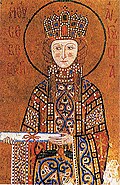 Irene of HungaryRight-Believing · Byzantine EmpressAug 13
 Cassian of ImolaMartyrAug 13
 Tikhon of ZadonskSaint · Bishop of VoronezhAug 13
 Maxim of MoscowFool-for-Christ · Fool for ChristAug 13
 Seraphim ZvezdinskyHieromartyr · Bishop of DmitrovAug 13
- Seridus of GazaVenerable · Abbot at GazaAug 13
 ConcordiaMartyr · Martyr of RomeAug 13
 Hippolytus of RomeMartyrAug 13
- Abundius of RomeMartyrAug 13