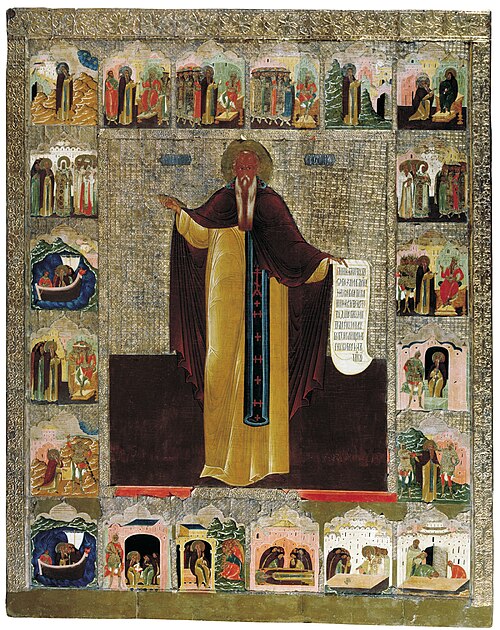
Venerable
Maximus the Confessor
Monk and Theologian
Monk and theologian who defended the faith against Monothelitism, tortured and exiled, died in Lazica in 662.
- Feast
- August 13old style August 26
- Reposed
- 6627th century
- Place
- Lazica
- Order
- Venerables
Life
The Holy Venerable Maximus the Confessor was a Byzantine monk and theologian, the foremost defender of the right faith against Monothelitism, the teaching that Christ has only one will. For his confession he was tried, beaten and had his tongue and right hand cut off, and he died in exile at the foot of the Caucasus in 662. The word Confessor shows that he suffered for the faith without being killed as a martyr. His writings entered the Philokalia, and the Church commemorates him on 21 January and 13 August (Menaion dates; Churches on the old calendar keep them thirteen days later by the civil calendar).
Youth and monastic life
The Greek Life of the saint says that he was born in Constantinople about 580, into a devout family. A later Syriac biography makes him a Palestinian, but scholars doubt it. He received a fine education in philosophy, grammar, rhetoric and theology, reading the ancient writers, Plato and Aristotle.
Because of his learning, Emperor Heraclius (610 to 641) made him his chief secretary, protoasekretis, and counsellor. Maxim saw, however, that the emperor and many others were touched by Monothelitism, and he left the court. He was tonsured in the monastery at Chrysopolis, across the Bosphorus, where after a few years the brethren chose him abbot. Even then he remained a simple monk, loved for his humility and wisdom.
The struggle for two wills in Christ
Monothelitism said that Christ, though he has two natures, divine and human, has only one will and one activity. It was an attempt to reconcile the Church with the Monophysites, who had not accepted the Council of Chalcedon. In 638 the emperor and Patriarch Sergius issued an edict, the Ecthesis, requiring all to accept the teaching of one will. Maxim saw that if Christ has no human will, man cannot be saved whole.
As the heresy spread, he went to the West, where it had been rejected, and strengthened the bishops of Africa. He lived many years at Carthage, a disciple of Saint Sophronius of Jerusalem, and studied the works of Gregory the Theologian and Dionysius the Areopagite. About 645 he held a public debate there with the former patriarch Pyrrhus before the African bishops, and Pyrrhus admitted his error. Maxim accompanied him to Rome, but Pyrrhus later returned to his false teaching.
In 648 Emperor Constans II issued a new decree, the Typos, forbidding any dispute about one will or two. Maxim urged Pope Martin to examine the question in a council. The Lateran Council of October 649 condemned Monothelitism and the Typos, and Maxim was among those who prepared its work.
Trial, torture and exile
Constans ordered Pope Martin and Maxim arrested. The pope was brought to Constantinople, condemned and exiled to the Crimea, where he died. Maxim was arrested in 653 or 654 and accused of treason. He was sent into exile in Thrace, at Bizya, and then brought again before judges. His enemies also charged him with helping the Arab conquests, which he rejected as slander.
In 662 he was tried once more, again as a heretic. Wishing to silence his mouth and stop his hand, the executioners cut out his tongue and cut off his right hand, together with two of his disciples, among them Anastasios. They were sent to Lazica, on the Black Sea coast, to the fortress of Schemarum, near Tsageri in present-day Georgia. The road was long and hard. After three years the Lord revealed to him the hour of his death, and he fell asleep on 13 August 662.
Miracles and relics
The Synaxarion says that three candles appeared over his grave and burned miraculously, a sign that he was a beacon of Orthodoxy in life and after death. Many healings took place at his tomb. His teaching on the two wills was confirmed by the Sixth Ecumenical Council at Constantinople (680 to 681), and Maxim was honoured as a saint soon after his death.
His right hand is kept at the Monastery of Saint Paul on Mount Athos. In 2010 his grave was found at Tsageri, and his relics were authenticated in 2015. The Tsageri monastery in Georgia is his resting place. In the Greek Menaion, 13 August commemorates the transfer of his relics to the Monastery of the Mother of God at Chrysopolis; the main commemoration on 21 January may have been chosen because 13 August falls in the leave-taking of the Transfiguration.
Writings and teaching
Maxim left a vast body of work. Among his writings are the Mystagogy, an explanation of the divine services, the Ambigua, clarifications of hard passages in Dionysius and Gregory the Theologian, the Questions to Thalassius, the Chapters on Love, commentaries on the Lord's Prayer and on Psalm 59, the Dispute with Pyrrhus and three hymns. He taught that human nature cannot reach God by itself, and that deification is a gift of the grace of the Spirit. His thought was carried forward by Saint Symeon the New Theologian and Saint Gregory Palamas.
Commemorated the same day August 13
 PontianHieromartyr · Bishop of RomeAug 13
 EudociaRight-Believing · Empress of ByzantiumAug 13
 RadegundVenerable · Frankish queen, founder of a conventAug 13
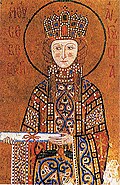 Irene of HungaryRight-Believing · Byzantine EmpressAug 13
 Cassian of ImolaMartyrAug 13
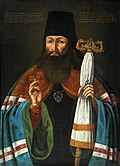 Tikhon of ZadonskSaint · Bishop of VoronezhAug 13
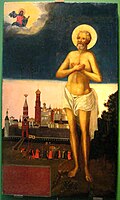 Maxim of MoscowFool-for-Christ · Fool for ChristAug 13
 Seraphim ZvezdinskyHieromartyr · Bishop of DmitrovAug 13
- Seridus of GazaVenerable · Abbot at GazaAug 13
 ConcordiaMartyr · Martyr of RomeAug 13
 Hippolytus of RomeMartyrAug 13
- Abundius of RomeMartyrAug 13