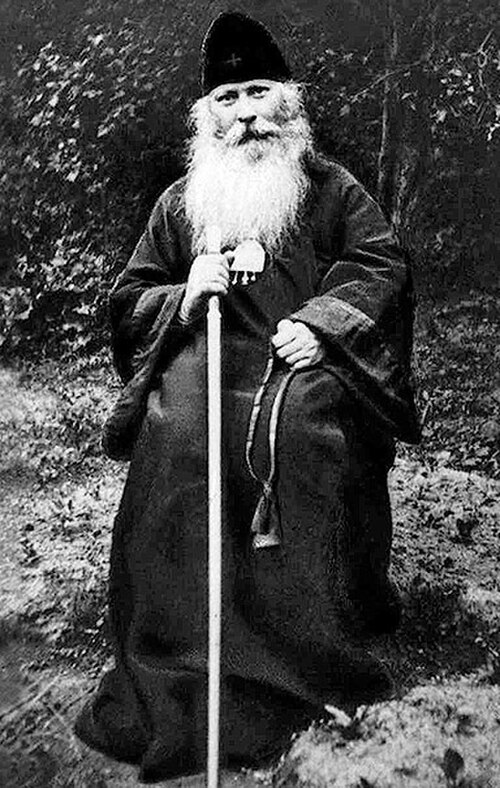
Hieromartyr
Seraphim Zvezdinsky
Bishop of Dmitrov
Bishop of Dmitrov and vicar of the Moscow diocese, executed at Ishim in 1937; canonized in 2000.
Life
Saint Seraphim (Zvezdinsky), Hieromartyr and Bishop of Dmitrov, vicar of the Moscow diocese, was a prayerful bishop and beloved preacher who passed through prisons and exile for fifteen years and was shot at Ishim in Siberia in 1937. He left sermons on the Divine Liturgy and many akathists and canons. He was numbered among the saints in 2000.
Family
In the world he was Nicholas Ivanovich Zvezdinsky, born in Moscow on 7 (20) April 1883. His father, Ivan Gavrilovich Bonefatyev, had first been a priestless Old Believer and then joined the Edinoverie, the Old Rite communities united with the Orthodox Church, which keep the rites from before Nikon's reform but recognise the canonical hierarchy. He changed his surname to Zvezdinsky and became a priest, serving in Rzhev and then in Moscow, where he was dean of all the Edinoverie churches. He was musically gifted with a fine voice and died in 1907. His mother, Evdokia Vasilyevna Slavskaya, the daughter of an Edinoverie priest, died when her son was two.
Childhood and education
From childhood he was constantly at the services, and his father taught him to love the services, the church, singing and reading. He graduated from the school of the Edinoverie church (1895), the Zaikonospassky theological school in Moscow (1899), the Moscow Theological Seminary (1905), as one of its best students, and the Moscow Theological Academy as a candidate of theology (1909). Already at the academy he became known as a gifted preacher.
The monk
He had a special love for Saint Seraphim of Sarov. In 1902 he fell gravely ill but recovered after praying before an icon of the elder Seraphim, who had not yet been glorified. After the canonisation, Nicholas's father composed a service to the saint. On 26 September 1908 Nicholas was tonsured a monk with the name Seraphim in honour of Saint Seraphim of Sarov; on 22 October 1908 he was ordained hierodeacon and on 8 July 1909 hieromonk.
He was a friend of Bishop Arseny (Zhadanovsky), the vicar of the Chudov Monastery in the Kremlin, and a spiritual son of Elder Alexis (Solovyov) of the Zosima Hermitage. From 10 December 1909 he taught Church history at the Bethany Seminary, and from 21 September 1912 homiletics at the Moscow Seminary.
On 10 June 1914 he was raised to archimandrite, and on 14 June he became Bishop Arseny's assistant at the Chudov Monastery. He was strict with himself and others in keeping the monastic rule. From August 1914 to August 1915 he served as inspector of the parish schools of Moscow and led the banner-bearers' brotherhood of the Chudov Monastery. In 1918 he was forced to leave the monastery and lived until 1919 with Bishop Arseny at the Seraphim-Znamensky skete.
Bishop of Dmitrov
In 1919 Patriarch Tikhon summoned him to Moscow to be consecrated bishop, which took place on 3 January 1920. At the meal after the consecration Metropolitan Sergius (Stragorodsky), who had taken part, showed him his spoon and advised him, half in jest and half in earnest, to get one, since he would have to go to prison, where it would be very useful. Patriarch Tikhon counselled him to walk the apostolic path, on foot where necessary, to be troubled by nothing, not to fear hardship and to endure everything, reminding him that a bishop is censed thrice three times not in vain, but for his labours, struggles and sufferings as a confessor and for guarding the Orthodox faith unto blood.
In Dmitrov he preached much and celebrated the Liturgy daily with great fervour. He founded the Brotherhood of the Life-giving Cross of the Lord, whose aim was that the faithful, united in prayer, should draw strength to build their lives according to Christ's commandments and to serve their neighbour for Christ's sake. He gave much attention to monastic life. From 1920 to 1922 he lived in Dmitrov in the clergy house of the church of the Kazan icon of the Mother of God, now a memorial museum.
First exile
On 12 December 1922 he was arrested in Moscow and held in the Lubyanka and then in Butyrka, where he fell gravely ill. There he wrote an akathist to the Lord Jesus Christ crowned with thorns and bearing the Cross. On 30 March 1923 he was sentenced to two years of exile in the Zyryan region, first at Ust-Sysolsk (today Syktyvkar), then in the village of Sredny Kolel. In this exile, as in the others, he wrote constantly to his flock, giving them spiritual guidance. He celebrated the Liturgy daily and during the day withdrew to pray in the forest.
In 1925 he returned to Moscow and also lived at the Anosin hermitage. He worked with the Patriarchal Locum Tenens, Metropolitan Peter (Polyansky), who in December 1925, before his own arrest, named him in his testament chairman of a council of the vicar bishops of Moscow for the temporary government of the diocese, but this council never came into being.
At Diveyevo
In the summer of 1926, at the demand of the political police, he was forced to move to Diveyevo, where he served until 8 September 1927, when the convent was closed. His sermons from that time were written down by T. A. Artsybusheva and circulated in samizdat in the 1980s. On 22 September 1927 he was arrested and held for two weeks, then summoned to Moscow by the security officer Yevgeny Tuchkov, who directed the struggle against the Church. Tuchkov asked him to cooperate with the authorities and with Metropolitan Sergius, who by then had issued his well-known Declaration under the threat of executions of clergy. Bishop Seraphim refused and asked to retire, which was granted in 1928.
From October 1927 he lived at Melenki in the Vladimir province. He regarded Metropolitan Sergius's course with reserve but did not join the organised opposition; he was close to those who did not commemorate the metropolitan at the services. Faithful from Dmitrov and Moscow came to him at Melenki.
Second exile
On 23 April 1932 he was arrested again, taken to the Lubyanka and Butyrka, and on 7 July 1932 sentenced to three years of exile in Kazakhstan. He was at Alma-Ata, Guryev and Uralsk, where he fell gravely ill with malaria. In January 1935 he was sent to Siberia, to Omsk and then to Ishim, where he remained after his term ended in May 1935.
Martyrdom
On 24 June 1937 he was arrested by the NKVD, together with some twenty people in Ishim who were or had been clergy, and accused of belonging to a counter-revolutionary organisation of the “True Orthodox Church”. He was held in the prisons of Ishim and Omsk. In three interrogations he did not admit guilt, and when asked whom he knew he replied that he knew no one among the clergy of Ishim and had met no one.
On 23 August 1937 the NKVD troika of the Omsk region sentenced him to death, on the grounds that he had not ceased his activity and that among the faithful of Ishim he “was reputed a holy man”. He was shot at Ishim on 26 August 1937 (13 August in the Old Style). His relatives were officially told that he had been sent to a camp and had died there. After his death his spiritual children wrote down and collected their memories of him.
Writings
He left sermons on the Divine Liturgy and studies on the angels, on monastic life in the writings of Saint Nilus of Sinai, on the Chudov Monastery in the time of Metropolitan Philaret and on the last days and Passion of the Lord, published in 1915-1917. He composed a “Lament of Repentance”, akathists to the Lord Jesus Christ (crowned with thorns, the Saviour of sinners in times of temptation, and an akathist of thanksgiving after Holy Communion), akathists to the Holy Cross and to the Myrrh-bearer Tamar, and canons to the Mother of God sung “in time of despair”.
Glorification
His name was included in the list of New Martyrs drawn up by the Russian Church Abroad for the canonisation of 1981. On 31 March 1999 the Holy Synod of the Russian Church approved the study of his life and death, and in August 2000 the Jubilee Council of Bishops numbered him among the New Martyrs of Russia. In 2004 a cross was set up on the site of a future church dedicated to him in the town of Iksha near Moscow, and on 28 November 2014 the saint's house-museum was opened in Dmitrov. He is commemorated on 13 (26) August.
Commemorated the same day August 13
 PontianHieromartyr · Bishop of RomeAug 13
 Maximus the ConfessorVenerable · Monk and TheologianAug 13
 EudociaRight-Believing · Empress of ByzantiumAug 13
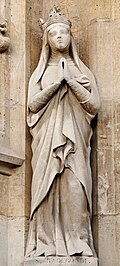 RadegundVenerable · Frankish queen, founder of a conventAug 13
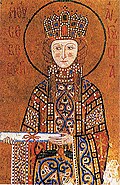 Irene of HungaryRight-Believing · Byzantine EmpressAug 13
 Cassian of ImolaMartyrAug 13
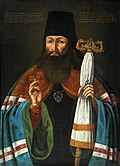 Tikhon of ZadonskSaint · Bishop of VoronezhAug 13
 Maxim of MoscowFool-for-Christ · Fool for ChristAug 13
- Seridus of GazaVenerable · Abbot at GazaAug 13
 ConcordiaMartyr · Martyr of RomeAug 13
 Hippolytus of RomeMartyrAug 13
- Abundius of RomeMartyrAug 13