Right-Believing
Irene of Hungary
Byzantine Empress
Hungarian princess, wife of Emperor John II Komnenos, founder of the Pantokrator Monastery in Constantinople.
- Feast
- August 13old style August 26
- Reposed
- 113412th century
- Place
- Constantinople
Life
Saint Irene of Hungary, born Piroska, the right-believing empress, was the wife of the Byzantine emperor John II Komnenos and, with him, the founder of the Pantokrator Monastery in Constantinople. The Orthodox Church honours her as a saint, and in Hungary she is venerated as Saint Piroska. She reposed on 13 August 1134 and is remembered on 13 August, under her monastic name Xene (Xenia).
Family and marriage
She was born in 1088, the daughter of King Ladislaus I of Hungary and Adelaide of Rheinfelden. She was orphaned young: her mother died in 1090 and her father in 1095. She grew up at the court of her cousin, King Coloman, who had her carefully educated. In 1104, at sixteen, she was betrothed to a man she had never met, John Komnenos, eldest son of Emperor Alexios I, who had been co-emperor with his father since 1092 and was expected to succeed him. Coloman arranged the marriage to improve relations with Byzantium. At Constantinople she received the Orthodox faith and the name Irene, like her mother-in-law, the empress Irene Doukaina.
Empress
John II came to the throne in 1118 and is regarded as one of the best emperors of the Komnenian dynasty. A lasting and harmonious marriage grew between him and Irene, as the sources of the time show. They had eight children, four sons and four daughters, among them Manuel, the future emperor Manuel I Komnenos. The poet Theodore Prodromos wrote verses for the empress and her children.
Irene took little part in government and gave herself to piety and to her children. She often received foreign delegations at court, pilgrims from the Holy Land and envoys from Hungary. With her husband she laid the foundation of the monastery of Christ Pantokrator, a complex with three churches, a monastery and a large hospital open to people of every rank, with a home for the elderly. The hagiographic sources see this foundation as the greatest work of her life. She supported the poor, the weak and the sick to the end, but she did not live to see the monastery consecrated.
Repose and veneration
Irene died unexpectedly on 13 August 1134 in Bithynia, where she had accompanied her husband on a campaign against the Seljuk Turks. Before her death she received, by Byzantine custom, the monastic tonsure with the name Xene. The emperor had her buried in the Pantokrator Monastery, where he too was later laid, and the monastery became the burial place of the Komnenoi and then of the Palaiologoi. Today the building is the Zeyrek Mosque in Istanbul.
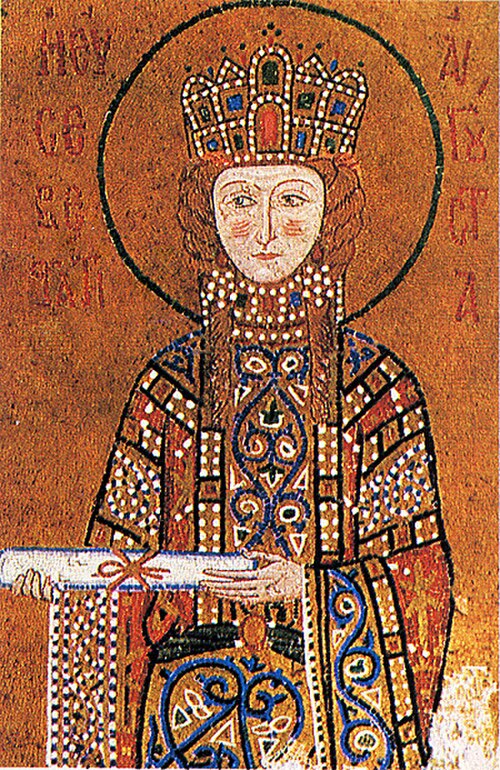
In the mosaic of Hagia Sophia in Constantinople, from about 1118, the empress appears beside John II before the Mother of God. She is the only member of the Árpád dynasty whose portrait made in her lifetime survives. She was canonized in the reign of her son Manuel I, most likely in 1166, the only canonized empress of twelfth-century Byzantium. The Church remembers her on 13 August.
Commemorated the same day August 13
 PontianHieromartyr · Bishop of RomeAug 13
 Maximus the ConfessorVenerable · Monk and TheologianAug 13
 EudociaRight-Believing · Empress of ByzantiumAug 13
 RadegundVenerable · Frankish queen, founder of a conventAug 13
 Cassian of ImolaMartyrAug 13
 Tikhon of ZadonskSaint · Bishop of VoronezhAug 13
 Maxim of MoscowFool-for-Christ · Fool for ChristAug 13
 Seraphim ZvezdinskyHieromartyr · Bishop of DmitrovAug 13
- Seridus of GazaVenerable · Abbot at GazaAug 13
 ConcordiaMartyr · Martyr of RomeAug 13
 Hippolytus of RomeMartyrAug 13
- Abundius of RomeMartyrAug 13