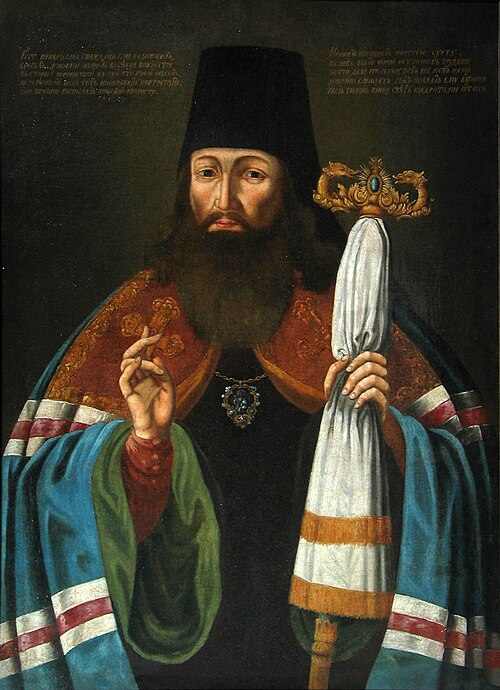
Saint
Tikhon of Zadonsk
Bishop of Voronezh
Bishop of Voronezh and spiritual writer of the eighteenth century, who retired to Zadonsk; glorified in 1861.
Life
Saint Tikhon of Zadonsk (in the world Timofey Savelyevich Sokolov, born Kirillov) was bishop of Voronezh, a spiritual writer and the most prominent Orthodox enlightener of eighteenth-century Russia. He was born in 1724 and fell asleep in 1783 at the monastery of Zadonsk, and the Russian Church glorified him as a saint in 1861. He is commemorated on 13 August (26 August on the new calendar) and on 19 July (1 August).
Childhood and studies
Timofey was born in the village of Korotsko, in the Novgorod region, in the family of a poor psalm-reader, Savely Kirillov. His father died early and the family was left in dire poverty, with four brothers and two sisters and no daily bread. It is told that a rich, childless coachman wished to take him as his son, and his mother, driven by want, led him by the hand to the man, but his eldest brother ran after them and, kneeling, begged her not to give him away, promising that they would work to teach him letters. His mother turned back home. Timofey himself remembered that when there was nothing to eat he harrowed a rich man's field all day to be given bread.
At thirteen he was brought to Novgorod and admitted to the Slavonic school of the bishop's house, and when the school was turned into a seminary, in 1740, he was transferred there at state expense as one of the most capable. He received bread and boiling water, and would sell half his bread to buy a candle and read. His wealthy classmates mocked him and, pointing to his bast shoes, sang in jest the hymn line praising him as a hierarch. He stayed in the seminary almost fourteen years, and in 1754 became a teacher, first of Greek, then of rhetoric and philosophy.
Monk and bishop
On 10 April 1758, at the age of thirty-four, he was tonsured a monk with the name Tikhon. In the following years he was prefect of the seminary, archimandrite at Tver and rector of the seminary there. On 13 May 1761 he was consecrated bishop of Kexholm and Ladoga, vicar of the Diocese of Novgorod, and on 3 February 1763 he was transferred to Voronezh. As bishop he worked to renew the spiritual life of the cathedral and the people, guided the clergy in their duties, set up a mission to bring sectarians back to Orthodoxy, made the courts aim at correction and not punishment, and defended his subordinates from the secular authorities. He promoted the people's education and turned the Slavonic-Latin school into a seminary, for which he drew up the curriculum and gathered experienced teachers. He wrote the treatise On the Seven Holy Mysteries, so that priests might understand the sacraments they served, another On the Mystery of Holy Repentance, as a guide for confessors, a long essay Flesh and Spirit, fifteen articles of exhortation for monks and several writings for the people, sent to all the churches.
At Zadonsk
After nearly five years as bishop, because of ill health, Tikhon asked to retire. At first he stayed at the Tolshevsky monastery near Voronezh, and in 1769 he settled at the monastery of Zadonsk, twenty-four kilometres from Voronezh, on the bank of the Don, where he remained until his death. There he gave himself to study and writing and kept a strict ascetic life: though frail, he ate very little and often worked with his hands. He was indulgent toward the weaknesses of others and was known for humility and forgiveness, although he himself was naturally nervous and sensitive. For all his learning he took lessons in spiritual life from simple, unlettered elders. His reputation for righteousness, humility, kindness and wisdom drew crowds to the monastery in search of his blessing and counsel. He did not shrink from leaving the monastery to go among the people when needed, and sometimes travelled farther.
His chief works of these years are A Spiritual Treasury Gathered from the World (1770) and On True Christianity (1776). He also wrote shorter works for monks, such as Rules of Monastic Life and Instruction to Those Who Turn from the Vain World. His life in the monastery was described by two of his cell attendants. He fell asleep on 13 August 1783.
Veneration
On 14 May 1846, during the building of the new cathedral at Zadonsk, his relics were uncovered, said to be incorrupt, and there were many reports of miracles at them. The Russian Church numbered him among the saints in 1861. A second commemoration, on 19 July (1 August), is linked with the uncovering of his relics. The saint is invoked especially in sicknesses of the soul. His life and writings inspired Dostoevsky, who reflected them in Bishop Tikhon in Demons and in Alyosha Karamazov and the Elder Zosima in The Brothers Karamazov. At Shanghai, Saint John of Shanghai founded an orphanage of Saint Tikhon of Zadonsk, which received nearly four thousand children.
Commemorated the same day August 13
 PontianHieromartyr · Bishop of RomeAug 13
 Maximus the ConfessorVenerable · Monk and TheologianAug 13
 EudociaRight-Believing · Empress of ByzantiumAug 13
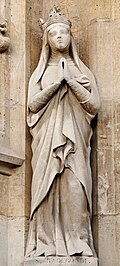 RadegundVenerable · Frankish queen, founder of a conventAug 13
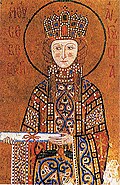 Irene of HungaryRight-Believing · Byzantine EmpressAug 13
 Cassian of ImolaMartyrAug 13
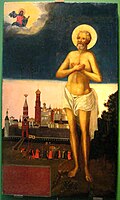 Maxim of MoscowFool-for-Christ · Fool for ChristAug 13
 Seraphim ZvezdinskyHieromartyr · Bishop of DmitrovAug 13
- Seridus of GazaVenerable · Abbot at GazaAug 13
 ConcordiaMartyr · Martyr of RomeAug 13
 Hippolytus of RomeMartyrAug 13
- Abundius of RomeMartyrAug 13