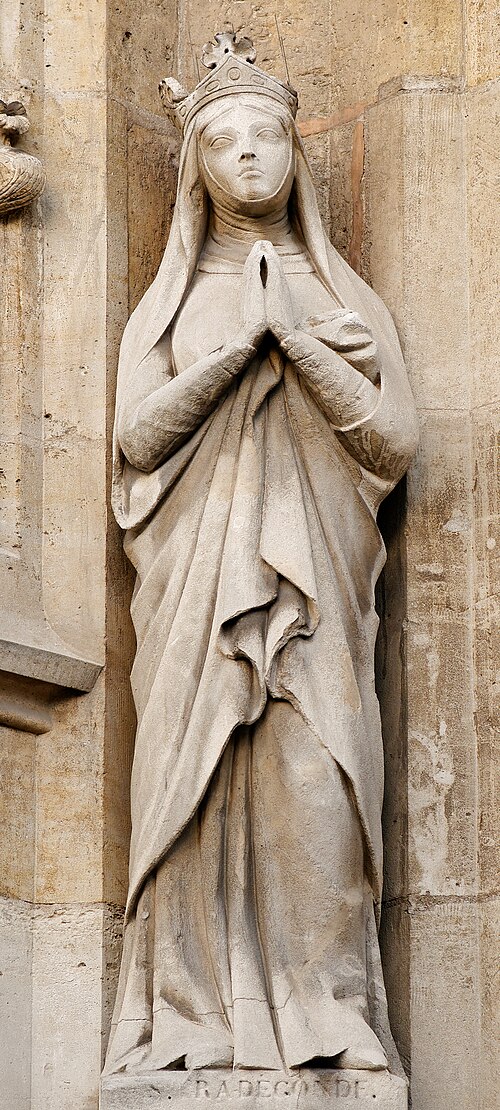
Venerable
Radegund
Frankish queen, founder of a convent
Princess of Thuringia and Frankish queen who founded the Abbey of the Holy Cross at Poitiers.
- Feast
- August 13old style August 26
- Reposed
- 5876th century
- Place
- Poitiers
- Order
- Venerables
Life
Venerable Radegund was a princess of Thuringia and queen of the Franks. After leaving her husband, King Chlothar I, she founded the Abbey of the Holy Cross at Poitiers. She is honoured as a saint of the undivided Church and commemorated on 13 August.
The princess
She was born around 520, the daughter of Berthachar, one of the kings of Thuringia. Her uncle Hermanfrid killed Berthachar in battle and took her into his household. In 531 the Frankish kings Theuderic and Chlothar I conquered Thuringia, and Chlothar took her back to Gaul as a child. She was raised for several years at his estate of Athies in Picardy, where she learned Latin and the Christian faith. Her brother, the last surviving male of the Thuringian royal house, was murdered on Chlothar's orders around 545.
The queen
Chlothar married her in 540, though he had other wives. Radegund had no children, and in the palace she lived more like a nun. She was known for her almsgiving and for harsh asceticism: she kept severe fasts, abstained from meat, fish and eggs and from wine and other strong drink, and in Lent gave up bread, oil and salt, drinking only a little water. When Chlothar ordered her brother killed, she fled the court and put herself under the protection of the Church. Bishop Medardus of Noyon ordained her a deaconess.
The monastery at Poitiers
Around 560 she founded the monastery of the Holy Cross at Poitiers, where she cared for the sick. The nuns lived under the Rule for Virgins of Saint Caesarius of Arles, which Radegund had received from her niece Caesaria: they had to read and write, read the Scriptures, copy manuscripts, and do weaving and needlework. Radegund urged that Agnes be made abbess and remained herself a simple nun. She was believed to have the gift of healing.
The abbey took its name from a relic of the True Cross that Radegund obtained from the Byzantine emperor Justin II. Bishop Maroveus of Poitiers refused to install it, but at her request King Sigebert I sent Eufronius of Tours to perform the ceremony. For the occasion the poet Venantius Fortunatus, a close friend of Radegund, composed hymns, among them Vexilla regis, still sung in the services of the Cross. She was also a friend of Saint Gregory of Tours, who wrote about her.
Repose and veneration
Radegund fell asleep in the Lord on 13 August 587. The funeral took place three days later and was attended by Venantius Fortunatus and Gregory of Tours. She was buried in the church that came to bear her name at Poitiers, and her tomb is still in its crypt, the centre of her veneration. The nun Baudonivia wrote her life, and Fortunatus also wrote of her. She is patroness of several churches in France and England and of Jesus College, Cambridge.
Commemorated the same day August 13
 PontianHieromartyr · Bishop of RomeAug 13
 Maximus the ConfessorVenerable · Monk and TheologianAug 13
 EudociaRight-Believing · Empress of ByzantiumAug 13
 Irene of HungaryRight-Believing · Byzantine EmpressAug 13
 Cassian of ImolaMartyrAug 13
 Tikhon of ZadonskSaint · Bishop of VoronezhAug 13
 Maxim of MoscowFool-for-Christ · Fool for ChristAug 13
 Seraphim ZvezdinskyHieromartyr · Bishop of DmitrovAug 13
- Seridus of GazaVenerable · Abbot at GazaAug 13
 ConcordiaMartyr · Martyr of RomeAug 13
 Hippolytus of RomeMartyrAug 13
- Abundius of RomeMartyrAug 13