Venerable Martyr
Euthymius the New of Athos
An Athonite monk who died a martyr for his faith in Christ under Ottoman rule.
Life
Holy Venerable Martyr Euthymius the New of Athos, martyr at Constantinople, was one of the three venerable Athonite martyrs, Acacius, Euthymius and Ignatius, who suffered under Ottoman rule, at a time when many Christians who had yielded under pressure were returning to confess their faith in Christ.
Acacius
Acacius, given at nine to a shoemaker who beat him daily, wishing to escape this visible tyrant, fell into the claws of the invisible one. Weakened by beatings, he was consoled by two Ottoman women, whose cunning kindness led him to renounce Christ. Nine years he then lived in a rich house, in plenty, but at eighteen he went to Thessalonica and abandoned the Muslim faith.
His mother, blessing him to go to the Holy Mountain, said to him: Since you renounced Jesus Christ of your own will, in the same way you must confess Him boldly before the Turks. Labouring at Hilandar and Iveron, he learned of the recently martyred Euthymius and Ignatius and wished to be like them. Dressed in Turkish clothes, he came to the Ottoman Porte, entered the steps of the court and confessed Christ, the true God.
Ignatius
Ignatius, in the world John, died on 8 October 1814 at Constantinople; he was probably of Bulgarian origin, born at Stara Zagora, whose parents, George and Maria, moved to Plovdiv. From childhood he was distinguished by piety and for six years lived in the Rila Monastery, obeying an elder. He had returned to Plovdiv when the Turks were gathering men into the army to suppress the uprising in Serbia.
His father refused to fight against his brothers in faith and was cruelly killed, and his mother and two sisters were forced to convert to Islam. Learning of it, John hid with a pious old woman; his sisters betrayed him to the Turks, but he managed to escape. He stayed some time at Bucharest, then set out for the Holy Mountain and at Shumen met Eleutherius, an acquaintance from Bucharest, who had gone over to Islam.
His friend's renunciation disturbed him. On the road he was seized by Turks and, from fear, promised also to convert to Islam. On Athos he visited several monasteries, stayed in the skete of Saint Anne, then in the skete of Iveron dedicated to Saint John the Forerunner, where his guides were the spiritual father Nicephorus and the elder Acacius. Learning of the martyrdom at Thessalonica of the Holy Martyr David, in 1813, and of his friend Eleutherius, who had received monasticism with the name Euthymius, a martyr's death on 22 March 1814, John resolved to suffer for Christ and so to redeem the sin of faint-heartedness. The elder Acacius tonsured him a monk with the name Ignatius and blessed him for martyrdom.
On 29 September 1814 Ignatius came to Constantinople with the monk Gregory, who had earlier accompanied Euthymius. After several days, on a Tuesday, having received the Holy Mysteries, he dressed in Turkish clothes and went to the court session. There he tore the turban from his head, threw it to the ground and said that in his youth he had lied under compulsion by promising to renounce the faith, and now he took back his word and confessed Christ, the true God.
The judge urged him to change his decision, but he boldly rebuked the religion of the Muslims. They shut him in prison, where for two days they tried by persuasion and torture to make him renounce Christ, but the martyr was unshaken. Then he was condemned and hanged. After three days the monk Gregory ransomed his relics and on 20 October carried them to Athos, where he laid them with the relics of the martyr Euthymius in the new church of the skete of Saint John the Forerunner.
The honoured head of Ignatius is in the Russian Monastery of the Great Martyr Panteleimon on Athos, and particles of his relics are kept at the skete of Saint John the Forerunner and at the Iveron Monastery.
Veneration
Their veneration is widespread among Athonite monks. Their commemoration is kept on the day of the martyrdom, on 1 May with the venerable martyrs Euthymius the New and Acacius the New, and in the Synaxis of the Venerable Fathers of Athos. The life of Ignatius and his service were written by the monk Onuphrius of Iveron and first published at Athens in 1862. In honour of Ignatius, Euthymius the New and Acacius the New a common service and a eulogy were also composed.
The Synaxarion commemorates Euthymius on 14 May and in the Synaxis of the Venerable Fathers of Athos, which in the Russian calendar falls on 4 July, but is a movable day.
Commemorated the same day May 1
 JeremiahProphet · The ProphetMay 1
 Tamar of GeorgiaRight-Believing · Queen of GeorgiaMay 1
 Sigismund of BurgundyPassion-Bearer · King of the BurgundiansMay 1
 Bertha of KentRight-Believing · Queen of KentMay 1
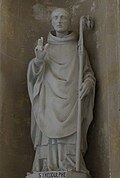 Theodulf of OrléansSaint · Bishop of OrléansMay 1
 Æthelred of MerciaRight-Believing · King of MerciaMay 1
 OrientiusSaint · Latin Christian poetMay 1
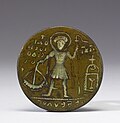 Isidore of ChiosMartyrMay 1
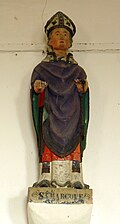 Marculf of NantusVenerable · Abbot in the CotentinMay 1
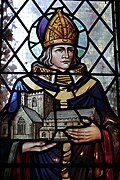 Asaph of LlanelwySaint · First Bishop of St AsaphMay 1
 AndeolusMartyr · Missionary in GaulMay 1
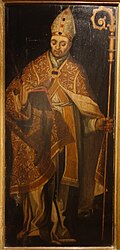 Torquatus of GuadixSaint · Bishop of GuadixMay 1