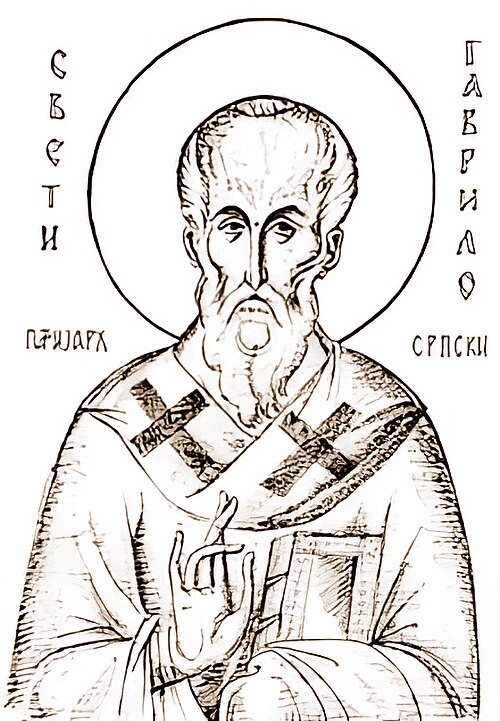
Hieromartyr
Gabriel I of Peć
Patriarch of Peć
Patriarch of Peć from 1648 to 1655, killed by the Ottomans; commemorated on December 13.
- Feast
- December 13old style December 26
- Reposed
- 165917th century
- Place
- Bursa
- Order
- Martyrs
Life
Saint Gabriel I Rajić (Rašković), Hieromartyr, patriarch of Peć between 1648 and 1655, shepherded the Serbian Church in a hard time, when the Serbian people had neither state nor ruler, and the burden of preserving national consciousness fell on the shoulders of the Church. He made long journeys for help, as far as Moscow, and on his return was falsely accused by the Turks and hanged at Bursa on 18 July 1659, because he would not renounce Christ. The Serbian Church commemorates him on 13 December and in the Synaxis of the Serbian saints.
Origin and the road to the patriarchate
He was born at Štitkovo, near Nova Varoš, in Stari Vlah, in a family of landowners, the Rajićs. The Serbian and Russian sources give the year 1595, an English source speaks of 1605 to 1610. Before he was elected patriarch he was bishop of Smederevo and, in 1643, metropolitan of Raška (Novi Pazar). Around 1644 he led the rebuilding of the monastery of the Holy Archangels Michael and Gabriel in the Kovilje Mountains, where he lived for a time. At the beginning of 1648, after the repose of Pajsije I, he was elected patriarch of Peć at a council held at Morača monastery. He came to head the Serbian Church in a hard period, when the Serbs had neither state nor prince, and Catholic pressure in the Balkans grew with the Cretan war. At that time false acts of supposed councils at Morača (1648 and 1653) appeared, which scholarly study has shown to be forgeries born of Catholic proselytism.
In 1649 he went to Constantinople, to secure his position and ask the lifting of a tax laid by the Porte. In 1650 and 1651 he visited his dioceses, teaching the people and strengthening them in the truths of the Orthodox faith. In 1652 he met Pavlin Demski of the Congregation for the Propagation of the Faith and the Catholic bishop of Prizren, Fran Stojimirović, through whom he sought the help of Rome against the Turks; a union was also spoken of, but no agreement was reached.
The journey to Russia
To collect alms he set out in 1653 for Moscow, passing first by Krušedol monastery, then through Wallachia and Moldavia. At Târgoviște he stayed with Voivode Matei Basarab and worked for his reconciliation with Bohdan Khmelnytsky, hetman of the Ukrainian Cossacks, who had risen against Poland in 1648. He stayed at the same time with Patriarch Macarius of Antioch, who, on his way to Russia, had stopped in Wallachia. He was not allowed to enter Russia in 1653, because seven years had not passed since the last visit of representatives of the patriarchate of Peć, as agreed. He reached Moscow in May 1654 (28 May by one source) and was received twice by the tsar. On 5 June he said at the Ambassadorial Office that the patriarchate of Peć had eight metropolitans and thirty-two bishops. He brought with him two books for printing, the "Lives of the Serbian Emperors and Patriarchs" and the "Typikon" of Nilus Cabasilas against the Latin heresy, which he thought indispensable to his flock, exposed to Catholic propaganda. In Moscow the plague of 1654 found him. He was in friendship and brotherly love with Patriarch Nikon, took part in the synod of Moscow and supported Nikon's reform. In 1655 (by another source, 1656) he signed the letter of Patriarch Macarius III of Antioch to Nikon, which condemned those who held the sign of the cross with two fingers, and that condemnation was accepted by the council of the Church of Moscow as a conciliar decision.
Under the pressure of circumstances he decided to remain in Russia and sent his suite back to Serbia with the message to elect a new patriarch. Later he changed his mind and wished to return. Perhaps one reason was that his successor, Maximus, held to an understanding with the Turkish authorities and gave up any cooperation with the Christian allies that Gabriel had strengthened. The Bulgarian source says that at Moscow his rank as patriarch was not respected by Nikon, who called him only archbishop of Serbia. He was not easily let go from Moscow, and only when he said he wished to make a pilgrimage to Jerusalem was he allowed. Instead of going to Jerusalem, he returned to Serbia. In December 1657, according to a report of Metropolitan Michael of Kolasia, he was alive, had been seen in Constantinople and the Turks had done him no harm, but Maximus I had been elected to the throne. Gabriel wished to remain on the throne as before, but the authorities did not allow it.
Accusation, sentence and death
According to the "Peć Legend", after his return to Serbia he was slandered to the sultan, saying he had advised the Russian tsar to attack the Turks, that he had baptized some Jews and was working to Christianize Turks. He was taken to Bursa, where the sultan and the grand vizier Köprülü Mehmed Pasha then were. The vizier, knowing the charges were untrue, told him that he was accused of betraying the empire and by law deserved death. He was asked to renounce his faith in exchange for his life, with a promise of honour and well-being in the empire. Saint Gabriel declared with courage that he was innocent, showed the injustice of the sentence and added that for Christ he would bear any torment and not change his faith for any earthly good. The patriarch was subjected to cruel tortures, to break his will and make him renounce Christ, but he remained unmoved. Seeing that he could not shake him, they condemned him to death. He was hanged at Bursa, between two pillars, on 18 July 1659. The priest Pavle secretly buried his body. He was also a calligrapher and scholar. After his martyr's death he was numbered among the saints, and at Dubnica monastery, near Nova Varoš, a monument in his honour is to be raised.
The Serbian Church commemorates him on 13 December and on 30 August, in the Synaxis of the Serbian saints.
Commemorated the same day December 13
 SolomonProphet · King of IsraelDec 13
 JacobRighteous · The Patriarch IsraelDec 13
 LucyMartyr · of SyracuseDec 13
 RebeccaRighteous · The MatriarchDec 13
 DeborahProphet · Prophetess and JudgeDec 13
 BenjaminRighteous · The PatriarchDec 13
 MiriamProphet · Sister of Moses and AaronDec 13
 RuthSaint · Ancestor of the LordDec 13
 NathanProphet · The ProphetDec 13
 JudocVenerable · Hermit of Breton birthDec 13
 HezronRighteous · Ancestor of the SaviorDec 13
 JudithSaint · Widow who saved BethuliaDec 13