Martyr
Grata of Bergamo
Martyr of Bergamo
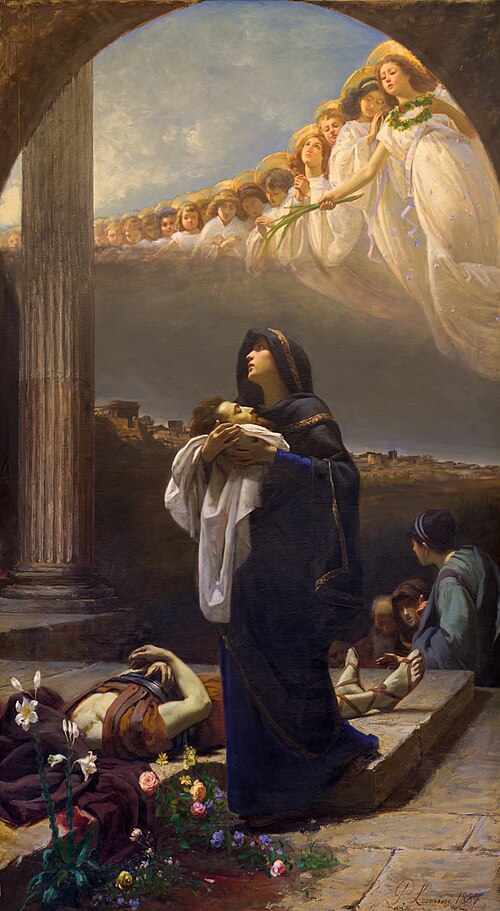
Martyr of Bergamo, daughter of Duke Lupus and sister of Saint Asteria, who died in 307.
Life
Saint Grata of Bergamo was a martyr of Bergamo in Italy, the daughter of Duke Lupus and the sister of Saint Asteria, who died in 307 according to the most widespread tradition. Our sources show her venerated in the Catholic Church, as patron of the city, not in the Orthodox. The sources do not agree on the day of commemoration: the record gives 1 May, the English source 4 September, and the Russian source 12 May.
Her parents were Lupus and Adelaide, duke and duchess of Bergamo. According to the writer Agnes Dunbar, Grata's husband was a great king in Germany. She did not become a Christian until after his death, when she converted her parents to Christianity and persuaded them to build the cathedral of Bergamo. She became known as a holy woman in Bergamo, especially for her zeal in securing Christian burial for the bodies of martyrs. She built three churches and a hospital for the poor in Bergamo. Together with her sister Asteria she buried the body of Saint Alexander of Rome, after Grata wrapped his head in a napkin. After her parents' death she governed Bergamo with wisdom and benevolence. Grata was put to death for burying Alexander. She is co-patron of the city of Bergamo. Women writers in particular wrote about her: a biography of 1596 by Flavia Grumelli and one of 1723 by the nun Maria Aurelia Tassis. The church of San Grata Inter Vites (among the vines, so called because until the seventeenth century it was surrounded by vineyards) in Bergamo, where she was buried until the year 1000, is dedicated to her; her body was moved to another church, also named for her, inside the city's walls.
The Russian source shows that, according to an old tradition, Grata lived between the fourth and sixth centuries and that, a few days after the execution of Saint Alexander, she found his remains, around which, in a few drops of blood, lilies had bloomed, gathered them and buried them in a garden outside the city. According to another tradition, Grata lived between the eighth and ninth centuries and was the daughter of Lupus, the Lombard duke of Bergamo, conquered by Charlemagne and converted to the Catholic faith; probably the traditions concern two different saints. According to the first tradition, Grata built three churches in Bergamo in honour of Saint Alexander and another church on the saint's tomb (the basilica and ancient cathedral of Saint Alexander, demolished in 1561 during building works); according to the other, with the help of her powerful family and other noble families of Bergamo, she built churches on each of the three hills of the city. After the conversion of her parents and husband, Grata remained a widow and devoted herself to the service of the sick and needy in the hospital she founded.
Asteria of Bergamo (Hesteria, died 307), her sister, is regarded as patroness of Bergamo. Asteria and Grata, in the time of Diocletian and Maximian, buried Alexander of Rome. Grata was put to death, Asteria buried her, and then she was arrested and tortured. An ancient epitaph describes her as beheaded as a Christian under Diocletian, when she had already reached her sixtieth year. Asteria, Grata and Alexander were all martyred for refusing to worship the god Jupiter, as Maximian had ordered. Asteria's feast day is 10 August.
Commemorated the same day May 1
 JeremiahProphet · The ProphetMay 1
 Tamar of GeorgiaRight-Believing · Queen of GeorgiaMay 1
 Sigismund of BurgundyPassion-Bearer · King of the BurgundiansMay 1
 Bertha of KentRight-Believing · Queen of KentMay 1
 Theodulf of OrléansSaint · Bishop of OrléansMay 1
 Æthelred of MerciaRight-Believing · King of MerciaMay 1
 OrientiusSaint · Latin Christian poetMay 1
 Isidore of ChiosMartyrMay 1
 Marculf of NantusVenerable · Abbot in the CotentinMay 1
 Asaph of LlanelwySaint · First Bishop of St AsaphMay 1
 AndeolusMartyr · Missionary in GaulMay 1
 Torquatus of GuadixSaint · Bishop of GuadixMay 1