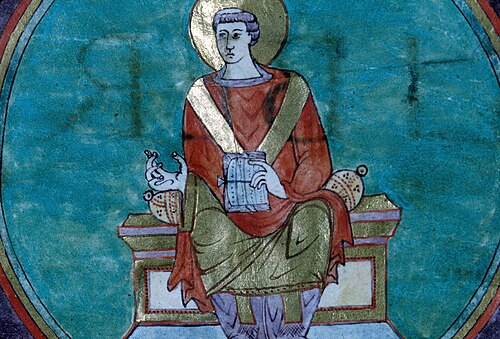
Saint
Gregory of Tours
Bishop of Tours
Bishop of Tours under the Merovingians, a historian called the father of French history.
- Feast
- November 17old style November 30
- Reposed
- 5946th century
- Place
- Tours
- Order
- Hierarchs
Life
Gregory of Tours was bishop of Tours in the Merovingian age, from 573 to 594, and a writer known as the father of French history. His book, the History of the Franks, is the main source for that time of passage from the Roman world to the early Middle Ages. The Orthodox Church commemorates him on 17 November among the saints of the West before the division of the Churches, together with the Venerable Aredius, abbot of Limoges, and the Venerable Vulfolaic, stylite of Trier (the Menaion date; by the civil calendar of Churches on the old calendar it falls on 30 November).
Family and youth
He was born around 30 November 538 in the Auvergne, in the region of Clermont, with the name Georgius Florentius. His father, Florentius, was a senator, and his mother, Armentaria, belonged to a family that had given several bishops. He himself said that he was related to thirteen of the eighteen bishops of Tours before him.
His father died when he was small. The boy was raised by his uncle Gallus, bishop of Clermont, and then by Gallus's successor Avitus, who ordained him deacon. During a grave illness he went in devotion to the tomb of Saint Martin at Tours, where he was healed. From then on he set out on the path of the Church.
Bishop of Tours
After the death of Bishop Euphronius, the clergy and people of Tours chose Gregory. The city's envoys overtook him at the court of King Sigebert of Austrasia and, though he resisted, he was consecrated in August 573, at the age of thirty-four, by Bishop Giles of Reims.
Tours was a place of pilgrimage at the tomb of Saint Martin, with a hospital and a refuge for the hunted, standing on the road between the Frankish north and Aquitaine. Here Gregory came to know almost all the powerful people of his time and dealt with the kings Sigebert, Chilperic, Guntram and Childebert II. He took part in the council of Paris in 577. His relations with Chilperic and his wife Fredegund were strained. When a rumour spread that he had spoken ill of the queen, Chilperic had him arrested and tried for treason, which put both his see and his life at risk.
His writings
His chief work, the Ten Books of Histories (the History of the Franks), begins with the history of the world from creation, passes to the Christianization of Gaul, to the life of Saint Martin and to King Clovis, who was baptized at the urging of his wife Clotilda, and then tells at length of the reigns of the Frankish kings down to about 591. From the fifth book he writes of his own time, as an eyewitness. The last book names the eighteen bishops of Tours and lists his writings. The History has a closing note written in the year of his death, 594.
Gregory also wrote a number of books on the lives and miracles of the saints. Among them are the Life of the Fathers, twenty lives of bishops, monks and hermits of Gaul, among which that of Saint Nicetius of Trier stands out, the Glory of the Martyrs, begun in 587, the Glory of the Confessors, and the books on the miracles of Saint Martin. His aim was to kindle his readers with the zeal by which the saints climbed to heaven, and to show the faithful in each place the work of God through the relics and tombs of the saints there.
He wrote in a late Latin and often complained of his grammatical mistakes. Yet he knew Holy Scripture well. Historians today observe that his stories of cruelty and vanity around the kings stand in contrast with the miracles of the saints, and that this contrast is the thread that binds his work.
His repose and veneration
Gregory died at Tours on 17 November 594. The people counted him a wonderworker and a saint. The Orthodox Church places him on its list of the saints of the West before the division. The sources we used give no details about his relics or his tomb.
Commemorated the same day November 17
 Hilarius of RomeSaint · Bishop of RomeNov 17
 Gregory the WonderworkerSaint · Bishop of NeocaesareaNov 17
 Hilda of WhitbyVenerable · Abbess of WhitbyNov 17
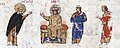 Lazarus the IconographerConfessor · Iconographer of ConstantinopleNov 17
- Maximus III of ConstantinopleSaint · Patriarch of ConstantinopleNov 17
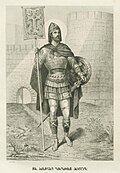 GobronMartyr · Georgian military commanderNov 17
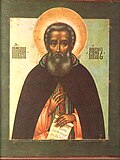 Nikon of RadonezhVenerable · Abbot of the Trinity MonasteryNov 17
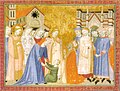 Eugenius of FlorenceSaint · Deacon at FlorenceNov 17
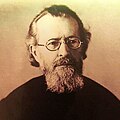 Sebastian DabovichVenerable · Archimandrite and missionary in AmericaNov 17
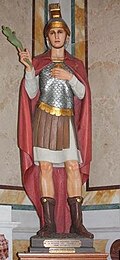 Laverius of GrumentumMartyrNov 17
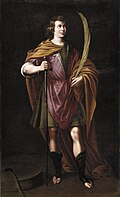 Acisclus of CordobaMartyr · Martyr of CordobaNov 17
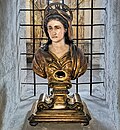 Victoria of CordobaMartyrNov 17