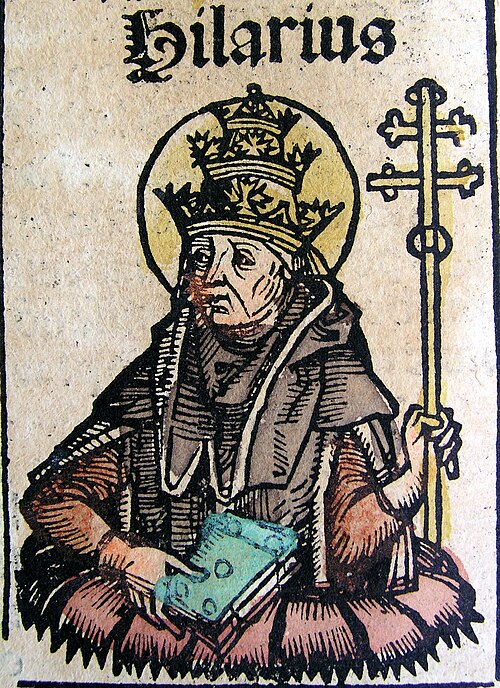
Saint
Hilarius of Rome
Bishop of Rome
Bishop of Rome from 461 to 468, sent by Leo the Great as legate to the Council of Ephesus in 449.
- Feast
- November 17old style November 30
- Reposed
- 4685th century
- Place
- Rome
- Order
- Hierarchs
Life
Saint Hilarius of Rome was bishop of Rome from 461 to 468. Born in Sardinia, the son of Crispinus, he was a disciple and archdeacon of Saint Leo the Great, a defender of the rights of the see of Rome and of the right faith in troubled times. The Orthodox Church commemorates him on 28 February, and the Roman Catholic Church on 17 November.
At the Second Council of Ephesus
In 449, as archdeacon, Hilarius was sent by Pope Leo with Bishop Julius of Puteoli as legate to the Second Council of Ephesus. The pope's letter, which was to be read there, was never read at all, because the emperor's letter was demanded first. Hilarius firmly opposed the condemnation of Patriarch Flavian of Constantinople, pronouncing in Latin a single word, Contradicitur, by which he annulled the sentence in Leo's name. In this way he drew the enmity of Dioscorus, patriarch of Alexandria, who presided over the synod. Flavian died shortly afterward, on 11 August 449, of the blows received from the followers of Dioscorus.
Dioscorus tried to stop Hilarius from reaching Rome or Constantinople by having the roads and harbours of Ephesus watched. With great difficulty he nevertheless escaped and returned to Rome by a roundabout route to bring the pope the news of what had happened. Later he built an oratory at the Lateran in honour of Saint John the Evangelist, to whom he attributed his escape.
Bishop of Rome
He was elected on 17 November 461 and consecrated on 19 November. He continued the policy of Leo, who had obtained from Emperor Valentinian III the famous edict of 445 on the primacy of the bishop of Rome. Hilarius worked to strengthen church discipline in Gaul and Spain. At Narbonne the archdeacon Hermes had become bishop without the pope's consent, and a Roman synod in November 462 left him bishop in title, without episcopal powers. In his letter to the bishops of the provinces Hilarius ordered that important matters be brought before the Apostolic See, that no bishop leave his diocese without the written permission of his metropolitan, and that church property not be sold without the synod's examination. In 463 he settled, through the bishop of Arles, the case of Mamertus of Vienne, who had consecrated a bishop at Die outside his jurisdiction.
In Rome he opposed the edict of toleration for schismatic sects given in 467, inspired by Philotheus, a favourite of Emperor Anthemius. It is said that he went to the tomb of Saint Peter, where he called on the emperor to answer and to promise that he would not allow schismatic assemblies in Rome.
Buildings and repose
The Book of the Pontiffs, the main source about him, praises him for the churches and buildings he raised in Rome: a chapel of the Holy Cross in the Lateran baptistery, two oratories dedicated to John the Baptist and John the Evangelist, convents, public baths and libraries near the basilica of Saint Lawrence outside the Walls.
He fell asleep on 29 February 468 and was buried in the basilica of Saint Lawrence outside the Walls.
Commemorated the same day November 17
 Gregory of ToursSaint · Bishop of ToursNov 17
 Gregory the WonderworkerSaint · Bishop of NeocaesareaNov 17
 Hilda of WhitbyVenerable · Abbess of WhitbyNov 17
 Lazarus the IconographerConfessor · Iconographer of ConstantinopleNov 17
- Maximus III of ConstantinopleSaint · Patriarch of ConstantinopleNov 17
 GobronMartyr · Georgian military commanderNov 17
 Nikon of RadonezhVenerable · Abbot of the Trinity MonasteryNov 17
 Eugenius of FlorenceSaint · Deacon at FlorenceNov 17
 Sebastian DabovichVenerable · Archimandrite and missionary in AmericaNov 17
 Laverius of GrumentumMartyrNov 17
 Acisclus of CordobaMartyr · Martyr of CordobaNov 17
 Victoria of CordobaMartyrNov 17