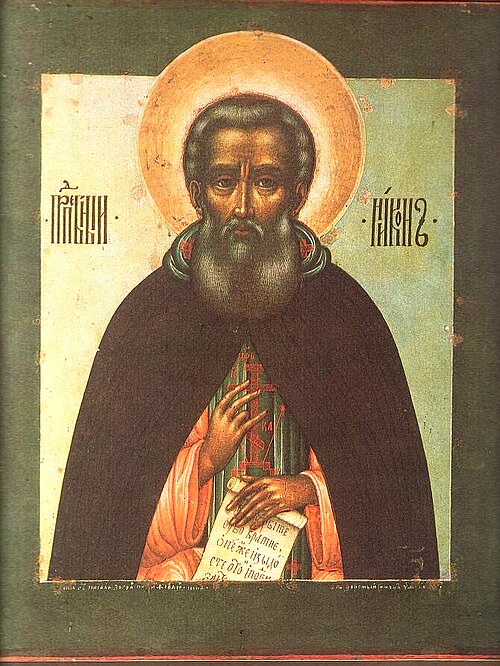
Venerable
Nikon of Radonezh
Abbot of the Trinity Monastery
Disciple of Sergius of Radonezh and second abbot of the Trinity Monastery, died in 1426.
- Feast
- November 17old style November 30
- Reposed
- 142615th century
- Place
- Sergiyev Posad
- Order
- Venerables
Life
Saint Nikon of Radonezh (1352-1426) was a disciple of Saint Sergius of Radonezh and the second abbot of the Trinity Monastery, which was to become the Trinity-Sergius Lavra. He raised the monastery from the ruins left by the invasion of Edigu, found the relics of Saint Sergius and laid the foundations of the stone church of the Trinity. He was canonized by the Moscow council of 1547, under Metropolitan Macarius. He is commemorated on 17 November (30 November by the new calendar).
Youth and discipleship
He was born in 1352 at Yuryev-Polsky; a Serbian source gives the year 1350. According to his life, he came from a wealthy merchant family. From a young age he desired monastic life and left his parents' home. Hearing of Sergius of Radonezh, he wanted to be his disciple, but he came to his monastery and was not received into the brotherhood. Sergius sent him to his disciple Athanasius, abbot of the Vysotsky monastery near Serpukhov, founded by Sergius at the request of Prince Vladimir the Bold. Nikon obeyed. Ordained priest, around 1380 he was tonsured a monk at Vysotsky. Having reached the age of thirty, he came again to Sergius, in 1382, and was received into the brotherhood of the Trinity. Seeing his virtues, Sergius took him into his cell and made him a close disciple, although an English-language source notes that it was mainly in the last years of the elder's life that he was close to him.
Abbot of the Trinity
The sources do not agree on how he became abbot. The Russian one says that Sergius himself, half a year before his death in 1392, retired into seclusion and made Nikon abbot. The English one says that after the death of Sergius, in 1392, Nikon began to fulfil the duties of abbot. In both accounts Nikon remained in office only a short while and then withdrew into seclusion, leaving the leadership of the monastery to Saint Sabbas of Storozhi, who was abbot from 1392 to 1398. In 1398, at the request of Prince Yuri Dmitrievich of Zvenigorod, Sabbas left and founded near Zvenigorod the Savvino-Storozhevsky monastery. Nikon came out of seclusion and took the leadership of the Trinity again.
Under him the monastery was destroyed in 1408 by the armies of Khan Edigu, and only the books and sacred vessels could be saved. Epiphanius the Wise and the brothers fled to Tver. Nikon began the rebuilding. Between 1409 and 1411 he bought nearby estates, among them lands at Dmitrov and Radonezh, and expanded the monastery's holdings. In 1411 the new wooden cathedral of the Trinity was completed. On 5 July 1422, at the laying of the foundation of the stone church dedicated to the Holy Life-Giving Trinity, he found the relics of Saint Sergius. To adorn the church he invited the icon painters Daniel Chorny and Andrei Rublev. Church tradition, accepted by most scholars, attributes to him the commission given to Rublev, "in praise of Saint Sergius of Radonezh", of the famous icon of the Trinity. In his time the Trinity monastery came to hold an important place in the spiritual life of Russia and became a place of pilgrimage.
Nikon reposed on 17 November 1426 and was buried beside the shrine of Saint Sergius. The brothers built a wooden chapel beside the monastery for his relics, where they also laid twelve disciples of Sergius and the disciple-founder Epiphanius, who wrote his life.
Veneration
Under Metropolitan Jonah of Moscow, Hieromonk Pachomius the Logothete wrote the life and service of Saint Nikon. His veneration began at the Trinity monastery and then spread to other monasteries, partly through the frequent visits of the ruling family, beginning with Grand Prince Vasily II, who took the monastery under his protection in 1456. On 25 February 1547 the church council in Moscow, under Metropolitan Macarius, established the general veneration of Saint Nikon, the wonderworker of Radonezh, and fixed his day on 17 November. He was counted among the "new wonderworkers". In 1548 a small stone church was built over his grave, of which only part of the foundation survives. In 1623-1624 the present church, without pillars, with one apse and one dome, was added to the south wall of the Lavra's Trinity cathedral on the site of the first. The shrine with the holy relics stands by the north wall of the church. The image of the saint on the shrine and the icon "Saint Nikon went out of his cell and saw the holy metropolitans of Moscow Peter and Alexis and Saint Sergius going toward the church" were made by the nun Juliana (Sokolova). The service in his church is held on the day of his commemoration, 30 November by the new calendar.
Commemorated the same day November 17
 Hilarius of RomeSaint · Bishop of RomeNov 17
 Gregory of ToursSaint · Bishop of ToursNov 17
 Gregory the WonderworkerSaint · Bishop of NeocaesareaNov 17
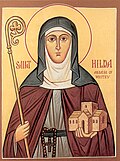 Hilda of WhitbyVenerable · Abbess of WhitbyNov 17
 Lazarus the IconographerConfessor · Iconographer of ConstantinopleNov 17
- Maximus III of ConstantinopleSaint · Patriarch of ConstantinopleNov 17
 GobronMartyr · Georgian military commanderNov 17
 Eugenius of FlorenceSaint · Deacon at FlorenceNov 17
 Sebastian DabovichVenerable · Archimandrite and missionary in AmericaNov 17
 Laverius of GrumentumMartyrNov 17
 Acisclus of CordobaMartyr · Martyr of CordobaNov 17
 Victoria of CordobaMartyrNov 17