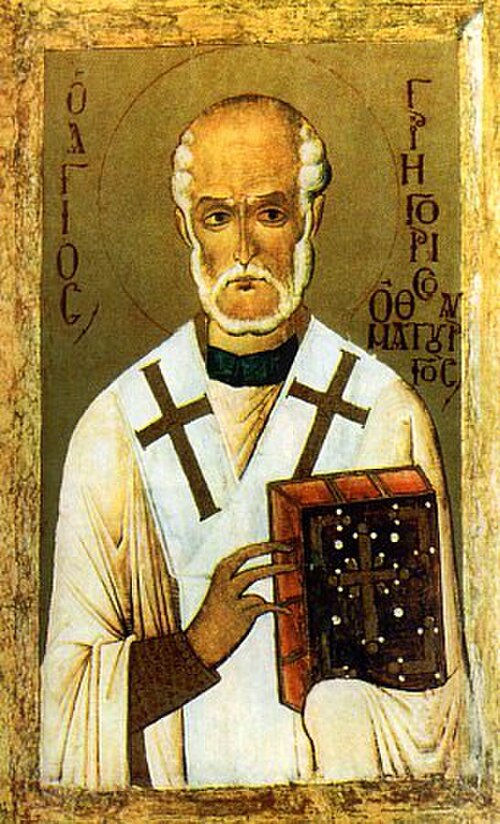
Saint
Gregory the Wonderworker
Bishop of Neocaesarea
Disciple of Origen, bishop of Neocaesarea in Pontus, and great wonderworker of the third century.
- Feast
- November 17old style November 30
- Reposed
- 2703rd century
- Place
- Niksar
- Order
- Hierarchs
Life
Saint Gregory the Wonderworker, also called Gregory of Neocaesarea or Thaumaturgus, was a bishop in Pontus in Asia Minor in the third century. The Church remembers him as the man who brought almost a whole city to faith in Christ, and as one of the great teachers of Pontus and Cappadocia. He is called the Wonderworker for his gift of healing and for the power of his prayer.
Early life and schooling
He was born around AD 213 in Neocaesarea (today Niksar in Turkey), into a wealthy and distinguished family that was still pagan. His first name was Theodore, meaning “gift of God”; he took the name Gregory, “watchful”, after baptism. His father died when he was fourteen, and his mother wanted him to have a fine education, from grammar to Roman law and rhetoric.
He set out with his brother Athenodorus for the famous law school at Berytus (Beirut), but on the way they reached Caesarea in Palestine, where the scholar Origen lived. The two young men listened to him and stayed. Origen won them to Christ and led them first into philosophy and then into theology. They remained near him for some seven years, roughly from 231 to 238. Gregory hoped to show that the Christian faith is the one true philosophy. When he left, he gave a farewell address of thanks before his master, which survives and tells us much about his years of study.
Bishop of Neocaesarea
Back in Pontus, Gregory thought of practising law, but Phaedimus, bishop of Amasea and metropolitan of Pontus, ordained him bishop of his native city. Tradition records that at the start there were only seventeen Christians in Neocaesarea. Gregory was about forty and he governed the church for thirty years. Through his preaching, his wise counsel and the wonders he worked, the flock grew until, at his death, only seventeen pagans were left in the city.
Saint Gregory of Nyssa, in the life he wrote of him, says that after his ordination Gregory spent a whole night pondering the mysteries of the faith. The Mother of God and Saint John the Evangelist appeared to him, and John gave him in clear words the confession of faith about the Holy Trinity. Gregory wrote it down, preached it in the Church and left it as an inheritance. The Cappadocian Fathers later leaned on this teaching.
During the persecution of Decius, around 250, Gregory led his faithful to a mountain. An unbeliever betrayed them and soldiers surrounded the mountain. Gregory entrusted those with him to his deacon, went out into the open and prayed with his hands raised. The soldiers searched the mountain several times without seeing anyone, and on returning reported that there were only two trees there, standing face to face. The informer was astonished, believed in Christ and was baptized.
When the persecution ended, Gregory returned to Neocaesarea and appointed days to commemorate the martyrs. He took part in the synod of Antioch (about 264-265), which condemned the false teaching of Paul of Samosata about the Holy Trinity. He departed this life in great old age, in the reign of the emperor Aurelian, around 270.
Veneration
Saint Basil the Great writes that the people of Neocaesarea held to Gregory’s word for a long time without replacing it with teachings of their own. Saint Macrina the Elder, grandmother of Basil and of Gregory of Nyssa, heard many of his sermons in her youth and passed them on to her grandsons. The title “Wonderworker” spread above all from the fifth century; before that he was usually called “the Great”. The Orthodox Church keeps his feast on 17 November.
Commemorated the same day November 17
 Hilarius of RomeSaint · Bishop of RomeNov 17
 Gregory of ToursSaint · Bishop of ToursNov 17
 Hilda of WhitbyVenerable · Abbess of WhitbyNov 17
 Lazarus the IconographerConfessor · Iconographer of ConstantinopleNov 17
- Maximus III of ConstantinopleSaint · Patriarch of ConstantinopleNov 17
 GobronMartyr · Georgian military commanderNov 17
 Nikon of RadonezhVenerable · Abbot of the Trinity MonasteryNov 17
 Eugenius of FlorenceSaint · Deacon at FlorenceNov 17
 Sebastian DabovichVenerable · Archimandrite and missionary in AmericaNov 17
 Laverius of GrumentumMartyrNov 17
 Acisclus of CordobaMartyr · Martyr of CordobaNov 17
 Victoria of CordobaMartyrNov 17