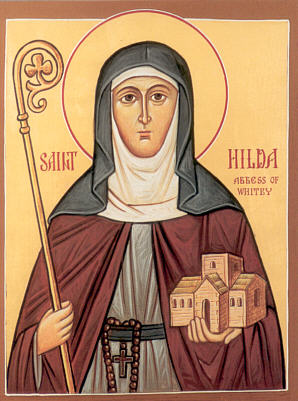
Venerable
Hilda of Whitby
Abbess of Whitby
Founder and first abbess of the monastery at Whitby, where the Synod of 664 was held.
- Feast
- November 17old style November 30
- Reposed
- 6807th century
- Place
- Whitby Abbey
- Order
- Venerables
Life
Venerable Hilda of Whitby (Hild) was the founder and first abbess of the monastery at Whitby, in seventh-century England, where the Synod of 664 was held. She was born in 614 and passed to the Lord on 17 November 680. She had an important part in the Christianization of the Anglo-Saxons and was honoured for a wisdom to which even kings came for counsel. Most of what is known of her is kept in the Ecclesiastical History of the English People by Bede.
Early life
Hilda was born into the royal house of Deira, the second daughter of Hereric, a nephew of King Edwin, and of Breguswith. While she was an infant her father was poisoned in exile at the court of the Brittonic king of Elmet. She was raised at the court of King Edwin of Northumbria. In 625 Edwin married the Christian princess Æthelburh of Kent, who came to Northumbria together with her chaplain, Paulinus. At Easter, 12 April 627, the king was baptized with his whole court, among them Hilda, thirteen years old, in a small wooden church hastily built on the site where York Minster now stands.
In 633 Northumbria was overrun by the pagan king of Mercia, and Edwin fell in battle. Paulinus accompanied the queen, Hilda and the others to Kent. Hilda's elder sister, Hereswith, had become a nun at Chelles in Gaul, and Hilda was about to join her. At thirty-three, however, she chose instead to answer the call of Bishop Aidan of Lindisfarne and returned to Northumbria as a nun.
Abbess
Her first monastery, a small one, stood on the north bank of the River Wear. There, with a few companions, she learned the way of Celtic monasticism that Aidan had brought from Iona. After a year Aidan made her the second abbess of the monastery at Hartlepool. In 657 she founded the monastery at Whitby, then called Streoneshalh, and remained there until her death.
Archaeology shows that the monastery was of the Celtic type, with small houses in which two or three people lived. It was a double monastery, where men and women lived apart but prayed together in church. Bede says that the old ideals of monasticism were kept strictly, that goods were held in common, and that peace and charity were preserved. All had to study Scripture and do good works. Five men from this monastery became bishops, among them Saint John of Beverley and Saint Wilfrid of York.
Her character
Bede describes her as a woman of great energy, a good administrator and teacher. Many people worked on her estates, with sheep and cattle, in the fields and cutting wood. She was so famed for wisdom that kings and princes sought her advice. Yet she also cared for ordinary people such as Cædmon, a herdsman of the monastery, who in a dream was given the gift of singing verses in praise of God. Hilda recognized his gift and urged him to develop it. All who knew her called her mother, writes Bede, for her devotion and grace. At Whitby the synod of 664 was held, in which the date of Easter was settled for the Church in Northumbria.
Veneration
Hilda fell asleep in the Lord on 17 November 680. She is venerated by the Catholic Church, the Anglican Church and the Russian Orthodox Church, where she is called the abbess of the English people. Her commemoration is on 17 November, and in the Russian Church also on 25 August, the day of the translation of her relics.
Commemorated the same day November 17
 Hilarius of RomeSaint · Bishop of RomeNov 17
 Gregory of ToursSaint · Bishop of ToursNov 17
 Gregory the WonderworkerSaint · Bishop of NeocaesareaNov 17
 Lazarus the IconographerConfessor · Iconographer of ConstantinopleNov 17
- Maximus III of ConstantinopleSaint · Patriarch of ConstantinopleNov 17
 GobronMartyr · Georgian military commanderNov 17
 Nikon of RadonezhVenerable · Abbot of the Trinity MonasteryNov 17
 Eugenius of FlorenceSaint · Deacon at FlorenceNov 17
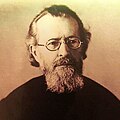 Sebastian DabovichVenerable · Archimandrite and missionary in AmericaNov 17
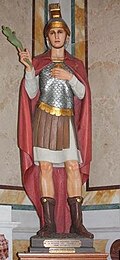 Laverius of GrumentumMartyrNov 17
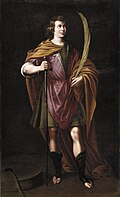 Acisclus of CordobaMartyr · Martyr of CordobaNov 17
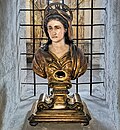 Victoria of CordobaMartyrNov 17