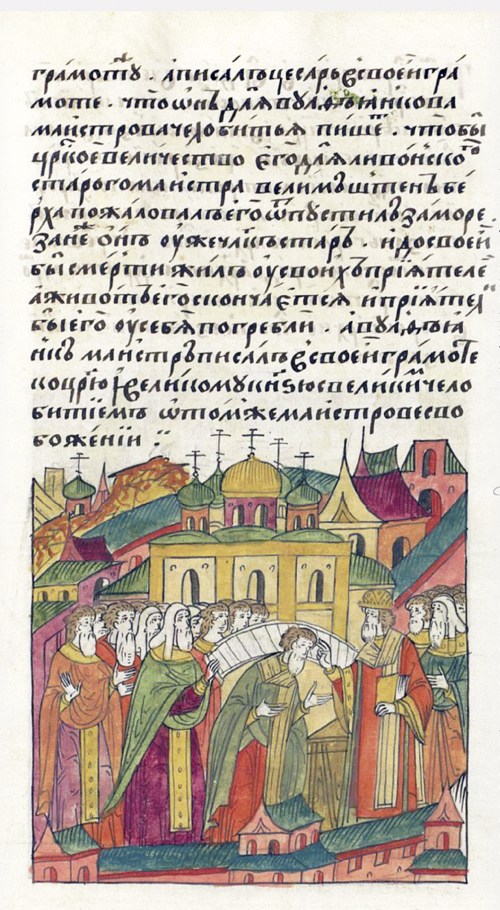
Saint
Herman of Kazan
Archbishop of Kazan
Archbishop of Kazan from 1564 to 1567, a candidate for the metropolitan see of Moscow; died in Moscow in 1567.
- Feast
- November 6old style November 19
- Reposed
- 156716th century
- Place
- Moscow
- Order
- Hierarchs
Life
Saint Herman of Kazan, Hierarch, was archbishop of Kazan and Sviyazhsk from 1564 until his death in 1567 and a candidate for the metropolitan see of Moscow. He died at Moscow on 6 November 1567 and is venerated as a hierarch, and in some sources as a martyr. His relics rest at Sviyazhsk, in the monastery of the Mother of God. He is remembered on 6 November (the day of his repose), on 25 September (the first transfer of the relics) and on 23 June (the second transfer).
Youth and monasticism
He was born in 1505 at Staritsa, in the Polev family, which traces its origin to the boyar Alexander Borisovich Pol, a descendant of the princes of Smolensk; Grigory Fyodorovich Sadyrev-Polev. In the words of Prince Kurbsky, he was “a man of illustrious family.” At twenty-five he was tonsured a monk with the name Herman at the Volokolamsk monastery, where he struggled under Abbot Gury (later archbishop of Kazan) and worked at copying books; in the monastery's inventory of 1545 there are entries for books written in his hand. At the monastery he met Maxim the Greek, who was serving a sentence there. At the beginning of 1551 he was named archimandrite of the Dormition monastery at Staritsa. In 1554, at Moscow, during the trial of the heretic Matvei Bashkin, he was charged with accompanying him into exile at the Volokolamsk monastery; after fulfilling the task he stayed there as treasurer.
At Sviyazhsk and Kazan
Saint Gury, receiving the new flock at Kazan into his care, called Herman as helper and, on 3 February 1555, made him abbot of the Dormition monastery at Sviyazhsk, founded by Gury, of great importance for the spread of Christianity among the peoples of the Kazan region. Under Herman stone churches were built in the monastery: the church of Saint Nicholas, with a bell tower and refectory (1556), and the Dormition cathedral (1558). At Kazan the monastery's metochion was opened, which by the end of the sixteenth century became an independent monastery. After Gury's death, on 12 March 1564, Herman was elected by the council of Russian bishops archbishop of Kazan and Sviyazhsk. At Kazan he stayed about two years, then was summoned to Moscow to take part in the Land Council and the Church Council.
Candidate for the metropolia
Arriving at Moscow in 1566, Herman was designated, at the insistent demand of Tsar Ivan the Terrible and against his own will, metropolitan of Moscow and was lodged in the metropolitan's residence until his consecration. Then the saint demanded of the tsar the abolition of the oprichnina and began to rebuke him, calling him to repentance. The tsar, listening to the complaints of his courtiers, who said: “Do you want, O tsar, to be in that bishop's bondage worse than you were with Alexei and Sylvester?” ordered Herman to be told: “You are not yet raised to the metropolia and already you take my freedom,” drove him from the metropolitan's residence and ordered him kept in Moscow under guard. He was probably not deposed, for his name is mentioned in the Nikon Chronicle among those who took part in the enthronement of Metropolitan Philip.
Death
Saint Herman died at Moscow on 6 November 1567, during a plague, but there is an opinion that he was strangled or poisoned by the tsar's order. In his “History of the Grand Prince of Moscow,” Andrei Kurbsky writes that two days after his expulsion from the metropolitan's residence his body was found in the courtyard: some say that he was secretly strangled, at the tsar's command, others that he was killed by poison. According to the Life of Saint Philip, Herman was killed in his cell by an oprichnik, who cut off his head with an axe. The re-vesting of the relics in 1888 (a new mitre was placed on his head) and their opening in 1922 partly confirmed this version; the description of the relics says: “his head is cut off, and indeed in a way unusual for an ordinary execution, with two blows, one from the front which cut off the lower part, and another from behind across the neck.”
Burial and veneration
He was buried in the cathedral of Saint Nicholas Gostunsky in the Kremlin, which has not survived (in other sources, in the church of Saint Nicholas Mokry in Zaryadye, also lost). His relics were found in 1595 (in other sources, in 1592) and, with the permission of Tsar Feodor Ivanovich, were moved to the monastery of the Mother of God at Sviyazhsk. In 1714 they were moved from the altar of the monastery's Dormition church into the church itself. In 1842 a new cypress shrine, silver-gilt, was made, and in 1888, when a new mitre was placed on the saint's head, the record noted the incorruption of the relics and a cut on the neck, which gives grounds to speak of his martyr's death. A new service was composed, in which he is called a hieromartyr, but the Synod did not allow its publication. His relics remain at Sviyazhsk.
Commemorated the same day November 6
 Paul the ConfessorSaint · Bishop of ConstantinopleNov 6
 IlltudVenerable · Abbot of Llantwit MajorNov 6
 Barlaam of KhutynVenerable · Founder of Khutyn MonasteryNov 6
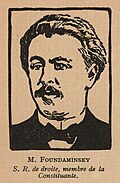 Ilia FondaminskyNew Martyr · Russian writer and political activistNov 6
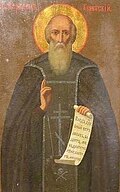 Varlaam of KeretVenerableNov 6
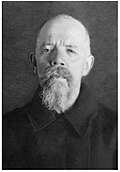 Constantine LyubomudrovHieromartyr · PriestNov 6
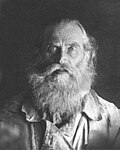 Varlaam NikolskyVenerable Martyr · AbbotNov 6
 Nikita DelektorskyHieromartyr · Bishop of Nizhny TagilNov 6
- Demetrianus of ChytroiSaint · Bishop of ChytroiNov 6
 Luke of the CavesVenerable · Monk of the Kyiv Caves LavraNov 6
 Arsenius TroitskyHieromartyr · ArchpriestNov 6
- Seraphima GorshkovaVenerable Martyr · NunNov 6