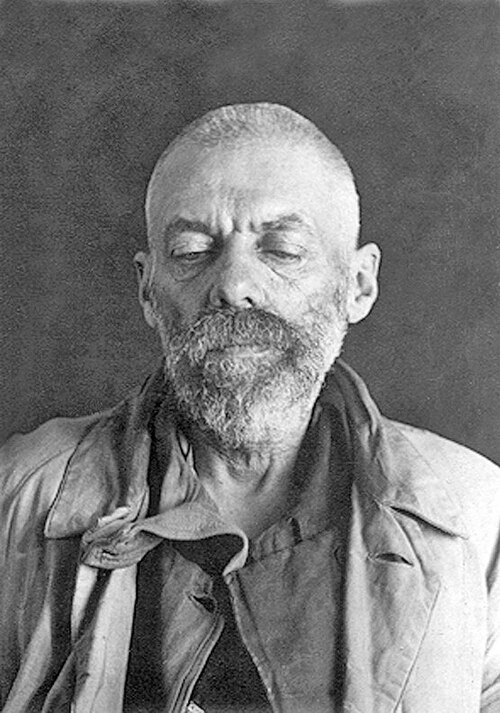
Hieromartyr
Nikita Delektorsky
Bishop of Nizhny Tagil
Bishop of Nizhny Tagil, born at Pokrov in 1876, shot at the Butovo firing range in 1937; canonized in 2000.
- Feast
- November 6old style November 19
- Reposed
- 193720th century
- Place
- Butovo firing range
- Order
- Martyrs
Life
Saint Nikita Delektorsky, Hieromartyr, was Bishop of Nizhny Tagil, a poor pastor stripped of everything who ended up wandering homeless through Soviet Russia, hiding his rank. He was born in 1876 at Pokrov and was shot on 19 November 1937 at the Butovo firing range near Moscow. The Russian Church numbered him among the New Martyrs and Confessors in August 2000.
Family and priesthood
He was born on 22 December 1876 in the town of Pokrov in the Vladimir governorate, into the family of Fr Peter Dmitrievich Delektorsky, a cleric of the church of the Protection of the Mother of God. He was baptized Theodore. He graduated from the Vladimir seminary in 1897 and taught religion at the school at Yuzha. In 1898 he married Antonina Florinskaya, daughter of a cathedral archpriest at Alexandrov, and on 3 August of that year he was ordained priest at the church of Saint Nicholas Convent in Pereslavl.
From 1901 to 1907 he was chairman of the audit committee of the Pereslavl ecclesiastical school, and from 1903 to 1907 he taught religion at the convent school and directed the Dormition parish school. In 1907 the marriage collapsed when his wife left; a daughter, Lydia, was born of it. In 1909 he retired from the clergy at his own request and enrolled as a free student at the Moscow Theological Academy, graduating in 1915 as candidate of theology with a thesis, "The Old Testament Prophets as Shepherds", which its reviewers praised highly. He stayed on as assistant secretary of the academy council and in 1916 received the kamilavka for special labours in wartime.
At the end of 1916, at the invitation of Bishop Andronic of Perm, he became archpriest of the Cathedral of Saints Peter and Paul in Perm and a teacher at the diocesan girls' school. In 1919 he received a gold pectoral cross from the provisional church administration of Siberia. Resolving to become a monk, he asked for the dissolution of his marriage, and Bishop Sylvester of Perm lifted the church's blessing from it, since his wife had been missing for fifteen years and the marriage had been dissolved in a civil court. In 1922 he returned to the Vladimir governorate as rector of the Cathedral of the Nativity of Christ in Alexandrov. Illness forced him to retire in April 1924.
Bishop
On 7 May 1924 Patriarch Tikhon and the provisional Synod, at the request of the faithful of Bugulma in the Samara diocese, decided to establish a see for a vicar bishop there and named Archpriest Theodore Delektorsky, to be tonsured a monk. On 9 May he was tonsured at the Valaam metochion in Moscow by Metropolitan Sergius of Nizhny Novgorod with the name Nikita, on the next day he was raised to archimandrite, and on 12 May he was consecrated Bishop of Bugulma, vicar of Samara, at the church of the Nine Martyrs of Cyzicus. The consecrators were Patriarch Tikhon, Metropolitan Sergius, Metropolitan Seraphim of Tver and Metropolitan Peter of Krutitsy.
On arriving at Bugulma he was arrested by the secret police on the charge of having been connected with the White Czechs during the civil war, which the investigators could not prove, and he was released after a month. In 1925 he was arrested again for serving without the permission of the authorities as a bishop subject to Patriarch Tikhon and commemorating him at services, when the state recognized only the Renovationists as a lawful religious body, and he spent a month and a half in the prison at Melekess. In August 1926 he was appointed bishop of the newly founded vicariate of Orekhovo-Zuevo in the Moscow diocese, where he served until 3 September 1927, and on 16 September 1927 he was named Bishop of Nizhny Tagil, vicar of the Sverdlovsk diocese.
Years of wandering
He was known for his freedom from possessions and for the ascetic labour of foolishness for Christ. Sometimes he went to Moscow and stayed with devout people who took in travellers. From 1930 to 1933 he served a sentence at the construction of the Dnieper hydroelectric station, where he worked as a watchman and stableman. In 1934 he returned to Orekhovo-Zuevo and lived in complete poverty, playing the fool for Christ, and people came to him as to an elder with the gift of foresight.
From 1935 he was sought by the police. He lived by collecting scrap and discarded things wherever he could. In 1936 and 1937, hiding his rank and name, he spent nights with a militiaman named Krasnov, who took pity on the homeless old man, let him sleep in the barracks and sometimes gave him tea. In the summer of 1937, with the start of mass repressions, the authorities of Orekhovo-Zuevo gathered information through the Renovationists serving in the cathedral about all clergy living in the town, among them Bishop Nikita. The cathedral choir director, S. G. Andreev, was arrested merely because he was said to be in contact with "the wandering Bishop Delektorsky", and he was shot at Butovo on 27 September 1937.
Arrest and martyrdom
On 18 October 1937 the bishop was tracked down and arrested for the fourth time. On the window of the cemetery church beside which he was seized, he quietly left a wallet with his papers, which local people took to the militia. In it were the documents giving his name and rank, eight bonds, a needle, thread, scissors and a five-ruble gold coin sewn into a scrap of cloth, probably all he owned. He was taken to Moscow, to the Taganka prison. Two priests, one from Orekhovo-Zuevo and one from Zagorsk, testified against him, calling him a monarchist and reactionary who slandered Soviet power. The indictment described him as an illegal wandering bishop, a figure of the "True Orthodox Church". On 17 November an NKVD troika sentenced him to death.
He was shot on 19 November 1937 at the Butovo range near Moscow, on the same day as 189 others, and buried in an unknown common grave.
Veneration
The saint was numbered among the New Martyrs and Confessors of Russia at the Jubilee Council of Bishops in August 2000, for veneration throughout the Church, and is honoured as the first of the new martyrs of Orekhovo-Zuevo. In the lower chapel of the church of the New Martyrs and Confessors at Butovo, icons of the Butovo saints line the walls, each marked with the date of execution. On the icon of the synaxis of 19 November, Nikita is shown at the centre in episcopal vestments with four other New Martyrs of Butovo. On 19 November 2009 Patriarch Kirill blessed the building of a chapel near the church, and since the day was the commemoration of Saint Nikita, the chapel, built in 2010, was consecrated in his honour on 8 August 2010.
Commemorated the same day November 6
 Paul the ConfessorSaint · Bishop of ConstantinopleNov 6
 IlltudVenerable · Abbot of Llantwit MajorNov 6
 Herman of KazanSaint · Archbishop of KazanNov 6
 Barlaam of KhutynVenerable · Founder of Khutyn MonasteryNov 6
 Ilia FondaminskyNew Martyr · Russian writer and political activistNov 6
 Varlaam of KeretVenerableNov 6
 Constantine LyubomudrovHieromartyr · PriestNov 6
 Varlaam NikolskyVenerable Martyr · AbbotNov 6
- Demetrianus of ChytroiSaint · Bishop of ChytroiNov 6
 Luke of the CavesVenerable · Monk of the Kyiv Caves LavraNov 6
 Arsenius TroitskyHieromartyr · ArchpriestNov 6
- Seraphima GorshkovaVenerable Martyr · NunNov 6