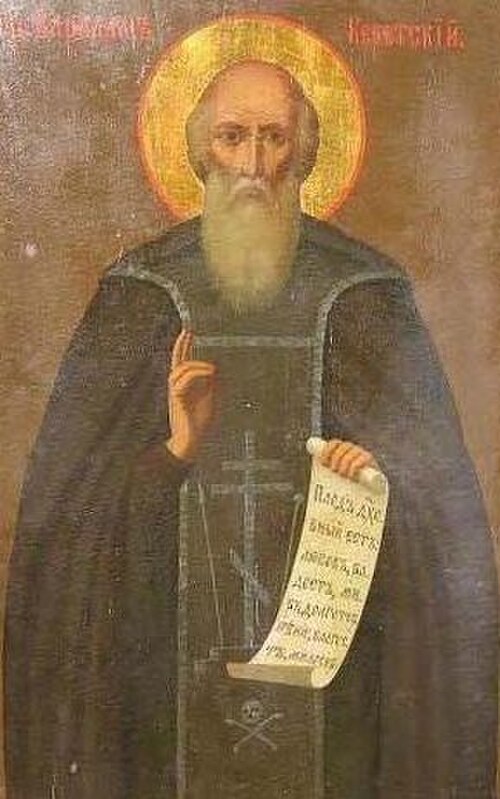
Venerable
Varlaam of Keret
Priest and later monk who led an ascetic life on the Kola Peninsula in the sixteenth century.
- Feast
- November 6old style November 19
- Reposed
- 159016th century
- Place
- Keret
- Order
- Venerables
Life
Venerable Barlaam of Keret (born Vasily) was a priest and later a monk who led an ascetic life on the Kola Peninsula in the sixteenth century, venerated for his repentance and as a helper of those at sea. Born in the village of Keret, on the shore of the Kandalaksha Gulf of the White Sea, into a Pomor family, between 1505 and 1525 by some reckonings, he died in 1589 or 1590. He is commemorated on 6 November (19 November New Style) and in the Synaxis of the Saints of Kola and of Karelia.
Sources
The "Tale of Venerable Barlaam of Keret" tells of him, the oldest copy of which is from the end of the seventeenth century. Fuller is the canon written by 1658 by the Solovki monk Sergius Shelonin, who probably had a fuller copy of the Tale. There is also a later life, written by the Old Believer scribe Tryphon Petrov, poorer in content, as well as a sung "starina", a simplified account of the saint, reconstructed and performed in 2021 by Alexander Matochkin.
Life
Barlaam, called Vasily in the world, was born at Keret, a village of the Solovki monastery, at the mouth of the river Keret, probably into a Pomor family. According to the lives of the saints, he learned letters, perhaps at the Shuerets skete, with the elder Zosima and Venerable Theodoret of Kola. Around 1535 he married and was ordained first deacon, then priest, and sent as rector to the church of Saint Nicholas in the town of Kola. After Theodoret's return to Kola and the founding of the Trinity monastery of Kola, in 1540 he was moved to the church of Saint George at Keret.
According to tradition, while rector at Kola, Fr Vasily drove out a demon who dwelt on Abram Cape and demanded sacrifices even from baptized fishermen. Leaving his place, the demon threatened to take revenge on the "priest"; the revenge was fulfilled when Vasily and his wife returned to their native village. There the tragedy took place that changed his life: the priest killed his wife, with no sure knowledge of the reason. According to the life and the "starina", he suspected her of infidelity and killed her in a fit of jealousy; according to another version, in Sergius Shelonin's canon, his wife began to be seized by an evil spirit, causing disturbance and rumours among the villagers, and Fr Vasily, trying to free her, mortally wounded her, being deceived by the evil one. After the deed he became convinced of his wife's innocence and of his own deception by the demon and repented almost at once.
After burying his wife, he went to Kola, to his confessor, Venerable Theodoret, who gave him an unusual and very hard penance: to carry the coffin with his dead wife in a boat, until the body decayed, travelling from Keret to Kola, on the White Sea, on the Barents Sea and back. He had to keep a very strict fast and only at Pascha, once a year, was fish allowed him. Back at Keret, he dug the coffin out of the ground and for three years sailed on the stormy sea, singing unceasingly the penitential psalms of the prophet David; bad weather in fact accompanied him all the time. His labour went on without rest, and his back bent from rowing. In the third year, at the portage at Holy Cape, seeing the multitude of shipworms (teredo), which destroyed many wooden ships, he prayed to God and, sprinkling water, drove them out, making "the way easy to pass". The miracle was the proof of his forgiveness.
Burying his wife's remains a second time, he received monastic tonsure with the name Barlaam, with great probability at the Pechenga monastery, from Hieromonk Jonah, in 1548. Shelonin's canons show a close spiritual closeness between Saints Barlaam of Keret and Tryphon of Pechenga; both left the monastery then. The canon foretells to Tryphon of his brethren that "there will be people and villages very untameable like wild beasts"; Tryphon gathered alms for eight years and sent them to the monastery, and Barlaam returned to his native places and settled by Lake Keret; but being disturbed by those who went mushroom and berry picking, he moved far from settled places, to one of the islands of Chupa gulf or into coastal caves. It is said he received the gift of healing and working miracles and fled the glory of men. His body was found by a poor peasant and carried to the village of Keret, where he was buried.
Veneration
Even in life he became known by miracles, as healer and saviour at sea; after death the miracles multiplied, so he began to be venerated no less than Saint Nicholas. In 1722, at the dismantling of the chapel of Saint George, the incorrupt relics of Barlaam were found, examined in 1725. In spite of popular veneration, he was not officially canonized for a long time: his local veneration, at once and on a par with that of Tryphon of Pechenga, known in the North in the middle of the seventeenth century, gradually faded in the official Church, among other things because all the late redactions of the life were written by Old Believers, and the village of Keret stood firm in the "old faith". Only in 1903 was he entered in the "Faithful Menologion" and since then has a day of commemoration. Until 1961 the relics were in the village, then disappeared without trace. In the dioceses of Murmansk and Karelia the vigil is served by the common Menaion and there is a seventeenth-century canon.
In 2000, on the Tersky coast of the White Sea, in the "Tonya Tetrina" complex, a chapel of Barlaam of Keret was built and consecrated; on 7 June 2001 a cemetery church in his honour was consecrated at Kola, on the site of the former Trinity Ust-Kola monastery; in 2002 a church of his was built at Chupa, burned in May 2010; in 2014 the parish at Ostrovnoy was given his name, and on Holy Cape the cross was restored at the place of the "miracle of the casting out of the shipworms". On 28 January 2015, in the settlement of Loukhi, in the Kostomuksha diocese of the Karelian metropolis, the venerable's relics were found, in the service of finding, led by Bishop Mitrofan of Severomorsk and Umba.
Commemorated the same day November 6
 Paul the ConfessorSaint · Bishop of ConstantinopleNov 6
 IlltudVenerable · Abbot of Llantwit MajorNov 6
 Herman of KazanSaint · Archbishop of KazanNov 6
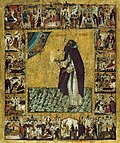 Barlaam of KhutynVenerable · Founder of Khutyn MonasteryNov 6
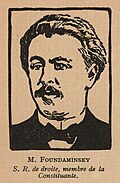 Ilia FondaminskyNew Martyr · Russian writer and political activistNov 6
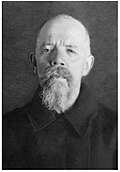 Constantine LyubomudrovHieromartyr · PriestNov 6
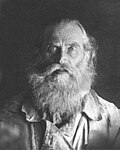 Varlaam NikolskyVenerable Martyr · AbbotNov 6
 Nikita DelektorskyHieromartyr · Bishop of Nizhny TagilNov 6
- Demetrianus of ChytroiSaint · Bishop of ChytroiNov 6
 Luke of the CavesVenerable · Monk of the Kyiv Caves LavraNov 6
 Arsenius TroitskyHieromartyr · ArchpriestNov 6
- Seraphima GorshkovaVenerable Martyr · NunNov 6