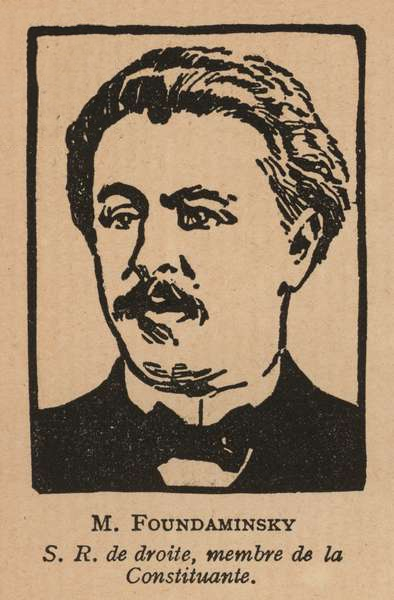
New Martyr
Ilia Fondaminsky
Russian writer and political activist
Russian writer and political activist of Jewish origin, killed at Auschwitz in November 1942.
- Feast
- November 6old style November 19
- Reposed
- 194220th century
- Place
- Auschwitz
- Order
- Martyrs
Life
Saint Ilya Fondaminsky (Fundaminsky), Martyr, was a Russian writer, editor and political figure of Jewish origin, born in Moscow on 17 February 1880. He lived in exile in Paris, received Orthodox baptism in the camp at Compiègne on 20 September 1941 and died at Auschwitz on 19 November 1942. The Ecumenical Patriarchate numbered him among the saints in January 2004, in the same year as Mother Maria Skobtsova, his close friend, and in the prayer of the Church he is commemorated as a lay martyr. His day is 20 July.
Family and youth
He was born in a Jewish merchant family of Moscow. His father, Isidor (Israel-Ilya) Fundaminsky, a native of Shklov, was a jeweller and in 1893 was entered among the merchants of the first guild. His older brother, Matvei, was a revolutionary of the "populist" movement. He studied at the private Kreiman gymnasium in Moscow, then between 1900 and 1904 at the philosophical faculties of Berlin and Heidelberg. He belonged to a circle of young socialist-revolutionaries together with Vladimir Zenzinov and Nikolai Avksentiev. On 10 March 1902 he was arrested on the Russian-German border and held two months in prison for carrying revolutionary literature. He joined the party of Socialist Revolutionaries. In 1903 he married Amalia Osipovna Gavronskaya (1882 to 1935), a cousin of Gots.
The 1905 revolution and first emigration
In December 1904 he returned to Moscow and became one of the leaders of the party's city committee. In 1905 he was co-opted into the central committee, and in September of that year he was arrested with his wife and held at Taganka, being released in October. He took part in preparing the December rising in Moscow. After it was crushed he went to Finland, and in 1906 took part in the party's first congress at Helsingfors. In May and June 1906 he was one of the sharpest critics of the State Duma at many meetings in Petersburg. He was also involved in the attempted mutiny on the cruiser "Pamyat Azova", but when he arrived there on 20 July the mutiny was already put down, and he was arrested by sailors who had stayed loyal to their oath. The naval court dropped the charge of seeking to change the order by force, and a second military court acquitted him. Fearing a new trial, he emigrated with his wife to France. Between 1907 and 1917 he lived in Paris, was elected in 1909 to the party's foreign leadership, and in 1912 produced with Avksentiev the journal "Pochin". In the First World War he stood for defence of the country and edited, with Plekhanov, the journal "Prizyv".
The 1917 revolution and exile
In February 1917 he returned to Petrograd. He was elected to the party's central committee, and in the summer of 1917 the Provisional Government appointed him commissar of the Black Sea Fleet. He was elected to the Constituent Assembly from the fleet. In 1918 he was a member of the Union for the Regeneration of Russia and took part in the Jassy conference. From the summer of 1918 he lived at Odessa, and in April 1919 he left with his wife for France and settled in Paris. In 1919 to 1921 he was for a time a member of Masonic lodges in Paris.
At Paris he was one of the editors of the leading journal of the Russian emigration, "Sovremennye Zapiski" (1920 to 1940), in which authors of differing views wrote, among them Lev Shestov, Semyon Frank, Georges Florovsky, Dmitri Merezhkovsky, Ivan Bunin, Vladimir Nabokov, Aleksei Remizov and Mark Aldanov. Between 1931 and 1939 he edited with Georgy Fedotov and Fyodor Stepun the Christian-democratic journal "Novyi Grad". He took part in the Russian Student Christian Movement and in "Pravoslavnoe Delo" ("The Orthodox Cause"). Fedotov wrote that he helped a multitude of people, in material and spiritual need, worthy and unworthy, without sparing his money, and that he drew to himself those weighed down by grief or lost on the paths of life, who came to him as to a friend but almost as to a spiritual father. Fedotov also wrote that money is a surer sign of kindness than smiles. Fondaminsky was a close friend of Mother Maria Skobtsova, and according to one of her biographers he sometimes gave talks at the Sunday gatherings at the house on rue de Lourmel. When his wife died, in 1935, he published a book with the memories of her friends.
Occupation, arrest and baptism
In June 1940 he left Paris, to escape the advancing German troops, for the unoccupied zone, where he spent the summer around Pau. The writer Nadezhda Teffi tells that he could have gone to America, where many of his friends had already reached, but he did not leave France and soon returned to Paris. In her view he would have been ashamed before those who remained, among them his best friend, Mother Maria, for having spared himself. English accounts add that he said he would accept whatever fate was in store.
On 22 June 1941 (by an English source, in July) he was arrested by the German occupation authorities, among a group of 120 Russian Freemasons. He was held in the Royallieu camp at Compiègne, where on 20 September 1941 he was baptized into the Orthodox Church. Most of the arrested Russians by nationality were released, but Fondaminsky, as a Jew, was kept in the camp. In 1942 he was sent to the camp at Drancy. Gravely ill, he was moved to hospital. Socialist friends offered to help him escape, but he refused, wishing to share the fate of the other Jews. He was sent to Auschwitz, where he died on 19 November 1942, at the age of 62.
Canonization
In 2004 the Ecumenical Patriarchate numbered him among the saints as a martyr, "the layman Ilya Fondaminsky", together with Mother Maria Skobtsova (by an English source, in 2003). His day of commemoration in the Orthodox Church is 20 July.
Commemorated the same day November 6
 Paul the ConfessorSaint · Bishop of ConstantinopleNov 6
 IlltudVenerable · Abbot of Llantwit MajorNov 6
 Herman of KazanSaint · Archbishop of KazanNov 6
 Barlaam of KhutynVenerable · Founder of Khutyn MonasteryNov 6
 Varlaam of KeretVenerableNov 6
 Constantine LyubomudrovHieromartyr · PriestNov 6
 Varlaam NikolskyVenerable Martyr · AbbotNov 6
 Nikita DelektorskyHieromartyr · Bishop of Nizhny TagilNov 6
- Demetrianus of ChytroiSaint · Bishop of ChytroiNov 6
 Luke of the CavesVenerable · Monk of the Kyiv Caves LavraNov 6
 Arsenius TroitskyHieromartyr · ArchpriestNov 6
- Seraphima GorshkovaVenerable Martyr · NunNov 6