Hieromartyr
John Suldin
A hieromartyr of the Russian Church, commemorated in the Orthodox calendar.
Life
Holy Hieromartyr John Suldin, a priest, was born on 12 January 1880 in the town of Ardatov in the Simbirsk province, in the family of the peasant Joseph Suldin. He received his first schooling at the theological school of Ardatov, then finished the Simbirsk Theological Seminary. Ivan Iosifovich was ordained deacon on 15 April 1902 and priest on 9 March 1903, for the church in the village of Novoe Tomyshevo. From 19 March 1920 he served at the church of Saint Elijah in the town of Syzran and soon was named its rector. With his wife he had six children; after the birth of the last his wife died, and the priest, without leaving the care of the children, gave even more time to the church. In 1922 he received the pectoral cross.
He was arrested several times, in 1923, 1924, 1925, 1926 and 1930. During the last arrest the church of Saint Elijah was closed, and after his release, like most priests of Syzran whose churches had been closed, he served at the Kazan Mother of God cathedral in the town. A witness said that at the Liturgy he gave a sermon about how the Christians of old were tormented for faith in Christ and that now the same time had come. He was arrested on 21 February 1931 together with Bishop Augustine (Belyaev) and a large group of clergy and laity of Syzran. A priest who collaborated with the authorities said of him and of the priest Pokrovsky that they were regarded in the town as true priests and had remained unreconciled with Soviet power; another priest testified that Suldin was for the local clergy a great authority, to whose word all listened, both among clergy and laity. At the interrogation Father John said that he belonged to the Tikhonite orientation, that he had received the declaration of Metropolitan Sergius and made it known to the parish council and in the church, and that he had submitted to it without resistance, but that he had not told his opinion to the priest Apollonov. On all points of the accusation he said that he did not admit guilt. An informer placed in the cell reported that Suldin and another priest said on 19 May 1931: whatever was done to them, they would admit nothing and would stand on their path to the end, feeling that they would not remain alive. On 28 October 1931 the Special Council of the OGPU sentenced him to three years in a concentration camp.
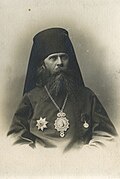
After serving it, in 1933 he was arrested again and sentenced to three years of exile in the Northern Region. From exile he came to Samara. On 30 November 1937 he was arrested once more, together with Archbishop Alexander (Trapitsyn) and other priests. The archbishop was accused of having united in Kuibyshev the priests without a place, above all those returned from exile. Neither the archbishop nor the priests returned from exiles and camps admitted guilt, and they rejected the accusations. On 21 December 1937 the NKVD troika sentenced them to death. Archbishop Alexander (Trapitsyn) and the priests John Suldin, John Smirnov, Alexander Organov and Alexander Ivanov were shot on 14 January 1938; because of the large number of executions, the other priests came into the next group, shot on 8 February 1938. All were buried in an unknown common grave.
The Church commemorates him on 14 January, the day of his death, in the new style, on 12 August in the Synaxis of the Saints of Samara, and on the movable day of the synaxis of the new martyrs.
Commemorated the same day January 1
 Basil the GreatSaint · Archbishop of Caesarea in CappadociaJan 1
 SarahRighteous · The MatriarchJan 1
 Fulgentius of RuspeSaint · Bishop of RuspeJan 1
 TelemachusVenerable MartyrJan 1
 Gregory of Nazianzus the ElderSaint · Bishop of NazianzusJan 1
 Platon KulbuschHieromartyr · Bishop of RevelJan 1
 Concordius of SpoletoMartyr · Martyr of SpoletoJan 1
 Nikolai BezhanitskyHieromartyr · Archpriest in EstoniaJan 1
 Basil of AncyraMartyr · Priest of GalatiaJan 1
 Alexander TrapitsynHieromartyr · Archbishop of PugachevJan 1
 Basil VitevskyHieromartyr · PriestJan 1
 Athanasius VolkhovskySaint · Bishop of Mogilev and PolotskJan 1