Venerable
Kanonike
Hermit of the Jordan desert
A hermit of the Jordan desert, daughter of a senator of Constantinople; venerated by the faithful, not formally canonized.
- Feast
- November 5old style November 18
- Era
- 6th century
- Place
- Jordan desert (daughter of a Constantinopolitan senator)
- Order
- Venerables
Life
Venerable Kanonike (sixth century) was a virgin, the daughter of a senator of Constantinople, who struggled as a hermit in the desert of the Jordan. She is commemorated on 5 November (by the old Georgian calendar) and is venerated by the faithful as a saint, without any known canonization.
Her life is preserved in the Georgian version of the "Life in the menologion," in manuscripts of the tenth to fifteenth centuries. It is based on a Greek text from the collections of apophthegms about the nameless daughter of a syncletic who lived in the desert of the Jordan. Her name appears nowhere in the text of the Life and not in the older versions either, but was added later in the title; perhaps the Greek word kanonike was taken for a personal name, from the title of a neighbouring story about a naked canoness. In the view of the researcher N. Mirashvili, the Georgian version was made not from the Greek text but from an Arabic translation.
The account is told from the viewpoint of the monk Silvanus (Siluan), who lived near the Pharan Lavra, close to Jerusalem. Walking once through the desert toward his teacher, who struggled in the neighbourhood of the Calamon monastery, Silvanus saw some tracks, which led him to a cave. There the abba found a monk who "looked like a eunuch or a woman." At the monk's request, the ascetic, after receiving a promise that he would tell no one while she lived, told her story. When she was eighteen, her father, a great official of Constantinople, decided to marry her off. The girl pretended that before the wedding she must make a pilgrimage and went to Jerusalem. After venerating the holy places, she gave alms to the monasteries and, secretly from her retinue, withdrew into the desert of Caprata (in the Greek version, Koprofa). There she received monastic tonsure and, so as not to be found, dressed in a monk's clothing. She settled in a cave and lived as a hermit in the desert for twenty-eight years. Silvanus was the first to find her dwelling. He asked leave to visit her, but when he came to the same place a few days later, he could not find the cave, "as if God had seen to it."
The calendar in the collection "Iadgari" of the Georgian hymnographer John-Zosimus (Sinait. iber. 34, tenth century) shows that her day of commemoration was set on 5 November. Despite her Constantinopolitan origin, her commemoration is not in the Constantinopolitan calendar used by John-Zosimus. She is entered in the "New Synaxarion of the Orthodox Church" of Hieromonk Macarius of Simonopetra (Athens, 2004).
Commemorated the same day November 5
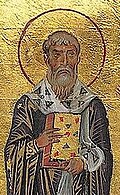 LinusApostle · Bishop of RomeNov 5
 Gaius of EphesusApostle · Apostle of the SeventyNov 5
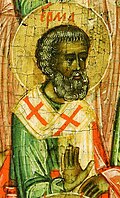 Hermas of PhilippopolisApostle · Bishop of PhilippopolisNov 5
- Philologus of SinopeApostle · Bishop of SinopeNov 5
 Galaktion and EpistemeHoly MartyrsNov 5
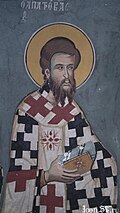 PatrobasApostle · Apostle of the SeventyNov 5
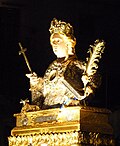 TrofimenaSaintNov 5
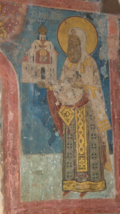 Jonah of NovgorodSaint · Archbishop of Novgorod and PskovNov 5
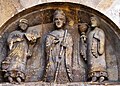 Mark of EcaSaint · Bishop of EcaNov 5
- Gabriel MaslennikovHieromartyr · PriestNov 5
- AgathangelusMartyrNov 5
- Augustine and PaulinusVenerableNov 5