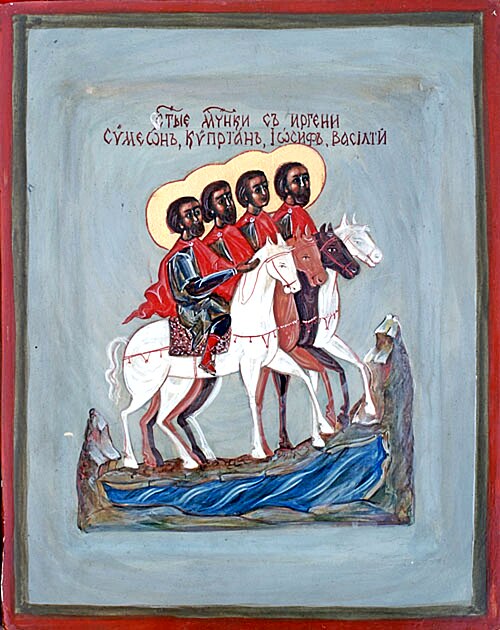
Martyr
Martyrs of Irgen
Soldiers of the detachment of Governor Afanasy Pashkov, tortured by him from 1656 to 1662 at the Irgen fort.
Life
The Martyrs of Irgen (Simeon, Cyprian, Joseph and Basil, with their companions) were soldiers of the detachment of the voivode Afanasy Pashkov, tortured by him between 1656 and 1662 in the Irgen fort, in Transbaikalia. In the Russian Orthodox Church they are commemorated as "Simeon, Cyprian, Joseph, Basil and those with them, of Irgen, in Siberia", on the second Sunday after Pentecost, the day of all saints who shone forth in the Russian land. The source gives no date for a formal canonization, however; Gerhard Müller wrote in 1735 of a chapel to the three saints "not yet canonized". Their commemoration is on 3 July (old style), and their veneration was first of all popular.
Who they were
The Martyrs of Irgen were Cossacks who reached Transbaikalia with the detachment of the voivode Pashkov. The first written report of them is in the notes of the hieromartyr Ephraim, head of the Transbaikal Spiritual Mission, published in 1911, which gather tales of the local clergy and of pilgrims who visited Irgen. The names of three of them, Simeon, Cyprian and Joseph, were kept by popular tradition; the name of the fourth, Basil, became known only in 1886. A merchant's wife, Skobeltsina, of Blagoveshchensk, gravely ill, saw in a dream a soldier who called himself Basil of Irgen and told her to get well. Healed, the woman went to Irgen, told the priest of the vision and had a memorial service sung for "the martyr soldier Basil". From then on the name "Basil" was added to the other martyrs of Irgen.
More recent works (a 1998 article by the Chita local historian G. A. Zherebtsov, and the 2006 "Paterikon of the Siberian Saints and Ascetics of Piety" by Archpriest Anatoly Dmitruk) speak of them as "four brothers of good life, hardworking, wealthy and with a strong and beneficial influence on the people round about". In support of this view is the icon of the Mother of God "of the Sign", venerated at Irgen, on whose margins are the faces of Saint Simeon the Fool for Christ (sixth century), the Martyr Cyprian of Nicomedia (third-fourth century) and Saint Joseph the Betrothed; it is supposed that the brothers took this icon of their heavenly patrons with them on the Siberian expedition.
How they died
A first version attributes their death to the envy of the voivode Pashkov toward the "honest and hardworking brothers". Using a minor fault as a pretext, he ordered them to salt in a short time forty barrels of crucian carp "tongues". The brothers did not carry out the order and were tortured, beaten with whips and starved, and they died. According to tradition, on the day of the burial a miracle occurred: when the Cossacks returned from the funeral they saw the barrels filled to the brim with carp tongues.
As a more probable cause of death Archimandrite Ephraim names their adherence to the "old faith". In Pashkov's detachment, under the influence of Archpriest Avvakum, whom he was escorting, there were many followers of his religious ideas, ready to suffer for them to the death. In his "Memorandum on the abuses and cruelties of the voivode Pashkov", Avvakum gives numerous cases of the voivode's cruel treatment of his subordinates (more than five hundred people died of hunger alone). The fact that the brothers were buried not in plank coffins but in hollowed logs (the traditional form among Old Believers) may show that they belonged to that faith. Irgen, where they are buried, is also a customary place of pilgrimage for the Old Believers.
Veneration and place of burial
People turned to the Martyrs of Irgen for help in having children. A letter is known from a merchant of Semipalatinsk to Bishop Meletius of Transbaikalia and Nerchinsk, asking him to pray at Irgen at the martyrs' tombs for the gift of an heir.
There are two versions of the place of burial. According to one, the bodies were buried in the cemetery of the Irgen fort, which was entirely taken down in 1708 because of age. The tradition in Archimandrite Ephraim's notes says that the brothers appeared to the local Buryat herdsmen who drove their cattle to graze on their burial place, and asked them not to let the animals onto their graves. There are also reports of appearances to Orthodox believers, with the request to pray "for the repose of those who suffered at Irgen, Simeon, Cyprian and Joseph with their company", accompanied by a threat of drought and famine if the place of their burial were forgotten. After this a cross was first set up where the martyrs appeared, then a chapel was built, made from a simple house brought from the shore of Lake Shaksha, in which, by tradition, the exiled Metropolitan Arsenius (Matseevich) had lived. According to Archpriest Dmitruk's "Paterikon", relatives of the voivode Pashkov built a church on the site of the brothers' house and placed their remains under it; from the description of the Irgen fort it follows that the Cossacks' huts stood under its corner towers. Gerhard Müller, in his description of the Nerchinsk district (1735), mentions on the site of the fort a chapel to the three not yet canonized saints, Simeon, Cyprian and Joseph.
In 1862 the simple wooden chapel over the grave was rebuilt as a church in honour of Saints Simeon, Cyprian and Joseph, the heavenly patrons of the brothers. In 1877 the church burned, and under its ashes the relics of the martyrs were found, lying in hollowed logs. The same year a small church was built over the grave, consecrated likewise to those saints. Archimandrite Ephraim (Kuznetsov) reports that on the Saturday after the ninth Friday a funeral Liturgy and a memorial service for the soldiers tortured there are usually celebrated in that church, with the remembrance of all the departed who laboured for the preaching of Christ in Transbaikalia. From the late eighteenth century Irgen has been a place of pilgrimage: every year a procession went there from Chita with the local icon of the Mother of God "of the Sign". At one time the procession was forbidden by the Irkutsk diocesan authorities, as it had arisen without their knowledge and they were unaware of the shrines of Irgen and their history. Tradition says that after that "for more than a year there was a ruinous drought, crop failure and steppe and forest fires". The processions were revived in the late nineteenth century and continued until 1916; the tradition resumed at the end of the twentieth century.
The relics
The first report of the finding of the relics dates to 1877, when the church over their grave burned. It burned to the ground, floor included. When the pile of coals was dug through, the Orthodox and Buryats who had gathered at the fire saw with amazement that the log coffin with the venerated remains of the soldiers, lying above ground under the church floor, had remained untouched by the fire, though a huge pile of burning coals lay on it; even the brocade pall on the coffin was whole. In 1911, with the blessing of Bishop Methodius, the relics, in two log coffins under the church floor, were examined by Archimandrite Ephraim and the priest Nicholas Korelin; the act says that all the bones in both coffins are whole and well preserved. In the 1920s the church was taken down, and the relics remained in the ground. Excavations at the site of the fort in 1994, by an archaeological team led by A. R. Artemiev, did not find the burial place. In the village of Moty in the Irkutsk region, a chapel to the holy Cossack Martyrs of Irgen has been built at the church of the Russian Old-Orthodox Church (the Old Believers), dedicated to the Holy Martyrs Faith, Hope, Love and their mother Sophia.
Commemorated the same day July 3
 Leo II of RomeSaint · Bishop of RomeJul 3
 Anatolius of ConstantinopleSaint · Patriarch of ConstantinopleJul 3
- Anatolius of LaodiceaSaint · Bishop of LaodiceaJul 3
 Hyacinth of CaesareaMartyr · Martyr of CaesareaJul 3
 Heliodorus of AltinoSaint · First bishop of AltinumJul 3
 Basil KalikaSaint · Archbishop of NovgorodJul 3
 Euphrosyne of KolyupanovoFool-for-Christ · Fool for Christ and hermitJul 3
 Germanus of ManSaint · First bishop of the Isle of ManJul 3
 MustiolaMartyr · Martyr of ChiusiJul 3
 Basil Vsevolodovich of YaroslavlRight-Believing · Prince of YaroslavlJul 3
 Anatolius the RecluseVenerable · Recluse of the Kiev CavesJul 3
 John of YarenskVenerableJul 3